Who was Lipolelo Thabane?
Lipolelo Alice Thabane was the estranged wife of Thomas Thabane, who was due to begin another term as Lesotho's prime minister in June 2017. Contemporary police reporting described her as 58 years old.
Her public identity became entangled with a political and marital dispute, but that context should not replace the central fact: Lipolelo was the victim of a fatal shooting. Responsible coverage must distinguish her life and legal status from later allegations about other people.
What is established about the attack?
On the evening of 14 June 2017, Lipolelo was travelling home in Ha Masana, outside the capital Maseru, with her acquaintance Thato Sebolla. Gunfire struck both women. Lipolelo died; Sebolla survived with injuries. Some news reports render the survivor's surname as “Sibolla,” while Amnesty International uses “Sebolla.”
The African Union publicly condemned Lipolelo's assassination and located it in Ha Masana. Contemporary police reporting said the attacker was unknown and the motive had not been established. Thomas Thabane was inaugurated two days later.
Why did the investigation return to public attention?
The case remained unresolved after the initial investigation. In January 2020, a police letter brought renewed scrutiny by referring to communications evidence allegedly connecting a telephone number associated with Thomas Thabane to the area of the attack. That was an investigative allegation, not a court finding.
Maesaiah Thabane, whom Thomas Thabane married after Lipolelo's death, was charged in February 2020. Police alleged that she arranged the killing but was not present at the scene. She denied involvement. Reuters reported that Thomas Thabane later faced pressure over the investigation and resigned as prime minister in May 2020.
Public interest in the political consequences should not obscure the legal distinction between accusation and proof. Resignation, arrest, bail and a charging document do not establish criminal responsibility.
Witness-security concerns
Witness safety became a documented concern before the prosecution ended. In February 2020, Amnesty International said a person considered a key witness had died in unexplained circumstances and that other witnesses had left Lesotho after threats. It called for effective protection and a fair investigation into everyone responsible for ordering, planning and carrying out the crimes.
That reporting helps explain why witness availability later mattered. It does not establish that any particular person caused the threats, the witness's death or the attack on Lipolelo. Those questions require evidence and lawful findings.
Charges filed in 2021
On 30 November 2021, Reuters reported that former prime minister Thomas Thabane was charged in the High Court over Lipolelo's murder. Maesaiah Thabane, who had already been charged, was present when the allegations were read. Both denied involvement.
The charges also covered the attempted murder of Thato Sebolla and damage to Lipolelo's vehicle. Police alleged that Maesaiah had hired eight assailants. This archive attributes that assertion to police because the prosecution did not produce a verdict confirming it.
The proceeding was scheduled to be heard in March 2022, but a scheduled hearing and an indictment are procedural steps. They are not substitutes for a completed trial.
Why were the charges withdrawn?
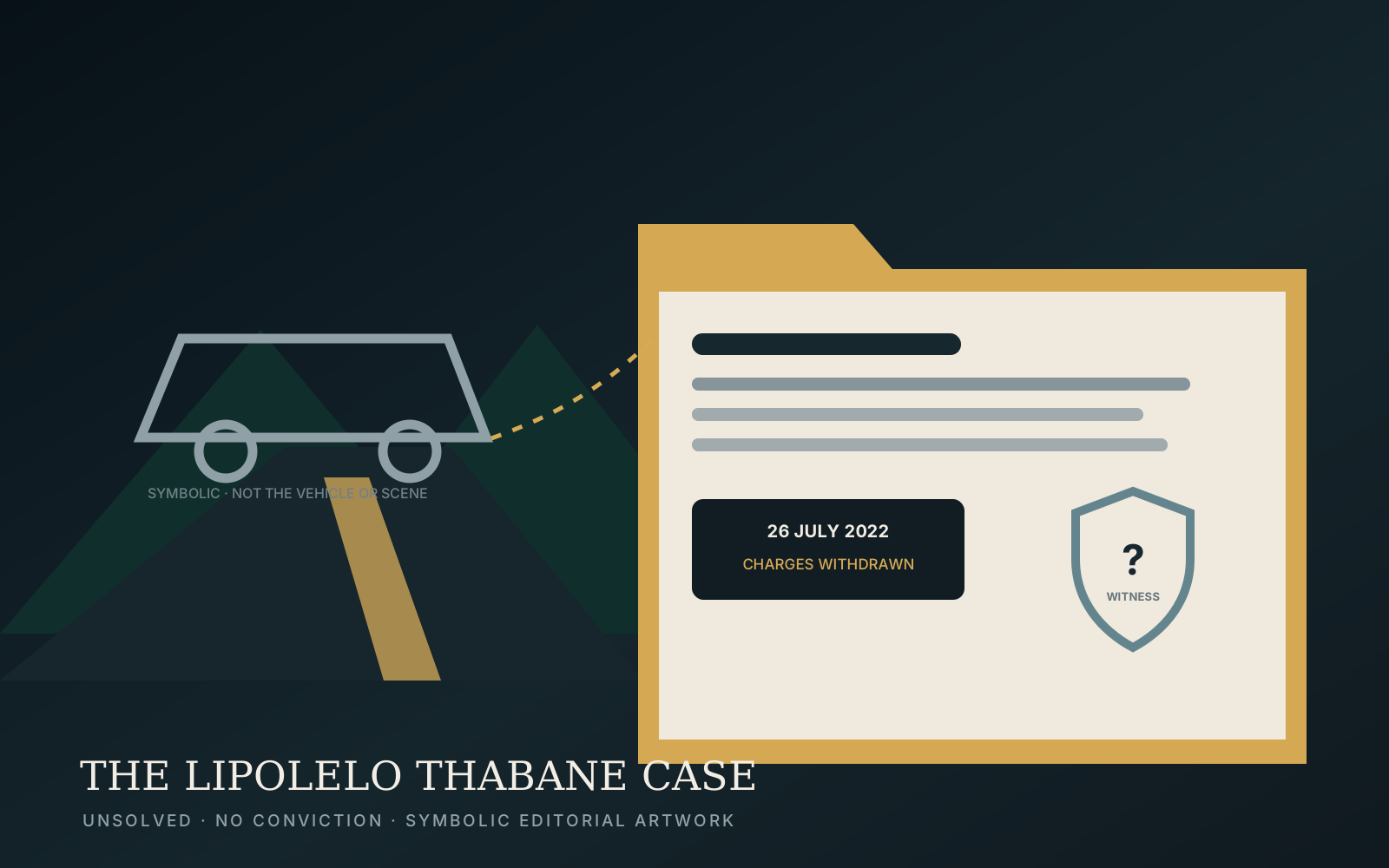
On 26 July 2022, a lawyer for Lesotho's Director of Public Prosecutions told the High Court that the charges against Thomas and Maesaiah Thabane were being withdrawn. Reuters reported that the stated reason was the inability to locate critical witnesses.
Local reporting by the Lesotho Times likewise recorded that the prosecution cited its failure to locate a key witness. Amnesty International's 2022/23 country report subsequently said the murder and attempted-murder charges were dropped for lack of witnesses and noted that some witnesses had died in unexplained circumstances while others had left the country fearing for their lives.
A withdrawn charge does not equal a conviction, an acquittal or a judicial determination of what happened. It means this prosecution ended without a trial verdict establishing guilt. Both former defendants' denials remain part of the record, and neither is identified here as a perpetrator.
Current verified status
Status: unsolved / no conviction. No judgment has identified the person or people responsible for killing Lipolelo or shooting Thato Sebolla. The prosecution against the two charged defendants was withdrawn in July 2022.
The 2026 Lesotho country report from the Bertelsmann Transformation Index discussed the case as an example of limited progress and noted that the case against Maesaiah Thabane had been dropped in 2022. In the sources reviewed through 22 October 2026, no reliable record showed a restored murder prosecution, a trial verdict or a conviction.
This is a date-bounded status statement. If a competent authority later files new charges or a court reaches a judgment, the classification should be updated to reflect that specific development.
What remains unanswered?
The main unanswered questions are who fired on the vehicle, whether other people ordered or assisted the attack, and whether remaining evidence could support a fair future prosecution. The attack on Thato Sebolla is also unresolved within the same failed proceeding.
The inability to locate witnesses raises further questions about protection and institutional capacity. It does not authorize speculation about who intimidated anyone or why a witness died. The archive therefore separates documented witness-security concerns from unproved causal claims.
Why this case matters
The case sits at the intersection of homicide, political power and the practical requirements of a criminal trial. Even a serious charge cannot be resolved without witnesses and evidence that can be tested in court.
It also demonstrates why long-term true-crime records must preserve legal outcomes precisely. “Charged,” “charges withdrawn,” “acquitted” and “convicted” describe different states. Collapsing them into a single claim would misstate the case and risk harming both the victim's search for justice and the rights of former defendants.
Timeline
Frequently asked questions
What happened to Lipolelo Thabane?
She was shot and killed while travelling home in Ha Masana outside Maseru on 14 June 2017. Thato Sebolla was wounded and survived.
Was anyone convicted?
No. Two people were charged, denied involvement, and had the charges against them withdrawn in July 2022.
Why were the charges withdrawn?
Prosecutors said critical witnesses could not be located.
Did the withdrawal prove either former defendant innocent or guilty?
No. The proceeding ended without a verdict establishing responsibility. This archive does not identify either former defendant as a perpetrator.
Why is the case classified as unsolved?
No final judgment established who ordered or carried out the attack, and no person has been convicted.
Sources and source quality
African Union Peace and Security Department — condemnation of the assassination, June 2017 — institutional record confirming Lipolelo Alice Thabane's death in Ha Masana on 14 June 2017.
Reuters — “Lesotho ex-PM Thomas Thabane charged over murder of estranged wife,” 30 November 2021 — contemporaneous reporting on the charges, the attempted-murder count, the police allegation and both defendants' denials.
Reuters — “Charges dropped against Lesotho ex-PM Thabane,” 26 July 2022 — contemporaneous High Court reporting confirming withdrawal of the charges because critical witnesses could not be located.
Amnesty International — witness-protection statement, 21 February 2020 — documents the attack on Lipolelo and Thato Sebolla and the reported death, threats and flight affecting people central to the case.
Amnesty International Report 2022/23 — Lesotho — later human-rights review recording the dropped charges and continuing witness concerns.
Lesotho Times — “Thabane, ‘Maesaiah walk free,” 3 August 2022 — local reporting on the DPP's withdrawal and the stated inability to locate a key witness.
Bertelsmann Transformation Index — Lesotho Country Report 2026 — current rule-of-law assessment discussing limited progress in the case and the 2022 dismissal of the prosecution.
Review note: The date and location were cross-checked against an African Union record and independent reporting. The charges, denials and withdrawal were checked against two Reuters reports, Amnesty International and local Lesotho reporting. The current-status assessment was compared with the 2026 BTI country review. Police theories are attributed and are not presented as adjudicated facts.