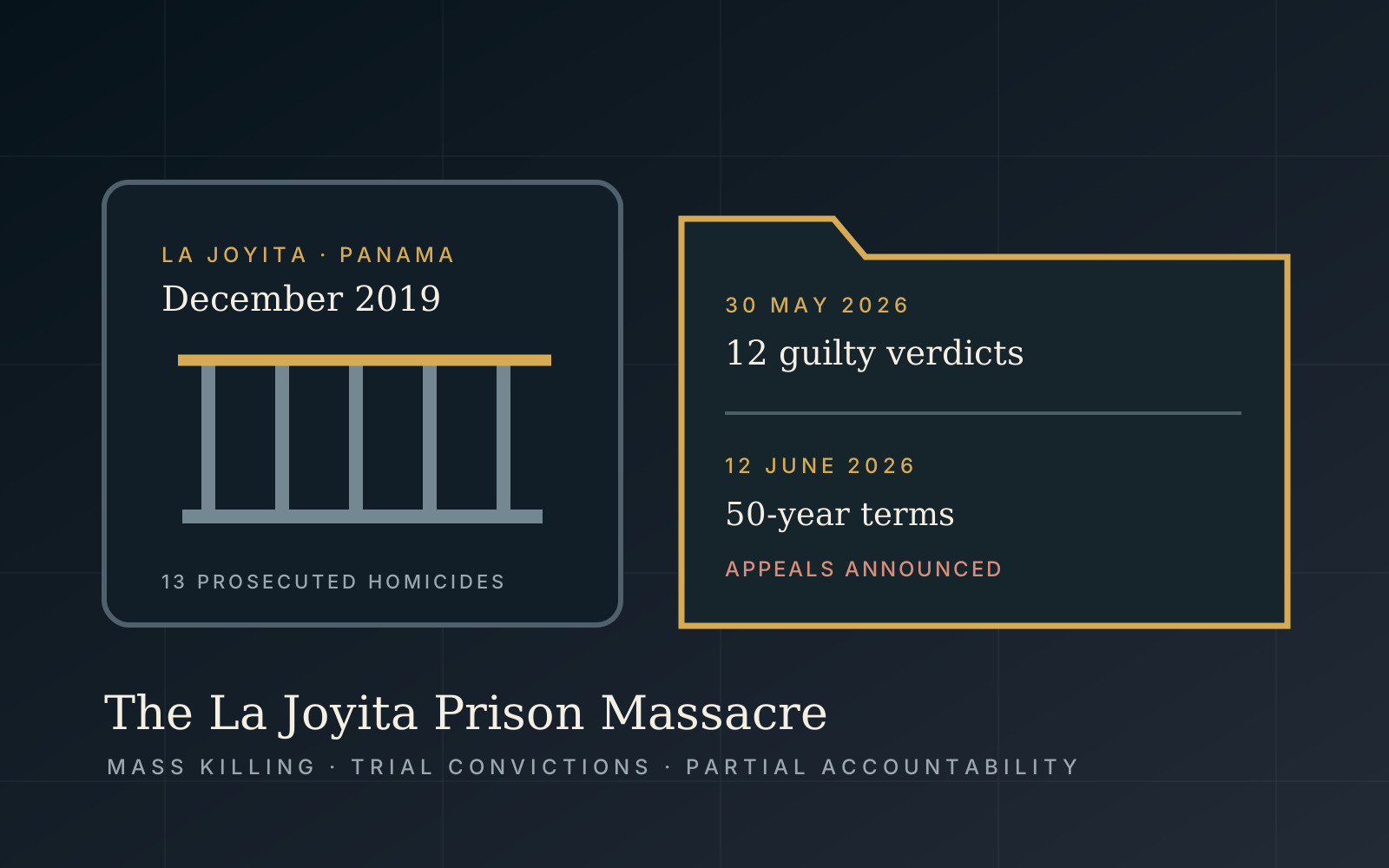
Case-status note: “Solved / partial” refers to the 12 jury convictions and trial sentences entered in 2026. It does not imply a final appeal, resolution of the separate alleged-organizer inquiry or certainty that the 13 homicide counts encompass every death reported publicly after the incident.
What happened at La Joyita?
In December 2019, violence erupted inside Pavilion 14 of La Joyita, a large prison complex at Pacora east of Panama City. Prisoners used firearms and bladed weapons during a confrontation authorities described as a gang dispute. The presence of multiple guns inside a secured facility immediately raised questions about prison searches, corruption and the ability of criminal groups to control space and weapons.
The later judicial case concerned 13 people killed and 11 wounded by gunfire or cutting weapons. Contemporary news reports initially recorded 12 deaths and later raised the public toll to 14. Those figures are not made artificially consistent here: the 2026 court release defines the counts proved to the jury, while contemporaneous sources document the broader toll reported at the time.
After a multi-year investigation, 12 prisoners were tried as perpetrators. A jury returned guilty verdicts on May 30, 2026 for aggravated intentional homicide and attempted aggravated intentional homicide. The trial court imposed sentence on June 12. Lawyers announced appeals, and the court referred information about a person identified during trial as a possible intellectual author for separate investigation.
A lethal event inside state custody
La Joyita had long been associated with overcrowding, poor conditions and security failures. People incarcerated there remained under state custody, even when violence was committed by other prisoners. The fact that high-powered weapons entered Pavilion 14 therefore became part of the public accountability question.
Officials said the confrontation was linked to a rupture within a criminal group. That description provides context but does not make gang membership itself proof of a particular homicide. The criminal trial still required prosecutors to connect each defendant to the charged killings and attempts.
The victims were incarcerated people, a status that does not reduce their right to life or justify treating the event as entertainment. This archive avoids nicknames, spectacle and graphic descriptions. The key issues are the fatalities, the evidence tying defendants to the violence, and how weapons circulated inside a controlled institution.
Why the victim totals differ
Early official and media counts changed as authorities assessed the scene and wounded prisoners. Voice of America reported 14 deaths on December 18, 2019 and about a dozen injured. Other later summaries have repeated 14 or 15 deaths.
The Panamanian judiciary's June 2026 sentencing announcement is narrower and procedurally exact. It says the case tried before the jury involved 13 deaths and 11 injuries, charged as 13 aggravated intentional homicides and 11 attempted aggravated intentional homicides.
There are several possible reasons for a difference between an incident toll and the counts in an indictment, including evidentiary decisions, later medical outcomes or reporting error. No reliable source reviewed here definitively reconciles the totals. The page therefore uses “13 prosecuted homicides” whenever describing the verdict and identifies 14 only as a contemporary public count.
Investigation and charging
The investigation had to reconstruct events within a crowded prison pavilion, identify weapons, trace individual acts and assess testimony from people living within the same criminal and custodial environment. The long interval between December 2019 and the May 2026 verdict reflects the scale of that task, though delay alone does not establish either diligence or misconduct.
Authorities recovered firearms after the violence, according to contemporary reports. The wider security question—how weapons capable of sustaining a mass shooting entered the prison—was distinct from proving which defendant committed or participated in each homicide.
The United States State Department's 2020 human-rights report described deficient prison security management as contributing to the massacre and used a figure of 13 deaths and 14 injured. That is an institutional assessment, not a Panamanian criminal verdict against particular prison officials.
The 2026 jury trial
The trial lasted approximately three weeks. On May 30, 2026, a jury of conscience found 12 defendants guilty as authors of the 13 aggravated homicides and 11 attempted aggravated homicides. Panama's judiciary later summarized the verdict without publishing the defendants' names in the sentencing notice used for this file.
Because the official release does not name the 12, this page does not manufacture a roster from secondary or social-media sources. Identification is an essential fact, and omitting unverified names is preferable to attaching criminal liability to the wrong person.
The verdict established trial-level responsibility. It did not decide the separate allegation that another person had intellectually organized the event, nor did it foreclose appellate review of the evidence, jury procedure or sentences.
Fifty-year sentences
On June 12, 2026, a three-judge trial panel announced 30 years of imprisonment for aggravated intentional homicide and 20 years for attempted aggravated intentional homicide. The court described the combined punishment as 50 years for each of the 12 defendants.
The defendants heard the judgment remotely from the prison where they were held. Defense lawyers present at the hearing announced that they would appeal. Other lawyers had a short statutory period to file written appeals.
A sentence pronounced at trial is a real judicial outcome, but “appeal announced” matters. The archive does not call the judgment final or claim that every defendant has exhausted review. It classifies the massacre as adjudicated at trial and partial in its wider accountability.
The alleged organizer inquiry
During the proceeding, one person was identified as an alleged intellectual author. The sentencing panel ordered a copy of the judgment sent to prosecutors so that allegation could be investigated. The prosecutor at the hearing said the Public Ministry already had an open investigative file connected with the cause.
An “intellectual author” allegation concerns planning or direction rather than necessarily firing a weapon. It is not a conviction, and this page does not name or label the person because the cited official record reports an investigation rather than a judgment.
The separate file prevents the trial of the 12 direct perpetrators from being mistaken for complete organizational accountability. As of September 15, 2026, no reliable final conviction in that organizer investigation was located.
Status as of September 2026
The strongest verified statement is that 12 defendants were convicted by a jury and sentenced at trial for 13 homicides and 11 attempts. Those are not allegations. The convictions exist unless and until a competent court modifies them.
At the same time, announced appeals mean the outcome should not be described as final. The alleged organizer inquiry also remained open. No appellate judgment or subsequent final organizer conviction was located in a source review through September 15, 2026.
The case is therefore “Solved / partial.” It has substantially stronger judicial resolution than an unsolved mass killing, but it has not reached the procedural or organizational closure implied by an unqualified “solved” label.
Questions beyond the verdict
The trial resolved the charged responsibility of 12 defendants at first instance. It did not publicly reconcile why some reports recorded more deaths than the 13 homicide counts, and it did not answer how the firearms entered or remained inside Pavilion 14.
Future records may clarify the appeals, the separate prosecutor's file and any institutional proceedings about prison security. Until then, those matters remain questions, not conclusions.
The victims' custodial status makes those gaps especially important. A prison sentence authorizes confinement; it does not expose a person to lethal violence or relieve the state of its duty to investigate deaths and prevent weapons from circulating within a secured facility.
Frequently asked questions
When did the massacre happen?
The violence occurred in December 2019; contemporary reporting identifies December 17.
How many deaths were tried in court?
The 2026 jury case concerned 13 homicides and 11 attempted homicides.
Why do some reports say 14 died?
Contemporary public reporting gave a higher toll than the 13 homicide counts in the judgment. No source reviewed here definitively reconciles the difference.
How many people were convicted?
A jury found 12 defendants guilty on May 30, 2026.
What sentence did they receive?
Each received a combined 50-year term at the June 12, 2026 sentencing.
Is the judgment final?
No final appellate ruling was located. Defense lawyers announced appeals, and a separate alleged-organizer inquiry remained open.