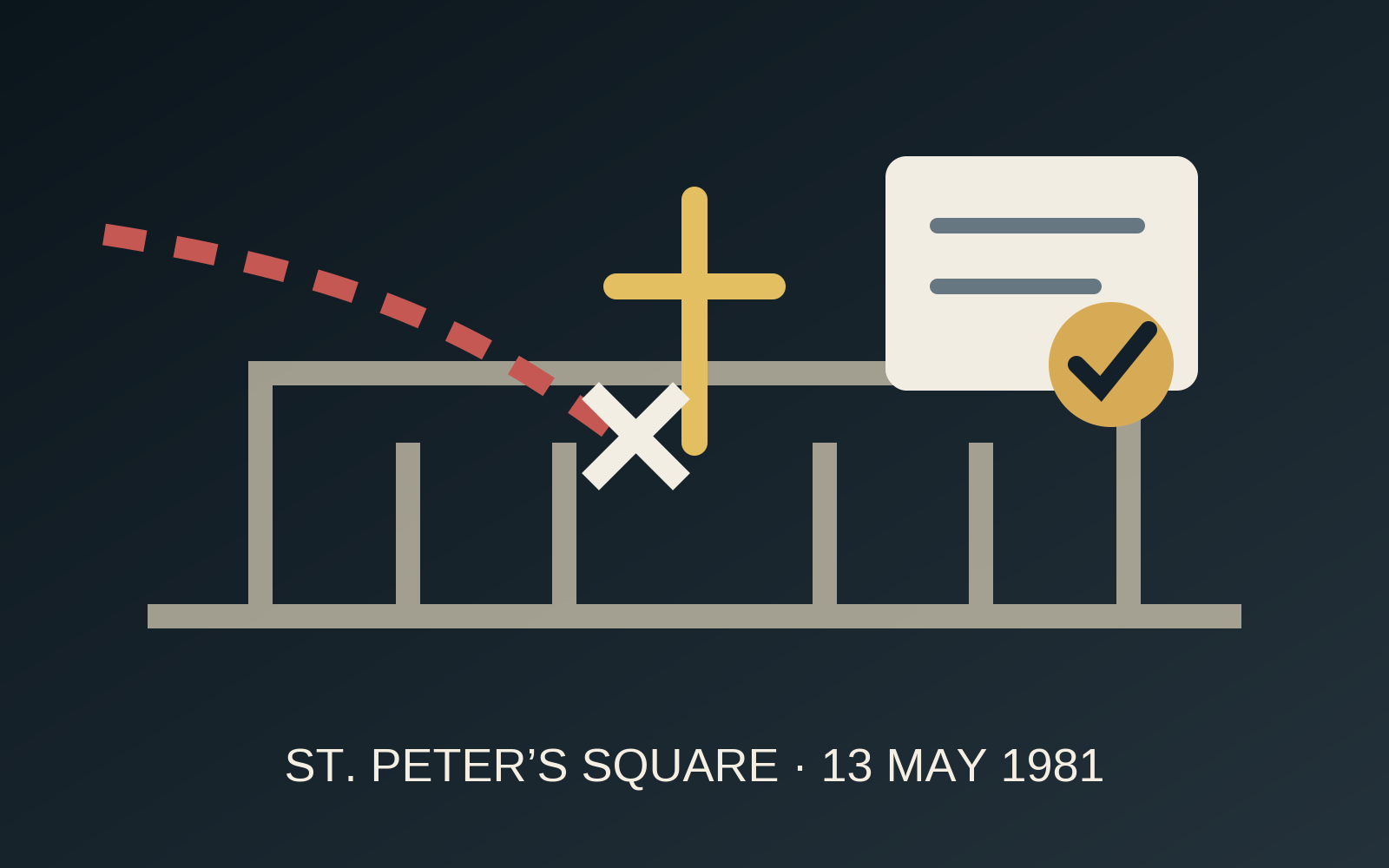
The shots in St. Peter’s Square
The weekly general audience on 13 May 1981 drew thousands of people into St. Peter’s Square. At approximately 5:19 p.m., Pope John Paul II was moving through the crowd in an open vehicle when Mehmet Ali Ağca fired from close range. A Holy See memorial page marks the precise place and records that the pope was struck while blessing those assembled.
John Paul II was seriously wounded and taken across Rome to the Agostino Gemelli hospital. Medical teams operated for hours and treated abdominal and upper-body injuries. He survived. Other people in the square were also wounded, but this archive avoids graphic reconstruction because it is unnecessary to understand either the prosecution or the historical consequences.
Ağca did not escape the square. People nearby and security personnel detained him, and Italian authorities took responsibility for the criminal process. Although the attack occurred within Vatican City, the Lateran framework and Italian criminal law meant that the prosecution proceeded before an Italian court.
The identified gunman
Ağca was a Turkish national with an established history of political violence. Before the Vatican attack, he had been convicted in Turkey for the 1979 murder of newspaper editor Abdi İpekçi and had escaped custody. His earlier affiliations and travels later became central to theories that he had received outside support.
Those surrounding facts do not change the narrow point proved in the first prosecution: Ağca was the shooter. In July 1981, an Italian court convicted him of attempting to assassinate the pope and imposed a life sentence. Reuters’ later review of the record describes that conviction as the legal resolution of his personal responsibility.
The alleged wider conspiracy
Investigators pursued the possibility that Ağca had not acted alone. Public attention focused especially on an alleged “Bulgarian connection,” with claims that Bulgarian operatives or Soviet-bloc intelligence services had supported the attack. Ağca gave changing accounts, and the resulting case placed several Turkish and Bulgarian defendants before an Italian court.
In March 1986, the court acquitted three Bulgarians and three Turks accused of participating in the plot. Contemporary reporting described the result as an acquittal for insufficient evidence. That outcome matters: it prevents a responsible account from presenting the Bulgarian or Soviet theories as judicially established fact.
Later political investigations, intelligence claims and memoirs continued to advance competing explanations. They do not replace the verdicts. No final criminal judgment identified a state sponsor, handler or organizer beyond Ağca. His motive and the extent of any assistance therefore remain historically disputed even though his own guilt is settled.
Forgiveness and the prison meeting
Within days of the shooting, John Paul II publicly said that he forgave the person who had attacked him. On 27 December 1983, he visited Ağca at Rome’s Rebibbia prison. Vatican records confirm the meeting, while Vatican News notes that their private conversation lasted about twenty minutes and was never publicly disclosed in full.
The meeting became one of the best-known images of the pontificate, but forgiveness was not an acquittal and did not erase the sentence. Ağca remained imprisoned in Italy for nineteen years. The moral and religious significance of the encounter should be kept separate from the legal history.
Pardon, extradition and later custody
In June 2000, Italy granted Ağca a presidential pardon connected to the Vatican attack. He was then extradited to Turkey, where he remained subject to punishment for the İpekçi murder and other offenses. Reuters reported that he was released from Turkish custody in January 2010 after the completion of the applicable term.
A pardon is an act of clemency, not a finding of innocence. The 1981 conviction remains the reliable legal record of the shooting. The later release likewise does not resolve the unanswered question of whether anyone else directed the attack.
Case timeline
- 13 May 1981 — Ağca shoots and seriously wounds Pope John Paul II in St. Peter’s Square and is detained.
- July 1981 — An Italian court convicts Ağca of attempted assassination and imposes life imprisonment.
- 27 December 1983 — John Paul II visits Ağca at Rebibbia prison.
- March 1986 — Six defendants accused in the alleged wider plot are acquitted for insufficient evidence.
- June 2000 — Italy pardons Ağca and extradites him to Turkey for other sentences.
- January 2010 — Ağca is released from Turkish custody.
What is solved — and what is not
The attempted assassination is solved as to the shooter. Ağca was caught at the scene, prosecuted, convicted and imprisoned. That conclusion does not depend on rumor or a retrospective theory.
The wider architecture of the crime remains unresolved. Courts did not establish that the six conspiracy defendants participated, and no other final conviction identified a sponsor. This page therefore classifies the file as solved and adjudicated for the gunman, with the motive and any broader conspiracy left open.
Frequently asked questions
Did Pope John Paul II survive?
Yes. He was seriously wounded, underwent emergency treatment and returned to public duties after recovery.
Was Ağca’s conviction overturned?
No reliable source located for this review reports an overturned conviction. Italy later pardoned him after nineteen years in custody.
Did a court prove the Bulgarian connection?
No. The defendants tried over the alleged conspiracy were acquitted for insufficient evidence.
Sources and verification
- The Holy See — memorial plaque for the 13 May 1981 attackOfficial location, time and core event record.
- Holy See Press Office — events in the pontificate of John Paul IIOfficial chronology of the attack and 1983 prison visit.
- Vatican News — forty-year retrospectiveContemporary institutional recollection of the shooting, recovery and forgiveness.
- Reuters — factbox on Mehmet Ali AğcaConviction, imprisonment, pardon and extradition.
- The Washington Post — 1986 conspiracy-trial acquittalsContemporary court reporting on the insufficient-evidence verdicts.
- Reuters — Ağca’s 2010 releaseItalian custody, pardon, Turkish sentences and release.