What is the current status of the case?
Direct answer: the case is classified as solved / adjudicated. The National Court convicted Bhosip Kaiwi of Jenelyn Kennedy’s murder on 15 June 2023. Justice Teresa Berrigan imposed life imprisonment on 8 December 2023.
The classification rests on a murder conviction and sentence, not on an arrest, accusation or public belief. Court reporting records that the trial judge was satisfied that Kaiwi caused Kennedy’s death through assaults between 18 and 23 June 2020 and intended to cause grievous bodily harm.
The accessible sources reviewed for this page did not identify a later appellate judgment overturning the conviction or sentence. The label nevertheless avoids the word “final” because those sources do not establish that every possible appeal or review has ended.
Who was Jenelyn Kennedy?
Jenelyn Kennedy was 19 years old and the mother of two young children. Public reporting and the United Nations response centered her as a daughter, sister, mother and community member—not only as the subject of a criminal file.
Her death became a national reference point in discussions of violence against women and girls in Papua New Guinea. Hundreds of people joined a mourning march in Port Moresby, and the United Nations country team called for stronger prevention, protection and accountability.
A victim-aware account should not reproduce degrading descriptions or imply that relationship difficulties caused the crime. The legal question was Kaiwi’s conduct and intent. Responsibility lies with the person convicted, not with Kennedy.
The death in Port Moresby
Kennedy died on 23 June 2020 after a period of violence at a home in Korobosea, Port Moresby. Early police and court reporting said she was taken to Port Moresby General Hospital, where she was pronounced dead.
At trial, the court considered medical and witness evidence about injuries and their timing. Acting Judge Laura Wawun-Kuvi found that Kaiwi’s assaults between 18 and 23 June caused Kennedy’s death. The judgment, as reported by The National, rejected the defence theory that alcohol and drugs accounted for the death because the judge found it lacked factual support.
This page does not restage the assaults. The legally material facts are that the court found a sustained course of violence, causation and the intent required for murder under Papua New Guinea’s Criminal Code.
Police response and the earlier protection question
Kaiwi surrendered to police after the death and was charged with murder. The prosecution file moved through the Waigani Committal Court before the case reached the National Court.
Separately, Police Commissioner David Manning ordered an investigation into the handling of Kennedy’s case before her death. He publicly asked what authorities had done to protect her and whether weaknesses in police, legal, welfare or court systems had prevented effective intervention.
Those comments should not be confused with the murder verdict. The criminal trial established Kaiwi’s responsibility for causing Kennedy’s death. It did not determine every question about how prior reports were handled, whether other actors breached duties or what became of the commissioner’s institutional review.
The 2023 National Court conviction
On 15 June 2023, the National Court found Kaiwi guilty of murder. The National reported the ruling four days later and attributed it to Acting Judge Wawun-Kuvi. The judge found the prosecution evidence sufficient to prove that the repeated assaults caused Kennedy’s death.
The court treated medical evidence as important to the timing and cause of the injuries. It also evaluated witness credibility rather than accepting every statement without scrutiny. That matters because a responsible case summary should explain the basis of adjudication, not merely repeat the outcome.
The reported reasoning addressed causation and intent. The judge concluded that Kaiwi intended to cause grievous bodily harm, satisfying the basis for a murder conviction under the law applied by the court.
The life sentence imposed in December 2023
Sentencing took place on 8 December 2023. Justice Teresa Berrigan imposed life imprisonment, which national reporting described as the maximum penalty. Both NBC Papua New Guinea and The National reported the result.
The sentencing judge emphasized the sustained nature of the offending, Kennedy’s vulnerability, the abuse of trust within the home and the need for the court to denounce such violence. The sentence was directed at the gravity of this murder; it should not be generalized into a claim about every case of family violence.
The source record reviewed here does not provide a later appellate ruling. For that reason, this archive records the conviction and sentence exactly as reported and does not add unsupported claims about parole eligibility, appeal exhaustion or later custodial changes.
What the conviction established—and what it did not
The conviction established that Kaiwi was criminally responsible for Kennedy’s murder. The sentence determined the punishment imposed by the National Court. Those two facts support the solved / adjudicated classification.
The criminal judgment did not erase the earlier protection concerns raised by the police commissioner, nor did it decide the responsibility of every person who may have known about the abuse. It also did not by itself prove that national systems had been reformed after 2020.
Keeping these questions separate prevents two errors: calling the case unresolved despite a murder conviction, or suggesting that one conviction resolved the broader problem of violence against women and institutional protection in Papua New Guinea.
Public response and institutional context
In July 2020, the United Nations in Papua New Guinea offered condolences to Kennedy’s family and called for authorities and communities to strengthen prevention, services and justice. The statement described violence against women and children as a crime and a human-rights violation.
ABC reporting documented public demonstrations in Port Moresby and the family’s hope that the case would renew action against domestic violence. These responses are relevant because they show why the case became nationally significant, but they are not evidence of Kaiwi’s guilt. The conviction came later through court proceedings.
The distinction mirrors the site’s editorial method: social context helps explain significance; criminal responsibility must come from verified evidence and adjudication.
A victim-aware reading of the record
Kennedy’s age, motherhood and public photographs should not become material for sensationalism. The archive uses her name because it is central to the public court record, but avoids graphic detail and does not use a generated likeness.
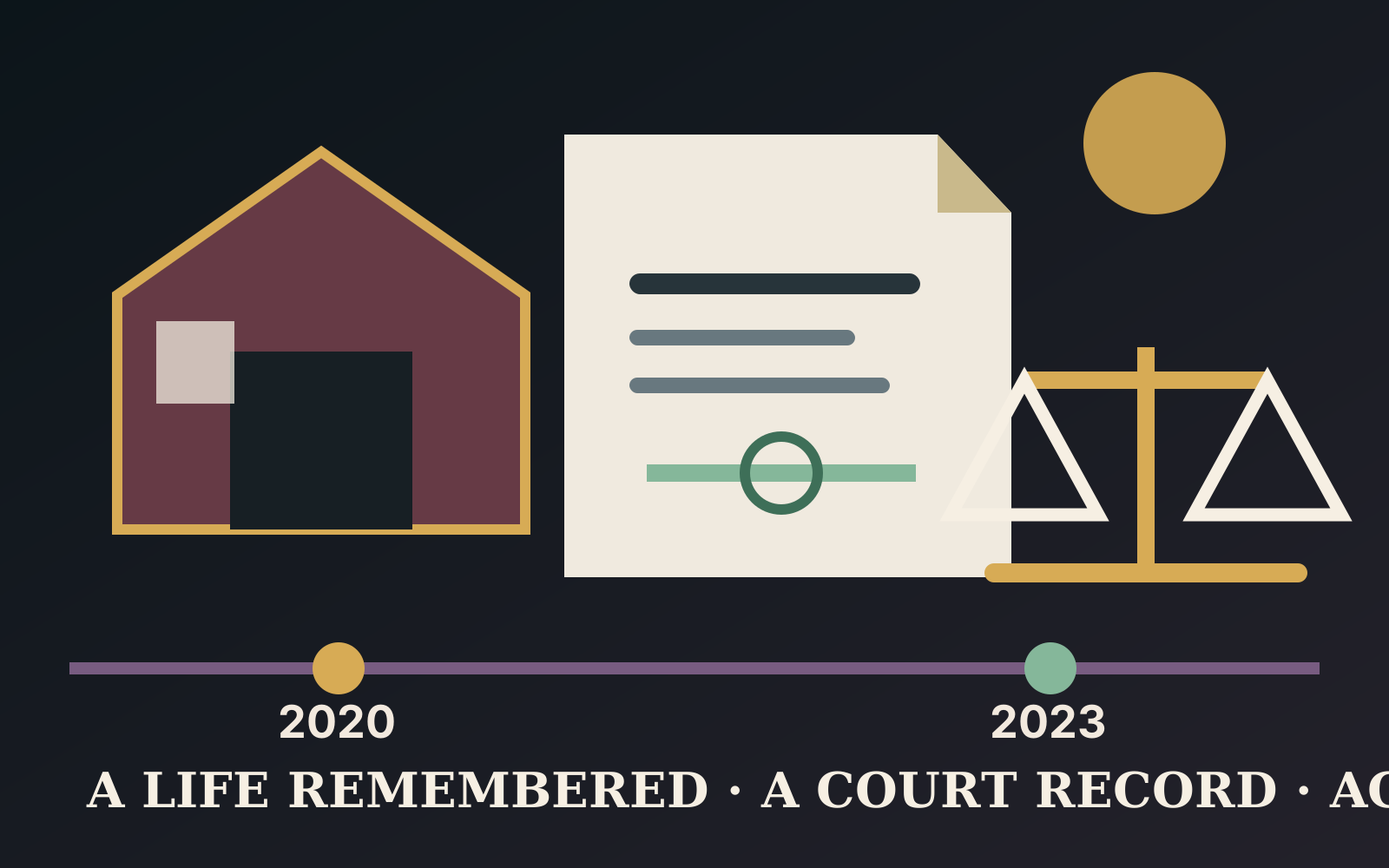
Symbolic artwork shows a home, a legal file, the years 2020 and 2023 and scales of justice. It communicates the movement from harm to adjudication without pretending to be evidence or depicting a real person.
The source list also separates stages: early police reporting, the United Nations response, the trial verdict and the sentence. That chronology makes clear which facts were allegations in 2020 and which became judicial findings in 2023.
Case timeline
- 18–23 June 2020 — The period of assaults later found by the National Court to have caused Kennedy’s death.
- 23 June 2020 — Jenelyn Kennedy dies in Port Moresby.
- 25 June 2020 — Police report that Kaiwi is in custody and charged with murder.
- 29 June 2020 — Police Commissioner David Manning announces a review of the earlier institutional handling of the case.
- 2 July 2020 — The United Nations country team calls for renewed prevention, protection and accountability.
- 15 June 2023 — The National Court finds Bhosip Kaiwi guilty of murder.
- 8 December 2023 — Justice Teresa Berrigan sentences Kaiwi to life imprisonment.
- 8 October 2026 — This archive reviews the accessible record; no later judgment overturning the conviction or sentence is identified.
Questions readers ask
When and where did Jenelyn Kennedy die?
Jenelyn Kennedy died in Port Moresby on 23 June 2020 after the assaults that the National Court found had occurred between 18 and 23 June at the home she shared with Bhosip Kaiwi.
Who was convicted of Jenelyn Kennedy’s murder?
The National Court convicted Bhosip Kaiwi of murder on 15 June 2023. Court reporting identified him as Kennedy’s husband or partner and the father of her two children.
What sentence did Bhosip Kaiwi receive?
On 8 December 2023, Justice Teresa Berrigan sentenced Kaiwi to life imprisonment, describing that penalty as the only sentence that adequately recognized the gravity of the murder.
Why is the case classified as solved or adjudicated?
A court found Kaiwi guilty of murder and imposed a life sentence. The label records that adjudicated responsibility; it does not claim that every wider institutional question or possible appellate step has been resolved.
Did the conviction answer concerns about earlier institutional failures?
No. Papua New Guinea’s police commissioner separately ordered an inquiry into how authorities had handled earlier reports and opportunities to protect Kennedy. The murder conviction established Kaiwi’s criminal responsibility, not the outcome of that institutional review.
Why does this archive use symbolic artwork?
The illustrations use a home, court file and scales of justice without imitating Kennedy, Kaiwi, her injuries or the crime scene. They are clearly editorial and are not presented as documentary evidence.