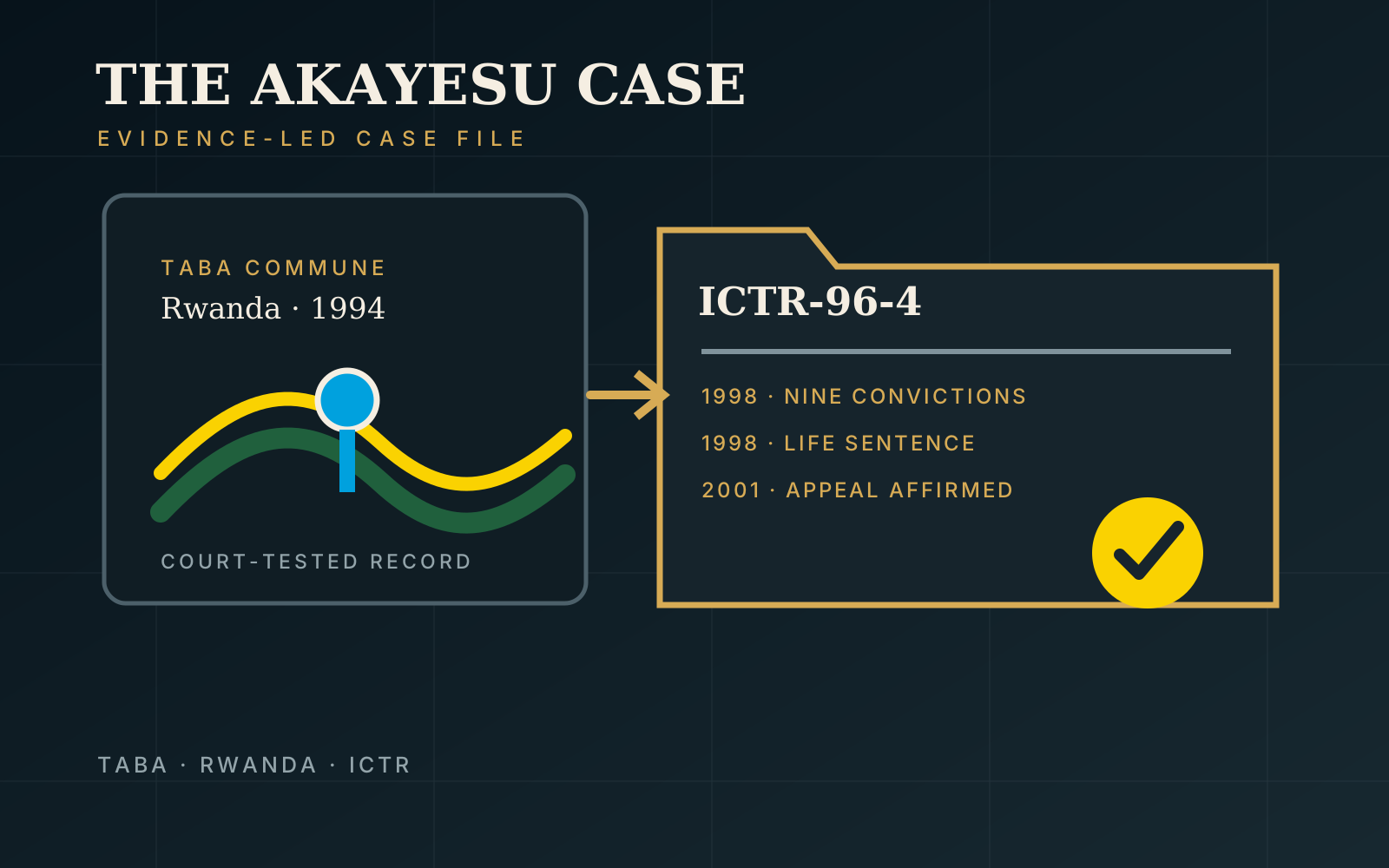
Case-status note: “Solved / adjudicated” refers specifically to Jean-Paul Akayesu's final convictions and life sentence in ICTR-96-4. It does not mean that every killing or act of sexual violence in Taba was individually prosecuted, that all perpetrators were identified, or that one trial resolved the wider genocide.
What happened in the Akayesu case?
The United Nations International Criminal Tribunal for Rwanda prosecuted Jean-Paul Akayesu for conduct connected with violence in Taba commune between April 7 and the end of June 1994. Akayesu was Taba's bourgmestre—the senior local official commonly described in English as its mayor. The prosecution argued that he used, and failed to use, the authority of that office in ways that contributed to genocide and crimes against humanity.
Trial Chamber I convicted Akayesu of genocide, direct and public incitement to commit genocide, and multiple crimes against humanity. Those crimes against humanity included extermination, murder, torture, rape and other inhumane acts. The chamber convicted him on nine of the 15 counts then before it and acquitted him on the remainder, including the alternative complicity-in-genocide count and charges brought under the tribunal's armed-conflict jurisdiction.
The legal result became final after appeal. The Trial Chamber delivered judgment on September 2, 1998 and a separate sentencing judgment on October 2. It imposed concurrent terms whose effective sentence was life imprisonment. On June 1, 2001, the Appeals Chamber rejected Akayesu's challenges to his convictions and sentence. The United Nations tribunal's legacy profile continues to record the life sentence as affirmed.
Taba commune in 1994
Taba was a commune in the former Gitarama prefecture of central Rwanda. In 1994, a bourgmestre sat at the centre of local administration: the office coordinated public functions, exercised authority over communal police and could convene residents. That institutional power made Akayesu's choices legally important. The case did not treat him as responsible simply because he held a title; it examined what he did, said, knew and permitted while violence unfolded.
The judgment concerned the period after the April 6, 1994 plane crash that killed President Juvénal Habyarimana and Burundi's president, Cyprien Ntaryamira. Across Rwanda, extremist authorities and armed groups organized the genocide against the Tutsi while also targeting Hutu political opponents. In Taba, the tribunal heard evidence about killings, attacks, forced displacement and sexual violence at or near communal premises and other local sites.
A responsible case file must avoid turning that history into a single-defendant story. Akayesu's trial addressed particular charges and particular forms of individual responsibility. The genocide involved national and local institutions, militia members and many other actors, some prosecuted elsewhere and many never tried. This page therefore uses “the Akayesu case” for the judgment, not as a substitute name for the genocide itself.
Akayesu's office and the court's findings
Akayesu had served as bourgmestre since April 1993. The Trial Chamber examined the legal powers of the office, his ability to direct communal police, his public standing and his presence at key events. Witness evidence and documents were used to determine when he acted, when he gave orders or encouragement and when he allowed crimes around communal facilities to continue.
The court found that Akayesu initially attempted to maintain order in Taba, but that his conduct changed as the genocide developed. It concluded that he participated in and encouraged criminal acts, including through public speech, and that he had knowledge of sexual violence committed at or near the bureau communal. His authority supplied context; the convictions rested on proved conduct and intent rather than office alone.
This distinction matters for understanding international criminal law. Political or administrative responsibility is not automatically criminal responsibility. A prosecutor must prove the elements of charged crimes and a recognized mode of liability. The chamber's count-by-count verdict—nine convictions and six acquittals—shows that it did not accept every allegation simply because the defendant was a mayor.
Sexual violence and the genocide finding
The Akayesu judgment is especially important because the Trial Chamber treated sexual violence as part of the campaign to destroy the Tutsi group, not as an incidental crime detached from genocide. The evidence concerned rape and other assaults against Tutsi women around the bureau communal. The court found that Akayesu knew about this violence and that his words and presence encouraged acts committed in that setting.
The chamber defined rape in international law by focusing on a physical invasion of a sexual nature under coercive circumstances, rather than limiting the offense to a narrow list of body parts or acts. It also described sexual violence more broadly as sexual conduct committed under coercion. Those legal formulations were developed to address evidence without forcing every survivor's experience into an unduly mechanical definition.
Most significantly, the chamber held that rape and sexual violence can constitute genocide when committed with the specific intent to destroy, in whole or in part, a protected national, ethnic, racial or religious group. It found that the acts proved in Taba formed an integral part of the destruction of the Tutsi group. This did not make every sexual offense genocide automatically; the required genocidal intent still had to be proved.
Evidence, witnesses and a changing indictment
The prosecution's original indictment focused on killings, torture, incitement and related offenses. During trial, testimony exposed the scale and function of sexual violence in Taba. The indictment was amended in June 1997 to add three counts addressing rape, other inhumane acts and outrages upon personal dignity. The added allegations were then tested through the same adversarial process as the original charges.
The case relied heavily on witness testimony because local crimes are rarely documented in a single complete archive. The chamber assessed identification, consistency, translation, elapsed time and the conditions under which witnesses observed events. It also considered the broader historical context and evidence about how communal authority operated.
Witness-centered cases require care in retelling. A judicial finding is stronger than an untested allegation, but it does not justify publishing graphic detail. This file summarizes the nature and legal significance of the violence without reproducing intimate testimony. It also distinguishes what the Trial Chamber found from later summaries written by archives or legal researchers.
The September 1998 judgment
On September 2, 1998, Trial Chamber I found Akayesu guilty on nine counts. The convictions included genocide and direct and public incitement to commit genocide, together with crimes against humanity. He was acquitted of six counts. Because complicity in genocide had been charged as an alternative, the chamber did not add that conviction to the completed offense of genocide.
The judgment was historic in two connected ways. It was the first conviction by an international court for the crime of genocide under the 1948 Genocide Convention's framework. It was also the first international judgment to recognize that rape and other sexual violence could be acts of genocide when used with the intent to destroy a protected group.
The judgment did not create a rule that context replaces proof. For genocide, the chamber still had to find specific intent. For crimes against humanity, it had to connect acts to the required widespread or systematic attack on civilians. For each count, it had to decide whether the evidence proved Akayesu's personal responsibility beyond a reasonable doubt.
Life imprisonment
The Trial Chamber delivered a separate sentencing judgment on October 2, 1998. It imposed different prison terms for the individual convictions, ranging from ten years to life, and ordered them to run concurrently. The practical result was a single life sentence.
Separating verdict and sentence prevents a common reporting error. September 2 is the conviction date; October 2 is the sentencing date. The later appeal did not replace life imprisonment with a fixed term, nor did it create a death sentence. The ICTR did not have authority to impose capital punishment.
The sentence reflected the gravity of the crimes proved, including the abuse of local authority and the harm to civilians. It remained a sentence for Akayesu's individual criminal responsibility. Other defendants faced their own indictments, evidence and outcomes in separate ICTR or domestic proceedings.
The June 2001 final appeal
Akayesu challenged both the convictions and the sentence. His appeal raised issues including the quality and choice of defense counsel, evidentiary rulings, witness examination, detention and alleged factual or legal errors. The prosecution also appealed several legal conclusions concerning the tribunal's jurisdiction and modes of responsibility.
On June 1, 2001, the Appeals Chamber dismissed Akayesu's grounds and affirmed his life sentence. It addressed prosecution arguments that clarified points of law but did not overturn the nine convictions or change the punishment. Refworld's tribunal record identifies the decision as ICTR-96-4-A, while the ICTR legacy profile states plainly that life imprisonment was affirmed on that date.
This final appellate judgment makes the procedural classification unusually clear. There is no unresolved trial verdict or publicly pending appeal to qualify. The proper label is “Solved / adjudicated,” with the scope note that the resolution belongs to this defendant and this case.
Why the case changed international criminal law
Before Akayesu, genocide had been defined in treaty law but had not produced an international-court conviction. The 1998 judgment demonstrated how prosecutors could prove the crime through conduct and intent in a local setting. It connected public incitement, killings and other violence to a plan directed at a protected group.
The treatment of sexual violence was equally consequential. By recognizing rape as both a crime against humanity and, under the facts proved, an act of genocide, the chamber rejected the idea that such violence was peripheral to mass atrocity. Later international prosecutions built on, refined and sometimes debated the legal definitions used in Akayesu, but the case remains a foundational precedent.
Its importance should not obscure the people whose testimony made the judgment possible. Survivors described violence under conditions of danger, stigma and grief. Ethical reporting credits the evidentiary role of that testimony without making victims' suffering a spectacle or reducing the case to a legal “first.”
What the judgment did—and did not—resolve
The case established Akayesu's guilt on nine counts and imposed a final life sentence. It also established legal principles about genocide, incitement, crimes against humanity and sexual violence. Those are concrete judicial outcomes supported by trial and appeal records.
It did not identify every person who committed crimes in Taba, produce an individual case history for every victim or adjudicate the responsibility of national leaders not before the chamber. Six counts ended in acquittal. Other ICTR cases and Rwandan proceedings addressed different defendants and events, while many families' experiences never became a courtroom record.
The verified bottom line is therefore precise: Akayesu was the bourgmestre of Taba; the ICTR found him guilty on September 2, 1998 of genocide, incitement and crimes against humanity; it imposed life imprisonment on October 2; and the Appeals Chamber affirmed that sentence on June 1, 2001.
Frequently asked questions
Who was Jean-Paul Akayesu?
Jean-Paul Akayesu was the bourgmestre, or mayor, of Taba commune during the 1994 genocide against the Tutsi in Rwanda.
What did the ICTR convict Akayesu of?
Trial Chamber I convicted him on nine counts, including genocide, direct and public incitement to commit genocide, and crimes against humanity.
When was Akayesu convicted?
The tribunal delivered judgment on September 2, 1998 and imposed life imprisonment on October 2, 1998.
Was the life sentence appealed?
Yes. The ICTR Appeals Chamber rejected Akayesu's challenge and affirmed the life sentence on June 1, 2001.
Why is the judgment important?
It was the first international-court conviction for genocide and established that rape and other sexual violence can constitute genocide when the required intent is proved.
Does solved mean every crime in Taba was resolved?
No. The label refers only to Akayesu's final convictions in ICTR-96-4, not to every perpetrator, victim or offense connected with the 1994 genocide.