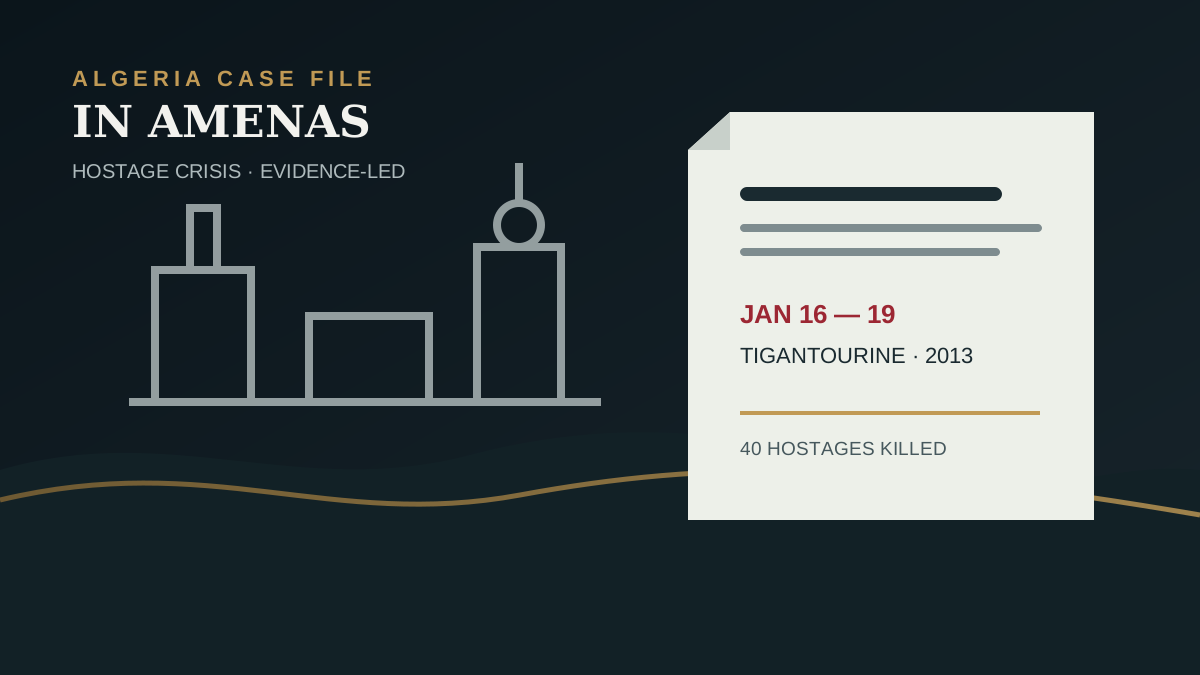
Classification note: Crime by Region classifies this file as Unsolved / partial. The armed assault, hostage-taking and organizational responsibility are established in the public record. Most attackers were reported killed during the Algerian response, and some alleged survivors were reportedly investigated or prosecuted. The accessible source record does not document a transparent, comprehensive set of final individual judgments covering the full operational chain.
The Tigantourine gas complex
The Tigantourine facility lies in Algeria's Sahara, near the town of In Amenas and relatively close to the Libyan border. The industrial site was operated by a joint venture involving Algeria's Sonatrach, BP and Norway's Statoil, now Equinor. Algerian and international personnel lived and worked there, making it both economically important and unusually multinational.
The regional security environment had deteriorated after the collapse of Libya's government in 2011 and conflict across the Sahel. Weapons and armed groups moved through border areas. Five days before the attack, France began a military intervention against Islamist forces in Mali. The attackers later invoked that intervention, but later evidence indicated that an operation of this scale required prior preparation.
The attack on January 16
Gunmen struck early on January 16, first attacking a bus carrying workers and then entering the residential and production areas. Workers from many countries were caught inside. Some hid for hours or escaped across the desert; others were seized and moved through the complex.
The perpetrators were associated with the al-Mulathameen network and a faction commonly translated as the “Those Who Sign in Blood” battalion, linked to veteran Algerian militant Mokhtar Belmokhtar. Public claims framed the raid as retaliation for the French operation in Mali. That organizational attribution is stronger than the public proof available for every named individual's specific acts.
Four days of captivity
The crisis continued through January 19. Hundreds of Algerian employees were held alongside foreign workers. Contemporary totals changed rapidly because many people escaped, hid or could not immediately be accounted for. For clarity, this page uses the later inquest-era total of 40 hostages killed rather than repeating every provisional figure published during the siege.
Survivor accounts and the British inquest described threats, forced movement and explosive devices used to control captives. Crime by Region does not reproduce graphic material. The record is sufficient to show deliberate hostage-taking and lethal coercion without turning the victims' final hours into spectacle.
The Algerian military response
Algeria rejected prolonged negotiation and launched military operations while hostages remained under the attackers' control. On January 17, helicopters attacked a convoy the gunmen were using to move captives. Fighting continued in different parts of the complex until Algerian forces ended the siege on January 19.
The response saved many people and prevented the armed group from retaining the facility, but it also became the subject of scrutiny because some hostages were struck by Algerian fire. The 2015 British inquest nonetheless concluded that responsibility for the deaths it examined rested with the terrorists. That legal conclusion does not erase questions about tactics, communication or preventability; it separates causal scrutiny from criminal responsibility.
The people who were killed
The final victim count used by the British inquest reporting was 39 foreign workers and one Algerian security guard. The dead came from multiple countries and included employees and contractors who had travelled to the facility to work. Seven were British passport holders or UK residents: Carson Bilsland, Kenneth Whiteside, Sebastian John, Stephen Green, Paul Morgan, Garry Barlow and Carlos Estrada Valencia.
Early casualty figures ranged widely as bodies were recovered and national governments confirmed identities. This page preserves the later consolidated figure and avoids treating the initial uncertainty as evidence of competing incidents. In Amenas was one coordinated hostage crisis, not a set of separate cases created from each nationality or phase.
Warnings and security failures
Evidence at the London inquest showed that the site lacked armed guards at key points around the living quarters, that drills were rare and that the joint venture's risk-scoring process diluted the assessed likelihood of a terrorist attack. The attackers entered the residential compound with little initial resistance.
An interim inquest ruling also disclosed that the British government had received information about a possible plan to kidnap British workers but had not processed it quickly enough to warn BP. The same ruling stated that the government had no advance knowledge of the specific In Amenas attack, and the information was later assessed as unreliable. Both parts are necessary: there was a delayed warning process, but not proof that officials knew this operation was imminent.
Security shortcomings can be materially important without making operators or governments perpetrators of the hostage killings. The inquest's narrative verdict criticized protections at the site while assigning responsibility for the deaths to the attackers.
The 2015 British inquest
Assistant coroner Nicholas Hilliard examined the deaths of the seven British residents. In February 2015, he concluded that they had been unlawfully killed. The proceedings reconstructed parts of the raid, the military response and the security arrangements that preceded it.
The inquest was not a criminal trial of the gunmen, the joint-venture companies or Algerian officials. Its findings establish the manner of death for the victims within its jurisdiction and provide a tested public record, but they do not supply individual convictions for the wider attack.
Perpetrators and the accountability gap
Algerian authorities reported that 29 attackers were killed during the response and that several were captured. The public record also links the operation to Belmokhtar's network. Numbers for militants vary in retrospective accounts, partly because officials revised their descriptions and because not every alleged planner was at the facility.
Reporting around the inquest said Algerian authorities were preparing proceedings against surviving alleged militants. The accessible sources reviewed for this page do not provide a sufficiently complete series of final judgments, charges, acquittals and appellate outcomes to label the event fully adjudicated. Deceased perpetrators cannot be convicted, group attribution is not a substitute for proof against an individual, and allegation must remain distinct from verdict.
What is established—and what remains unresolved?
- Established: armed militants seized the Tigantourine gas complex on January 16, 2013, and held Algerian and foreign workers hostage.
- Established: Algerian forces ended the crisis on January 19 after several military operations.
- Victim record: 40 hostages were killed—39 foreign workers and one Algerian security guard.
- Organizational attribution: the operation was carried out by al-Qaeda-linked militants associated with Mokhtar Belmokhtar's network.
- Judicially examined: a British coroner found seven UK-connected victims were unlawfully killed.
- Incomplete: the public record does not establish comprehensive final criminal accountability for every surviving participant, planner or commander.
Why the case matters
In Amenas was among the deadliest international hostage attacks on an energy installation. Its significance lies not only in the scale of the loss but also in the collision between cross-border militancy, industrial security and a rescue operation undertaken while hundreds remained at risk.
The case also demonstrates why “known perpetrators” and “solved case” are not synonyms. An armed group may claim an operation and many direct attackers may die at the scene, while individual criminal responsibility, planning roles and the adequacy of protective decisions remain only partly adjudicated.
Sources and editorial method
The principal public reconstruction used here is the 2015 British inquest reporting, supplemented by contemporary and later established reporting on the attack. Where casualty or attacker totals changed, this page uses the later consolidated hostage figure and identifies uncertainty rather than combining incompatible numbers.
- The Guardian — coroner's unlawful-killing findings and security evidence
- The Guardian — interim inquest ruling on the pre-attack kidnapping warning
- Associated Press — retrospective context on the 2013 gas-facility attack
Editorial boundary: References to al-Qaeda-linked factions and named commanders describe sourced organizational attribution. They are not presented as substitute convictions for every alleged participant. Security criticisms are likewise not converted into criminal findings against companies or state officials.