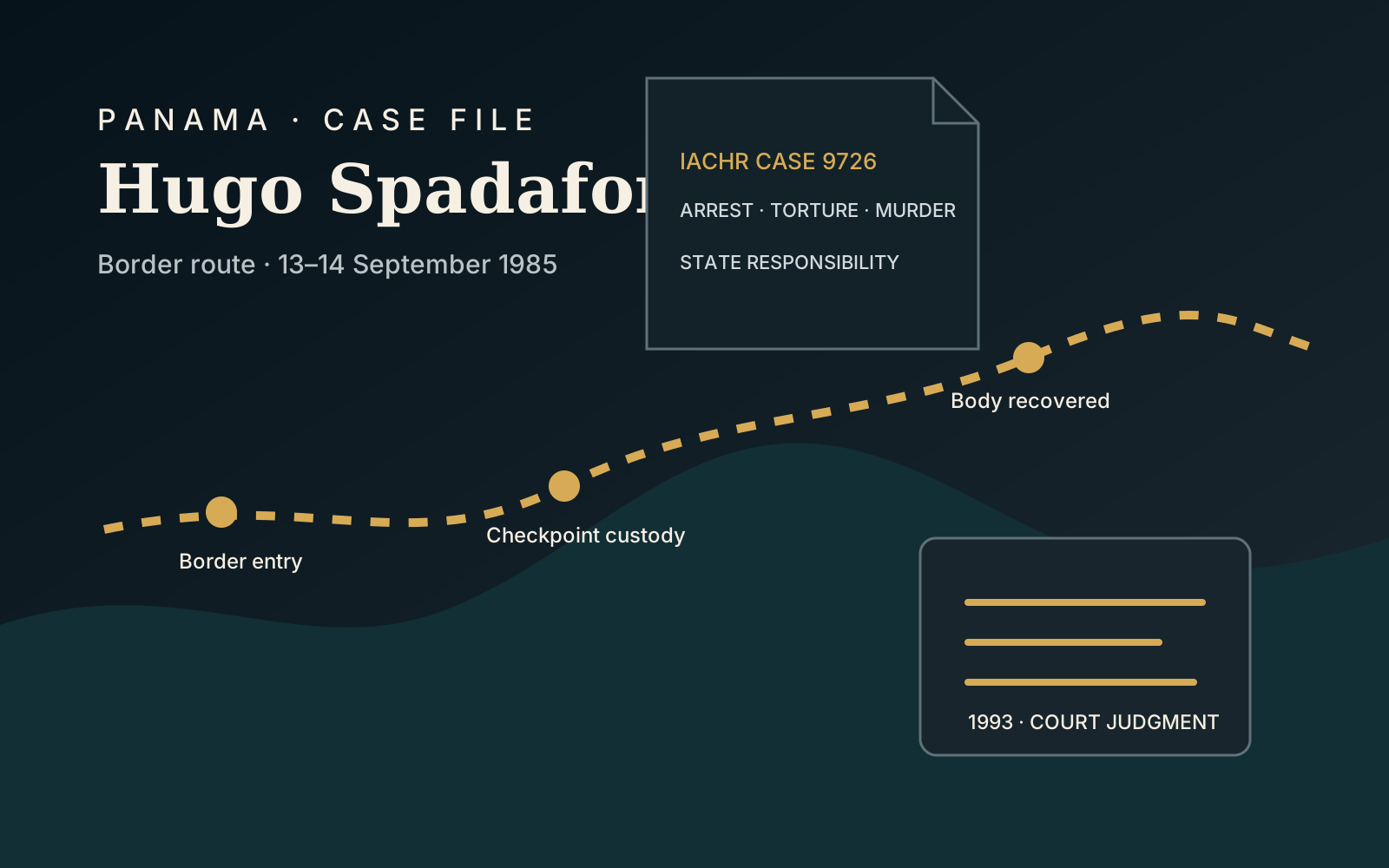
Case-status note: “Solved / adjudicated” refers to the Panamanian murder convictions of Manuel Antonio Noriega, Francisco Eliécer González Bonilla and Julio César Miranda Caballero. Noriega was convicted while imprisoned abroad and later returned to Panama. This label does not imply that every abuse of the military era was prosecuted.
What happened to Hugo Spadafora?
Hugo Spadafora Franco was a physician, a former deputy minister of health and an outspoken critic of Panama's military leadership. On September 13, 1985, he crossed into Panama from Costa Rica. The Inter-American Commission on Human Rights reconstructed his route from witness statements: military personnel temporarily detained him at the Jacú checkpoint and again at La Estrella.
Witnesses said that in Concepción, Francisco Eliécer González Bonilla—also known publicly as “Bruce Lee”—left the bus with Spadafora. That was the last documented sighting of Spadafora alive. On the morning of September 14, his body was found in El Roblito de Laurel, Costa Rica, roughly 200 metres from the Panamanian border.
The Costa Rican autopsy and the inter-American record established that Spadafora had been tortured and killed. This file omits unnecessary graphic detail. The evidentiary point is that the death was a deliberate homicide following custody and surveillance by Panamanian military personnel.
The border journey and disappearance
Spadafora travelled by taxi from the Costa Rican side toward Paso Canoas and then continued by bus through Panama's Chiriquí Province. Multiple passengers and transport workers later described the stops at Jacú and La Estrella. Their statements were central because they placed him in the hands of military agents before he disappeared.
At Concepción, González Bonilla insisted that Spadafora accompany him off the bus. Other evidence reviewed by the Commission included reports of military-type vehicles near the place where the body was recovered. The Commission concluded that the available evidence had not been weighed objectively by Panama's initial investigation.
The person behind the political case
Spadafora was 45. His public life had crossed medicine, government service and regional armed politics, but by 1985 he was best known in Panama as a critic of military power. Those roles explain the political significance of the case; they do not reduce him to a symbol. He was a person whose final movements were witnessed and whose family pursued accountability across national and international institutions.
A compromised initial investigation
The Inter-American Commission received the case after domestic authorities failed to provide an effective response. Its record describes witness testimony, Costa Rican investigative material and autopsy findings, then contrasts those facts with the conclusions reached by Panamanian officials.
In Report 30/87, the Commission found Panama responsible for Spadafora's arbitrary arrest, torture and murder. It concluded that the state had violated protections for life, humane treatment, personal liberty, a fair trial and judicial protection under the American Convention on Human Rights.
The Commission's finding was a determination of state responsibility under international human-rights law. It was not itself a Panamanian criminal conviction of a named individual. The later domestic criminal judgment supplied that separate form of accountability.
The Panamanian convictions
After the military regime ended, the case reached a Panamanian court. The Judicial Branch's later sentence-enforcement notice records that the Superior Court of the Third Judicial District sentenced Manuel Antonio Noriega to 20 years on October 20, 1993 for the crime against Spadafora's life and personal integrity.
Panamanian reporting identifies three men convicted in the homicide case: Noriega, González Bonilla and Julio César Miranda Caballero. Each received a 20-year term. The judgment treated Noriega as the instigator and González Bonilla and Miranda Caballero as the material perpetrators. The Supreme Court's Criminal Chamber affirmed the judgment on December 20, 1995.
Noriega was outside Panama when the domestic judgment was entered. After serving sentences in the United States and France for unrelated offenses, he was extradited to Panama in December 2011 and taken to prison to serve accumulated Panamanian sentences, including the Spadafora term. Amnesty International used his return to call for broader investigation of unresolved abuses from the military era.
What happened to the sentences?
González Bonilla and Miranda Caballero were released after serving their terms, according to Panamanian reporting. Noriega remained under the Spadafora sentence until his death on May 29, 2017. On August 8, 2017, a Chiriquí sentence-enforcement court formally extinguished that sentence because the convicted person had died.
Extinguishing a sentence after death did not vacate the conviction or declare the killing unresolved. The verified legal endpoint remains a homicide judgment against three men, alongside the Commission's separate finding of Panamanian state responsibility.
What remains beyond the verdict?
The murder convictions answered who the court held responsible for Spadafora's death. They did not produce a full public accounting of every officer who participated in surveillance, transport, detention or the obstruction of the first investigation. Nor did they resolve the wider record of disappearances and extrajudicial killings during Panama's military period.
That distinction matters: this individual case is adjudicated, while institutional truth and accountability remain broader historical questions. It would be inaccurate either to call Spadafora's murder wholly unsolved or to suggest that three convictions closed every issue raised by the evidence.
Frequently asked questions
Who was Hugo Spadafora?
A Panamanian physician, former deputy health minister and critic of the military government.
When did he disappear?
He was last seen alive on September 13, 1985 after military checkpoint detentions and a bus journey through Chiriquí.
Who was convicted?
Manuel Antonio Noriega, Francisco Eliécer González Bonilla and Julio César Miranda Caballero each received 20-year terms.
What did the IACHR decide?
It found Panama responsible for Spadafora's arbitrary arrest, torture and murder and related violations of the American Convention.