What the case established
Hissène Habré ruled Chad from 1982 until he was overthrown in December 1990 and went into exile in Senegal. During his government, the Directorate of Documentation and Security, commonly known by its French initials DDS, operated as a political police service. Accounts by survivors, later institutional findings and the DDS's own records described arbitrary detention, torture, deaths in custody, enforced disappearance and campaigns directed against perceived opponents and particular communities.
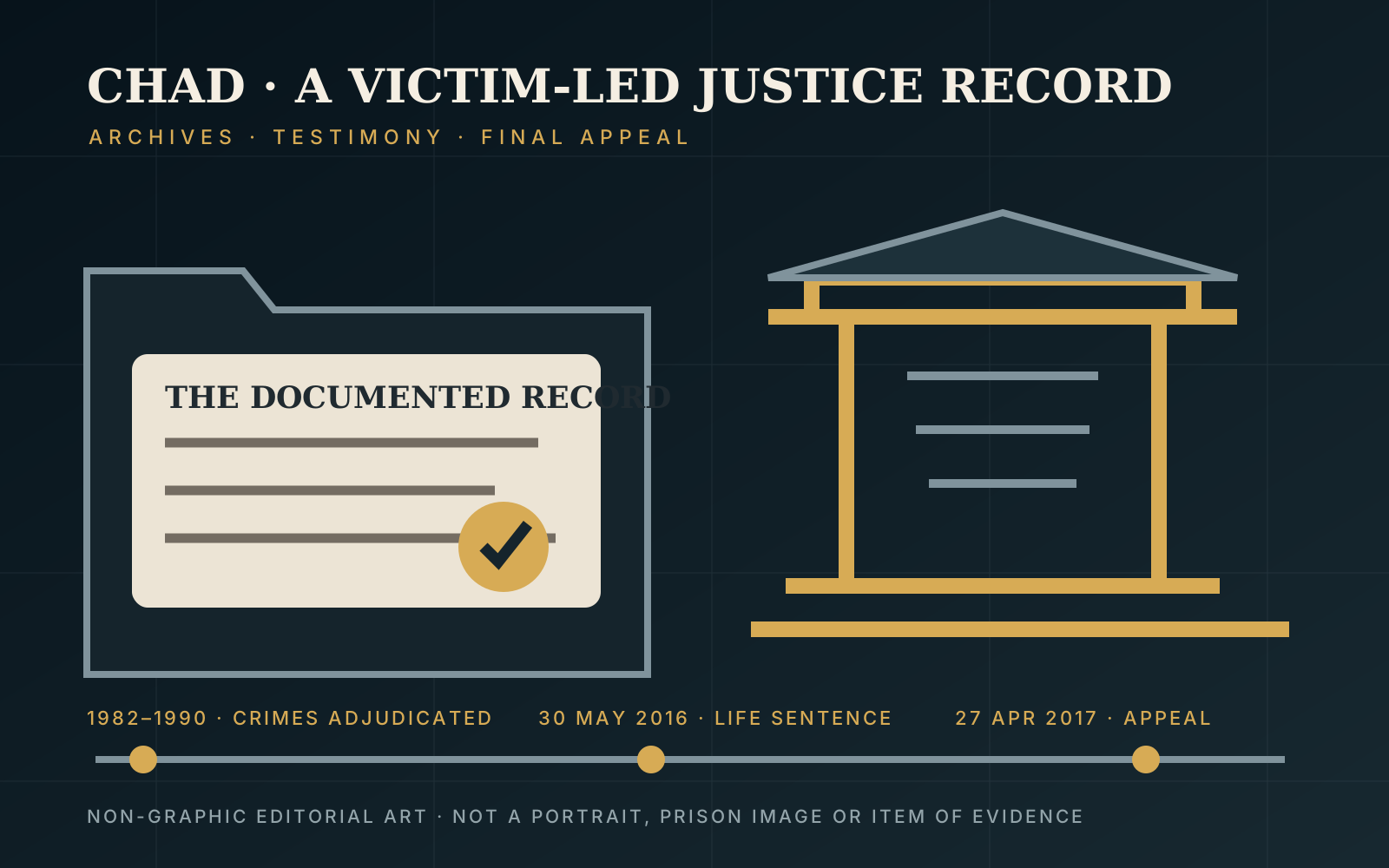
On May 30, 2016, the Extraordinary African Chambers in Dakar convicted Habré of crimes against humanity, war crimes and torture and sentenced him to life imprisonment. Human Rights Watch describes the judgment as including findings concerning sexual violence and rape. The appellate chamber issued its decision on April 27, 2017, confirming the life sentence and the core verdict and ordering approximately €123 million in compensation for victims.
The page does not turn a national commission's estimate into a judicial body count. Amnesty International reported that Chad's National Commission of Enquiry estimated that 40,000 people may have died at the hands of security forces during the Habré period. That is an attributed estimate about a broad system of abuse, not a finding that the Dakar court proved 40,000 individual killings by Habré.
The political-police archive
Physical records mattered because the case was not built only from memory decades after the events. In 2001, Human Rights Watch researchers found tens of thousands of DDS documents in abandoned offices in N'Djamena. The collection included prisoner lists, death records, interrogation and surveillance reports and communications about detainees.
Human Rights Watch's analysis reported that the files named 1,208 people who were killed or died in detention and mentioned 12,321 victims of different forms of abuse. It also reported 1,265 direct communications to Habré concerning 898 detainees. Those figures are important because they identify what the surviving documents themselves contained; they should not be confused with the larger estimate from the national commission or treated as a complete census of everyone harmed.
The records did not replace witnesses. They could corroborate parts of a detention system, show reporting relationships and preserve names that might otherwise have disappeared from the public record. At trial, the prosecution also relied on live testimony and expert evidence. Amnesty International recorded that 69 victims, 23 witnesses and 10 expert witnesses testified during the proceedings.
A case driven by victims
The prosecution did not arise quickly after Habré lost power. Victims and their representatives pursued complaints, evidence and legal remedies through repeated setbacks. Some complainants filed in Senegal in 2000, where Habré lived. Early jurisdictional obstacles blocked that route. Proceedings and petitions then moved through Belgian courts, United Nations mechanisms, the African Union and the International Court of Justice process concerning Senegal's obligation to prosecute or extradite.
That long route matters to the story because describing the result only as a tribunal initiative would erase the people who kept the allegations alive. Survivors gave accounts of detention and torture, families sought information about relatives, lawyers maintained files and organizations helped secure and analyze documents. Human Rights Watch says the eventual trial, 25 years after Habré's fall, resulted from the persistence of victims and their allies.
The delay also had costs. Amnesty International noted when the trial judgment was delivered that two of the victims who had filed the case had died before seeing the verdict. A respectful case history therefore treats the legal milestones as part of a longer struggle rather than as a clean or timely institutional response.
The Extraordinary African Chambers
The Extraordinary African Chambers were created within Senegal's court system after an agreement between Senegal and the African Union. Their mandate focused on the person or persons most responsible for international crimes committed in Chad between June 1982 and December 1990. The court opened Habré's trial in Dakar on July 20, 2015.
This structure explains why the case belongs in a Chad archive even though the courtroom was in Senegal. The conduct under examination occurred in Chad, the victims were primarily Chadian and the accused was Chad's former head of state. Senegal supplied the legal forum where Habré was present and could be tried.
Amnesty International described the proceeding as the first universal-jurisdiction case on the African continent and the first time a former African leader was prosecuted for crimes under international law before the court of another African country. Those descriptions concern the institutional significance of the proceeding. They do not make the process immune from scrutiny, and organizations continued to monitor fair-trial standards, witness protection and cooperation.
The 2016 judgment
On May 30, 2016, the trial chamber found Habré guilty of crimes against humanity, war crimes and torture and imposed life imprisonment. The findings covered a system of repression rather than a single incident. Public summaries by Amnesty International and Human Rights Watch also identify sexual violence as part of the judgment.
The verdict established criminal responsibility in a court, which is why this page does not use “alleged” when describing the offenses for which the judgment stood. At the same time, legal precision requires boundaries. The court adjudicated charges against Habré. A conviction of one leader is not a blanket verdict on every official who served during the period, nor is it proof of each allegation never presented or tested in court.
Reparations formed a distinct part of the process. The eventual appellate decision ordered approximately €123 million in victim compensation. An award on paper and payment in practice are not the same thing, and subsequent reporting continued to track gaps in implementation.
Appeal and finality
On April 27, 2017, the appeals chamber confirmed Habré's life sentence and the core convictions. That decision made the adjudicated outcome final within the Extraordinary African Chambers. The appeals stage also fixed the compensation order described by Human Rights Watch.
Some accounts summarize the appellate judgment as confirming the verdict. More detailed legal reporting notes a procedural change concerning one direct-rape finding while the broader findings on sexual violence by agents remained. To avoid collapsing those distinctions, this page describes the result at the level supported consistently across its sources: the life sentence and core convictions for crimes against humanity, war crimes and torture were confirmed.
Habré remained imprisoned in Senegal and died there in 2021. His death ended the sentence in practical terms; it did not erase the final judgment.
Reparations after the verdict
Compensation remained an incomplete chapter. In March 2024, the International Commission of Jurists reported that victims had begun receiving Chadian government payments totaling 10 billion CFA francs, approximately $16.5 million. It said 10,700 victims, including former prisoners and relatives of people killed, were to receive equal individual payments.
The same report emphasized that the payments were less than the total amounts ordered through the Senegal and Chad proceedings. It also recorded continuing calls for fuller reparations, remembrance and preservation of sites associated with the abuses. These later developments do not change the criminal status; they show that adjudication and repair operate on different timelines.
Verified timeline
- 1982: Hissène Habré takes power in Chad.
- 1982–1990: The period covered by later investigations and the Extraordinary African Chambers mandate.
- December 1990: Habré is overthrown and goes into exile in Senegal.
- 2000: Chadian victims file a criminal complaint against Habré in Senegal.
- 2001: Human Rights Watch researchers recover the DDS document archive in N'Djamena.
- 2012–2013: Senegal and the African Union establish and inaugurate the Extraordinary African Chambers.
- July 20, 2015: Trial opens in Dakar.
- May 30, 2016: Habré is convicted and sentenced to life imprisonment.
- April 27, 2017: Appeals judgment confirms the life sentence and core verdict and orders victim compensation.
- 2021: Habré dies while imprisoned in Senegal.
- March 2024: The International Commission of Jurists reports the start of Chadian government compensation payments to 10,700 victims.
Why Crime by Region marks it solved
The site's status vocabulary distinguishes suspicion, charge, trial judgment and final appellate outcome. Habré was not merely accused or arrested. A trial chamber convicted him, sentenced him to life and an appellate chamber confirmed the central outcome. “Solved / adjudicated” is therefore appropriate for his individual case.
The qualifier matters. The same archive may later document a separate unresolved disappearance, an unprosecuted official or an incomplete reparation process under another status. This page must not absorb all Habré-era suffering into a single solved label. The historical period is broader than the prosecution.
Frequently asked questions
Who was Hissène Habré?
He was president of Chad from 1982 until his overthrow in 1990, after which he lived in Senegal.
What crimes was he convicted of?
The Extraordinary African Chambers convicted him of crimes against humanity, war crimes and torture, with findings that included sexual violence, and sentenced him to life imprisonment.
When did the trial begin?
The trial opened in Dakar on July 20, 2015.
What happened on appeal?
On April 27, 2017, the appeals chamber confirmed the life sentence and core verdict and ordered approximately €123 million in victim compensation.
Is every Habré-era crime solved?
No. The status applies only to Habré's adjudicated individual responsibility. Other victims, incidents and alleged perpetrators may remain outside that judgment.
Were reparations paid?
Implementation was incomplete. The International Commission of Jurists reported in March 2024 that Chadian government payments totaling 10 billion CFA francs had begun for 10,700 victims, while broader compensation orders remained outstanding.
Sources and source-quality review
- Amnesty International — Hissène Habré verdictMay 30, 2016 · trial dates, witness totals, offenses, sentence and attributed National Commission estimate.
- Human Rights Watch — The Trial of Hissène HabréDecember 5, 2017 · conviction, life sentence, appellate confirmation and compensation order.
- Human Rights Watch — Background and DDS archiveRecovered political-police records, documented victim figures, communications and early Senegal proceedings.
- Human Rights Watch — Enabling a DictatorJune 28, 2016 · court mandate, historical context and archive-based methodology.
- International Commission of Jurists — Victim paymentsMarch 5, 2024 · compensation implementation, recipient count and continuing reparation gaps.
Editorial review: facts were cross-checked across a verdict-era account, a post-appeal account, archive documentation and a later reparation update. Numerical claims retain their source and scope. The page avoids graphic details and does not turn estimates into court-proven counts.