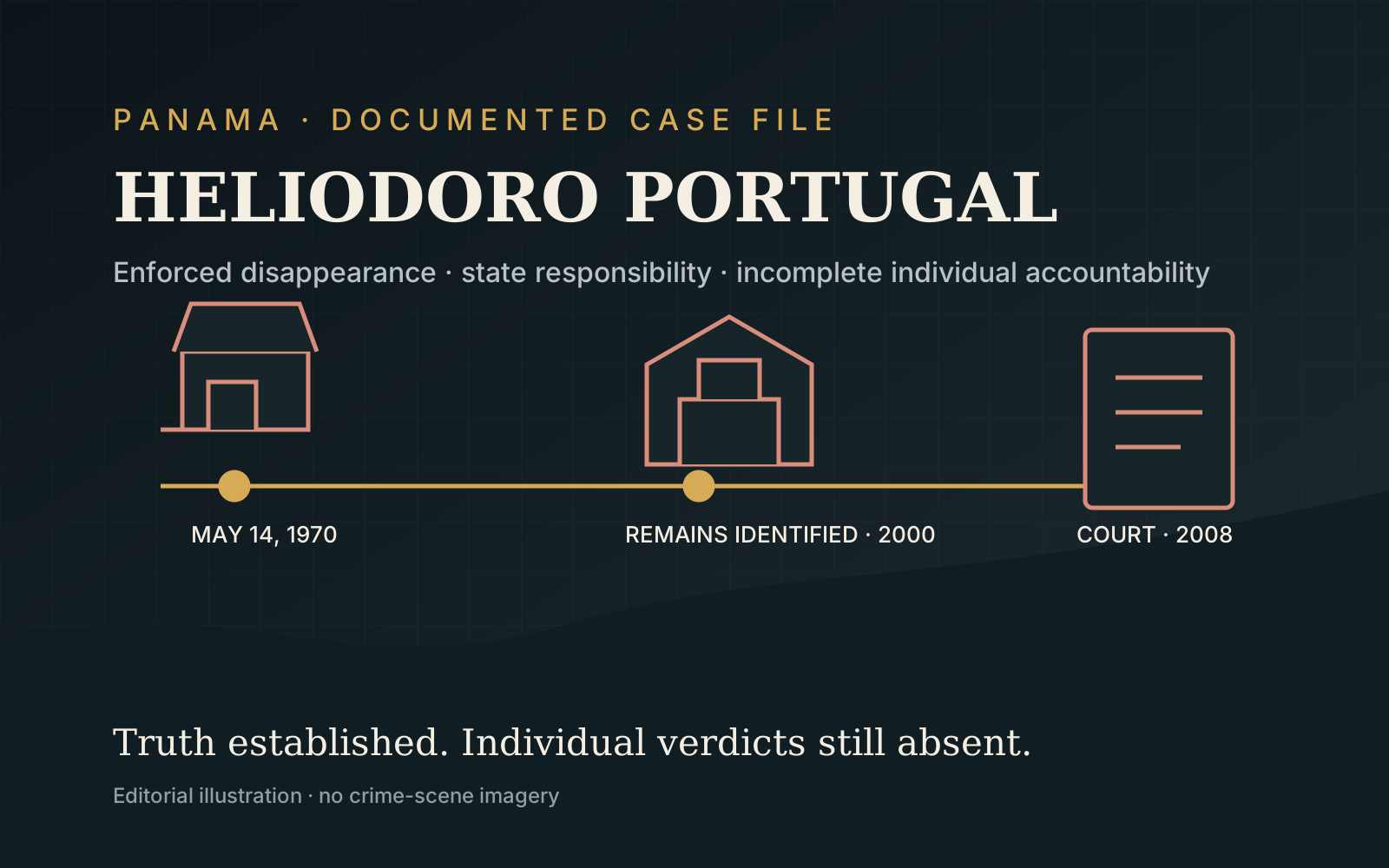
Case-status note: The Inter-American Court of Human Rights established Panama's international responsibility in 2008. That judgment is not an individual criminal conviction. Although Panamanian proceedings named and brought former military personnel toward trial, no reliable final perpetrator conviction was located in the reviewed record.
What happened to Heliodoro Portugal?
Heliodoro Portugal was a labor activist associated with the Movimiento de Unidad Revolucionaria. On May 14, 1970, he was at the Café Coca-Cola in Panama City when men in civilian clothing approached. The Inter-American Court's factual findings say the men were members of Panama's National Guard. They forced Portugal into a vehicle and drove away.
The seizure occurred during the military government that began after the 1968 coup. Portugal did not reappear, and the authorities did not provide his family with an explanation. For nearly thirty years, his whereabouts remained unknown. The disappearance was not a momentary detention followed by an openly recorded death: it combined a deprivation of liberty, concealment and the state's failure to acknowledge what had happened.
A family forced to search after dictatorship
Portugal's daughter, Patria Portugal, filed a criminal complaint in May 1990, after democratic government returned. The delay cannot fairly be treated as indifference by the family. The inter-American record describes conditions under military rule in which victims' relatives could not safely or effectively pursue complaints about state abuses.
The first domestic investigation was repeatedly stalled. The Inter-American Court later examined long periods of inactivity, contradictory forensic steps and the absence of an effective judicial result. It concluded that the delays harmed Portugal's companion, Graciela de León, and his children Patria and Franklin Portugal, who endured years of uncertainty while seeking truth and justice.
The Tocumen barracks discovery
In September 1999, human remains were found at a former military installation in Tocumen. Initial testing indicated that they belonged to Heliodoro Portugal. A later official examination disputed that conclusion, but an additional analysis requested through Panama's Truth Commission again identified the remains as his. The Court treated the identification as established and held that the enforced disappearance ended in 2000, when the family finally learned the fate of the missing man.
The recovery location mattered. Portugal had vanished after state agents seized him, and his remains were found inside grounds used by the security apparatus. The Court also evaluated evidence about torture and the killing, while avoiding the assumption that identification of the remains automatically identified every person who ordered, carried out or concealed the crime.
The 2008 inter-American judgment
On August 12, 2008, the Inter-American Court of Human Rights issued its judgment in Heliodoro Portugal v. Panama. It held the state responsible for violations tied to his enforced disappearance and for failures affecting his relatives' rights to a fair hearing and judicial protection. The Court also found breaches of the Inter-American conventions on forced disappearance and torture.
The decision addressed an important legal distinction. Enforced disappearance is a continuing violation while the state conceals the person's fate or whereabouts. Although Portugal was taken before Panama accepted the Court's jurisdiction, the concealment and failure to investigate continued afterward. The Court therefore could examine the continuing violation and Panama's later investigative obligations.
The judgment ordered Panama to investigate effectively, identify and, where appropriate, punish those responsible. It also ordered reparations, public acknowledgment, medical and psychological assistance for the family, and changes to domestic law. The judgment supplied authoritative findings about state responsibility; it did not declare any named former officer criminally guilty.
The domestic criminal proceedings
In April 2010, the Second Superior Court of Panama's First Judicial District called eight former military personnel to trial. CEJIL reported that the defendants included Melbourne Walker, Manuel Antonio Noriega, Moisés Correa and Aquilino Sieiro, among others. Being called to trial meant that the court found a basis to continue the case; it did not establish guilt.
Later reporting described a planned 2015 trial of Noriega, but his declining health and eventual death in 2017 prevented a final judgment against him in this case. The Court's 2017 compliance review still treated the obligation to investigate, prosecute and, if appropriate, punish as outstanding. The reviewed sources do not establish that the proceedings ended in a final conviction of any other defendant.
This file therefore uses “unsolved / partial accountability.” Panama's responsibility has been adjudicated internationally, and the victim's fate is known, but individual criminal responsibility remains incomplete in the accessible record. The label neither erases the Court's findings nor converts accusation into conviction.
What Panama completed—and what remained open
Compliance with the inter-American judgment has unfolded in parts. Panama held a public act acknowledging responsibility and paid ordered compensation. The Court also monitored legislative reforms and services owed to the family. Other measures, especially a criminal process capable of determining individual responsibility, remained under supervision.
That continuing oversight shows why a single word such as “closed” would be misleading. The disappearance was conclusively attributed to the state for international-law purposes, yet the question of which individuals bear criminal liability was not resolved by a final judgment found during this review.
Questions still without a final answer
The surviving public record does not provide a final criminal account of who ordered Portugal's seizure, who transported and held him, who caused his death, or who participated in concealing the remains and obstructing the investigation. Some former officers were formally accused, but accusation is not proof of guilt.
The family's decades-long effort did establish central truths: Portugal was taken by state agents, he did not voluntarily disappear, his remains were eventually identified, and Panama failed for years to investigate effectively. What remains missing is the complete individual accountability that the 2008 judgment required.
Frequently asked questions
Who was Heliodoro Portugal?
A Panamanian labor activist and promoter of the Movimiento de Unidad Revolucionaria.
When was he seized?
On May 14, 1970, at the Café Coca-Cola in Panama City.
Where were his remains found?
At a former military barracks in Tocumen in 1999; the identification was resolved in 2000.
Did the Inter-American Court convict anyone?
No. It adjudicated Panama's international responsibility. Individual criminal guilt required separate domestic proceedings.
Why is the case listed as unsolved?
Because no reliable final individual criminal conviction for the disappearance and killing was located, despite the authoritative state-responsibility judgment.