What happened?
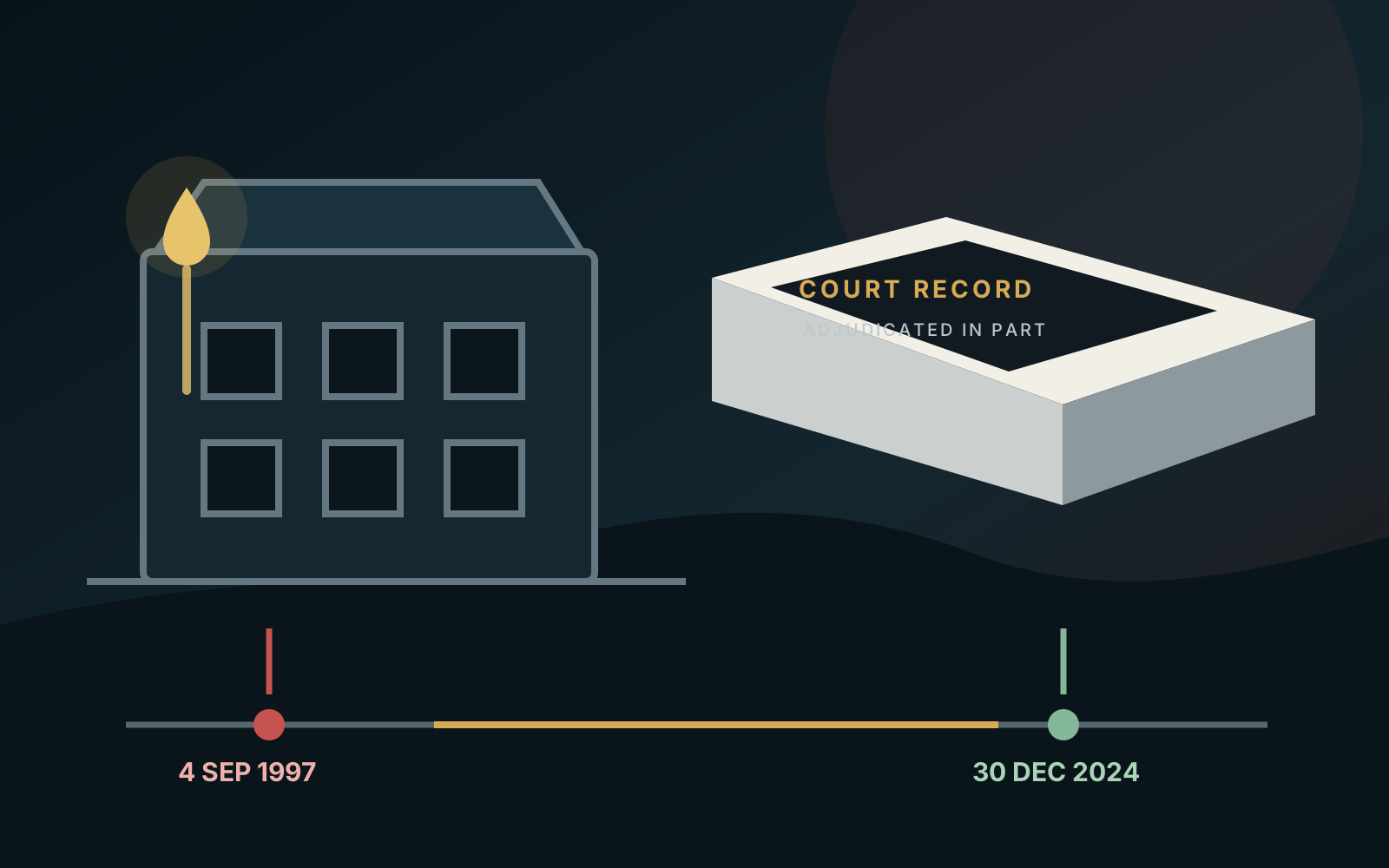
In 1997, explosive devices were placed at hotels and other tourism-related sites in Cuba. The attacks formed part of a campaign intended to frighten visitors and damage an industry that had become economically important to the island. On 4 September, a bomb exploded at the Hotel Copacabana in Havana and killed Fabio di Celmo, an Italian national. Other people were injured during the wider series of attacks.
The historical record is politically charged. Cuban authorities described the incidents as externally organized terrorism; reporting and later legal proceedings linked Central American operatives to the attacks and identified Cuban exile militant Luis Posada Carriles as an alleged organizer. A careful case file must distinguish three different categories: conduct admitted or established against the people convicted in Cuba; allegations about higher-level direction; and later United States proceedings that concerned false statements and immigration matters rather than a prosecution for the bombings themselves.
Fabio di Celmo and the human cost
Fabio di Celmo was not a political or military participant. He was visiting Cuba when the Hotel Copacabana device exploded. Contemporary and later accounts consistently identify him as the person killed in the September 1997 blast. Reducing the case to Cold War politics would obscure that a civilian lost his life and that other people were injured.
The archive therefore avoids graphic reconstruction and does not use his death as decoration. The relevant facts are the location, the date, the deliberate placement of an explosive device in a public hotel and the consequences for people who had no control over the political conflict invoked by those responsible.
Raúl Ernesto Cruz León’s prosecution
Cruz León, a Salvadoran national, was detained in September 1997. Amnesty International’s contemporaneous urgent actions reported that he was charged with carrying out bomb attacks against several Havana hotels and a restaurant. A Cuban court sentenced him to death in March 1999 on terrorism charges.
Recording that judgment does not settle every question about the process. Amnesty opposed the death penalty in all circumstances and raised broader concerns about fair-trial safeguards in Cuba, including access to an effective defence. Those concerns belong in the record because procedural quality and punishment are separate from the fact that a judgment was entered.
In December 2010, Cruz León’s death sentence was commuted to 30 years in prison. Reuters reported at the same time that the death sentence of another Salvadoran convicted in the bombing cases, Otto René Rodríguez Llerena, was also commuted. The decision removed the immediate risk of execution but did not erase the convictions.
On 30 December 2024, Cuban authorities reported that Cruz León had been released after completing the commuted sentence. Associated Press coverage noted that the release followed the 30-year term and explained the sentence-credit rule cited by Cuban authorities. Release after a completed sentence is not an acquittal, exoneration or reversal of the judgment.
Other defendants and the limits of the record
Francisco Chávez Abarca
A Havana court convicted Salvadoran national Francisco Chávez Abarca of terrorism in December 2010 and sentenced him to 30 years. Reuters reported that the two-day trial included testimony from Central Americans said to have been recruited for the attacks. His conviction is evidence of another adjudicated participant, but it does not automatically prove every assertion made by state media about the wider network.
Otto René Rodríguez Llerena
Amnesty International documented Rodríguez Llerena’s 1999 death sentence after he pleaded guilty to trying to bring explosives into Cuba and to planting a bomb at a Cuban hotel in August 1997. His sentence was later commuted to 30 years. His proceeding is distinct from Cruz León’s and should not be merged into one generic conviction.
Luis Posada Carriles
Declassified records and the United States case against Posada are important context, but the legal boundary is clear. The National Security Archive documents that U.S. prosecutors charged him with immigration fraud and perjury connected to denials about his role in the 1997 bombings. He was not prosecuted in that case for committing the Havana attacks themselves, and the 2011 jury acquittal on the false-statement charges was not a verdict deciding who planned the bombing campaign.
Reliable news accounts describe Posada as an alleged organizer and report statements attributed to him about the attacks. Because no completed bombing prosecution established his criminal responsibility, this page does not label him a convicted mastermind.
Verified timeline
- 1997 — A series of bombs targets Cuban hotels and other tourism-related sites.
- 4 September 1997 — An explosion at Havana’s Hotel Copacabana kills Fabio di Celmo.
- 12 September 1997 — Cruz León is arrested in Havana, according to a Cuban submission later circulated at the United Nations.
- 23 March 1999 — Amnesty International records Cruz León’s death sentence after his terrorism trial.
- December 2010 — Cuban authorities commute the death sentences of Cruz León and Rodríguez Llerena to 30 years. A separate Havana court convicts Chávez Abarca and imposes a 30-year sentence.
- 2011 — Posada is tried and acquitted in the United States on immigration and false-statement charges. The proceeding is not a bombing trial.
- 30 December 2024 — Cuba reports Cruz León’s release after completion of the commuted sentence.
What the sources establish
Strongly established
- A deliberate bombing at the Hotel Copacabana killed Fabio di Celmo on 4 September 1997.
- Cruz León was tried, convicted and sentenced to death in Cuba in 1999.
- His sentence was commuted to 30 years in 2010.
- Cuban authorities released him in December 2024 after treating the prison term as completed.
- Other participants, including Rodríguez Llerena and Chávez Abarca, also received Cuban criminal judgments connected to the bombing campaign.
Not fully adjudicated
- The complete command, financing and recruitment structure behind every 1997 device.
- Criminal responsibility of alleged organizers who were not tried for the bombings.
- Every claim made by opposing governments or political groups about intelligence connections and sponsorship.
A reported confession, a government accusation, a declassified background file and a criminal conviction are different forms of evidence. This page does not collapse them into a single level of proof.
Why “adjudicated in part” is the accurate status
Calling the entire matter “unsolved” would ignore final convictions and a completed sentence. Calling it completely solved would imply that the full alleged organization of the campaign was established in court. Neither description is precise enough.
The archive therefore uses Solved / adjudicated in part. That label answers two separate questions: yes, courts identified and punished specific participants; no, the broader responsibility alleged by Cuban officials and reported in international coverage was not comprehensively tested in a completed criminal case.
The status also avoids a common error in true-crime summaries: treating Posada’s U.S. acquittal on perjury and immigration charges as though it were an acquittal for the bombings. The elements, jurisdiction and conduct charged were different.
Trial fairness and death-penalty context
Amnesty International’s urgent actions are significant for two reasons. First, they independently date the charges, judgments and death sentences. Second, they preserve criticism of a punishment and judicial environment that cannot be omitted merely because the archive records the convictions.
A source-led account can recognize the death of Fabio di Celmo, the criminal judgments against bombers and the rights of defendants at the same time. Opposition to execution does not minimize the attack; documenting the attack does not require accepting every aspect of the prosecution uncritically.
Sources and verification
- Associated Press — Cruz León released after completing the commuted sentencePublished 31 December 2024; current procedural endpoint and distinction between convicted operative and alleged planners.
- Reuters — Chávez Abarca conviction and 2010 commutationsPublished 22 December 2010; trial outcome, sentence and related defendants.
- Amnesty International — 1999 death-penalty urgent actionContemporaneous documentation of Cruz León and Rodríguez Llerena’s sentences and fair-trial concerns.
- Amnesty International — Cruz León sentence recordRecords the March 1999 sentence and the charges involving hotels and a restaurant in Havana.
- United Nations Digital Library — General Assembly document A/53/970A Cuban state submission used for the arrest chronology; treated as an attributed government record, not neutral adjudication.
- National Security Archive — CIA file and U.S. Posada proceedingsDeclassified-document context and the scope of the later U.S. false-statement case.
Frequently asked questions
What happened in the 1997 Havana hotel bombings?
Bombs were placed at Cuban hotels and other tourism-related sites during a campaign intended to frighten visitors. Italian national Fabio di Celmo was killed at the Hotel Copacabana, and other people were injured.
Who was Raúl Ernesto Cruz León?
He was a Salvadoran national convicted in Cuba of terrorism for carrying out bomb attacks against hotels and a restaurant in Havana.
What sentence did Cruz León receive?
A Cuban court sentenced him to death in March 1999. The sentence was commuted to 30 years in prison in December 2010.
When was Cruz León released?
Cuban authorities reported that he was released on 30 December 2024 after completing the commuted prison sentence.
Why is the case classified as adjudicated in part?
Cuban courts convicted Cruz León and other participants, but allegations about higher-level organization and financing were not fully resolved through a completed criminal trial.
Was Luis Posada Carriles convicted for the Havana bombings?
No. He faced a United States trial involving immigration and perjury allegations connected to statements about the bombings, but he was not tried or convicted there for carrying out the attacks.