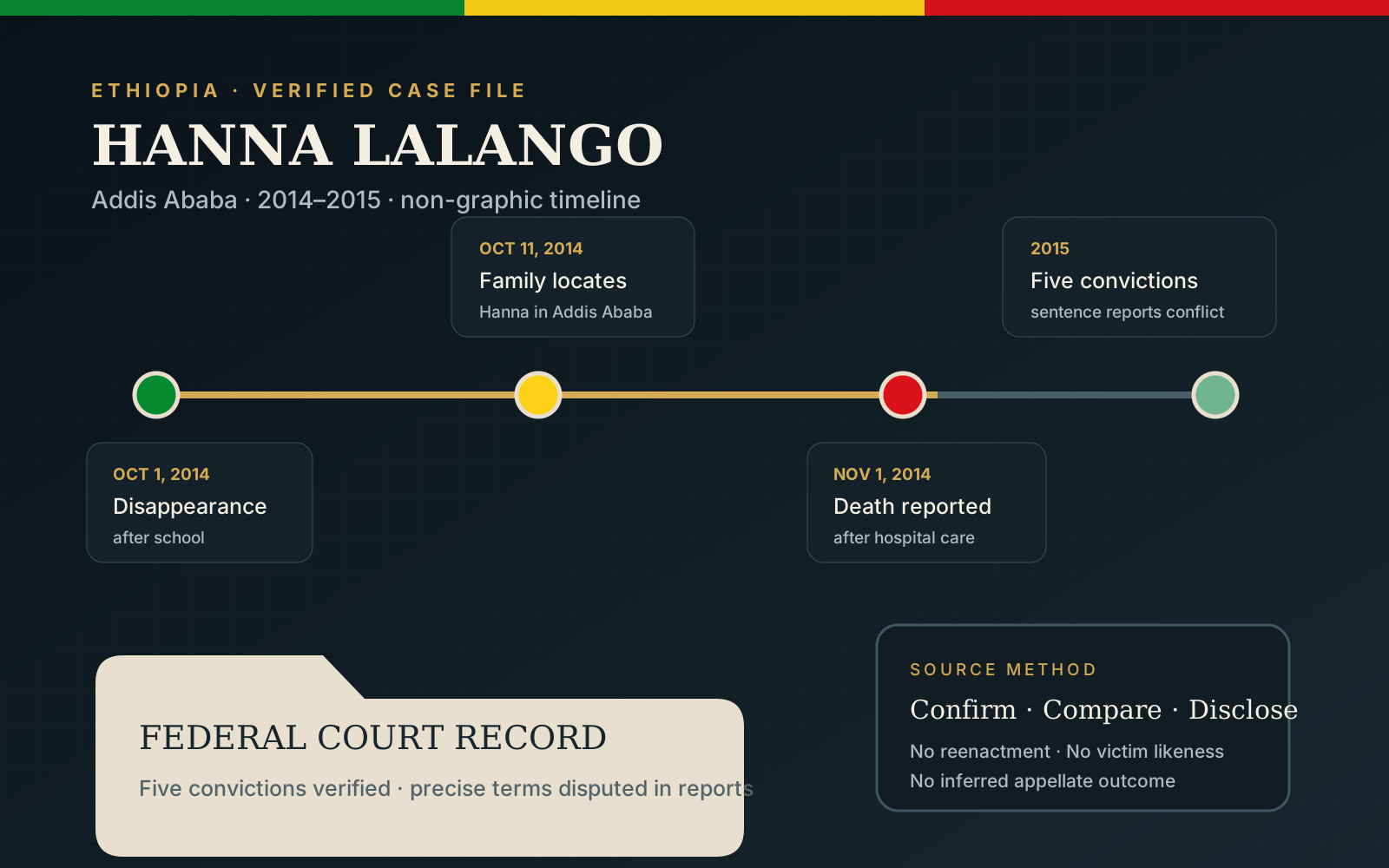
Case-status note: “Solved / adjudicated” reflects five reported convictions. It does not resolve the disagreement between public sentencing reports or assume an appellate outcome that could not be verified.
Hanna Lalango
Hanna Lalango was a 16-year-old student living with her family in Addis Ababa. Contemporary reporting described her as a diligent teenager who hoped to become a doctor. Those details matter because the case is first the story of a young person whose future was taken from her, not simply an entry in a criminal archive.
Her case later became nationally recognized through the Justice for Hanna campaign. Activists used it to call attention to sexual violence, victim blaming, gaps in public data and the constraints faced by organizations working on women's rights. This page includes that response as documented aftermath, without turning Hanna into a symbol detached from her family and life.
October 1: disappearance after school
Reports place Hanna's disappearance on October 1, 2014. She had left school and boarded a shared vehicle or public minibus for the journey home. She did not arrive at the expected time, and her family reported her missing and began searching.
VICE reported that people holding Hanna contacted her sisters and proposed a meeting connected to her release. The sisters were asked to enter a vehicle and refused. This detail comes from contemporary reporting; the page does not reconstruct dialogue or movements beyond what those reports document.
Al Jazeera later interviewed Hanna's family, medical staff and activists. Its account described the ordinary morning before she left for school, her father's wait for her return and the family's attempts to find her. These accounts establish the timeline without requiring graphic description of the violence she endured.
Recovery and hospital treatment
VICE reported that Hanna was found on October 11 in the Kolfe Keraneo area of western Addis Ababa after she contacted her father. Al Jazeera described the family locating her outside a church after a call eleven days after the disappearance. Both reports agree that she had been abandoned after being held and subjected to repeated sexual violence.
Her family took her for medical care, and she was transferred between facilities before receiving treatment at Zewditu Hospital. Al Jazeera interviewed a surgeon who said she arrived very late with serious injuries and infection. This archive does not reproduce graphic clinical detail because it is unnecessary to understand either the crime or the investigation.
Hanna died on November 1, 2014. The date is reported consistently by VICE and Al Jazeera. Her death transformed an already serious abduction and assault investigation into a case involving fatal violence.
Identification and investigation
While hospitalized, Hanna reportedly gave her family and investigators an account of what had happened. Al Jazeera and VICE reported that she identified three suspects. Investigators subsequently detained five men in connection with the case.
A victim's reported identification is part of the evidentiary history, but a conviction requires a court outcome. The distinction is important: this page does not label anyone guilty merely because of an arrest, accusation or identification. The solved classification rests on the later convictions reported by multiple outlets.
VICE reported that trial proceedings against five defendants began on December 1, 2014. Its contemporary account also noted restrictions on public access to the proceeding. Because a full public trial judgment was not located in this review, the archive does not add unverified testimony, forensic findings or alleged admissions.
Justice for Hanna and public attention
The case generated the Justice for Hanna campaign and the hashtag #JusticeForHanna. Activists connected Hanna's experience to wider problems of gender-based violence, underreporting, stigma and limited support for survivors. VICE documented calls for sustained reporting and stronger institutions rather than sensational coverage.
The Guardian reported in January 2015 that five men had been convicted and were awaiting sentence. Its article focused on women-led activism in Ethiopia and described the case as one of several incidents galvanizing public discussion. It also recorded activists' concern that routine harassment and victim blaming could create an environment in which more serious abuse was minimized.
Public impact should not be confused with the legal elements of a particular charge. The campaign's importance lies in the documented response to Hanna's death and the effort to support broader change. It does not alter the evidence standard used to describe the convictions.
Five convictions in 2015
By January 27, 2015, The Guardian reported that all five defendants had been convicted and were awaiting sentencing. A later Addis Standard court report, republished by Borkena on May 22, said the Third Criminal Bench of the Lideta Federal High Court sentenced five people found guilty in the case.
VOA Amharic published its own sentencing report on May 24, 2015. The two later reports agree on the core result: five defendants received prison sentences after the federal court proceeding. That agreement supports classifying the case as solved or adjudicated at trial level.
The available reports do not establish that every later procedural question ended in 2015. No reliable public final appellate judgment was located in English or in the indexed sources reviewed through September 13, 2026. The page therefore avoids phrases such as “all appeals exhausted.”
A documented conflict in the sentence record
The precise sentences cannot be presented as a single uncontested set. VOA Amharic reported terms of 20 years for the first two defendants and terms of 17, 20 and 18 years for the remaining three. Its text describes a sentencing range of 17 to 20 years.
The Addis Standard report republished by Borkena described two life sentences without parole and three fixed terms of 17, 20 and 28 years. That differs materially from VOA on both the first two sentences and the final fixed term.
Without the underlying judgment, an official correction or a reliable later decision resolving the discrepancy, selecting one report would create false certainty. This case file therefore states only what the sources support together—five convictions and custodial sentences—and displays the conflict whenever sentence length is discussed.
What the public record does not establish
The source search found no reliable public final appellate ruling tied to these five convictions. Absence from an online search is not proof that no appeal occurred. It means only that this archive cannot responsibly claim an appeal result.
The distinction between an adjudicated trial outcome and a fully traced appellate history is built into the page's status language. Future documentation could clarify the sentences or later proceedings; if so, the file should be updated with the new source and a dated revision note.
Why the case remains significant
Hanna's case brought sustained attention to violence against women and girls in Ethiopia. The response documented by Al Jazeera, VICE and The Guardian included public campaigning, discussion of victim blaming and demands for institutional reform.
Responsible coverage requires restraint. It should name the harm without reproducing graphic details, preserve Hanna's identity beyond the violence, distinguish advocacy claims from court findings and acknowledge gaps in the available record. That method is especially important when a victim was a child.
The five convictions are a verified legal outcome. The conflicting sentencing accounts are also part of the record. Publishing both is not indecision; it is the most accurate description possible with the sources currently available.
Frequently asked questions
Who was Hanna Lalango?
Hanna Lalango was a 16-year-old student in Addis Ababa. Her 2014 abduction, sexual assault and death became the focus of the Justice for Hanna campaign.
When was Hanna Lalango abducted?
Contemporary reports place her abduction on October 1, 2014, after she boarded public transport while returning from school.
When was she found and when did she die?
VICE reported that her family found her on October 11, 2014. She received treatment at several hospitals and died on November 1.
How many defendants were convicted?
Five defendants were convicted in the Ethiopian federal court proceedings. The Guardian reported the convictions in January 2015, before sentencing.
What sentences did the court impose?
Public reports conflict. VOA Amharic reported terms of 17 to 20 years, while an Addis Standard report republished by Borkena described two life terms and three fixed terms. The underlying judgment was not located, so this page preserves the discrepancy.
Is the case solved?
The archive classifies it as solved or adjudicated because five convictions are documented. No reliable public final appellate decision was located in the review completed September 13, 2026.