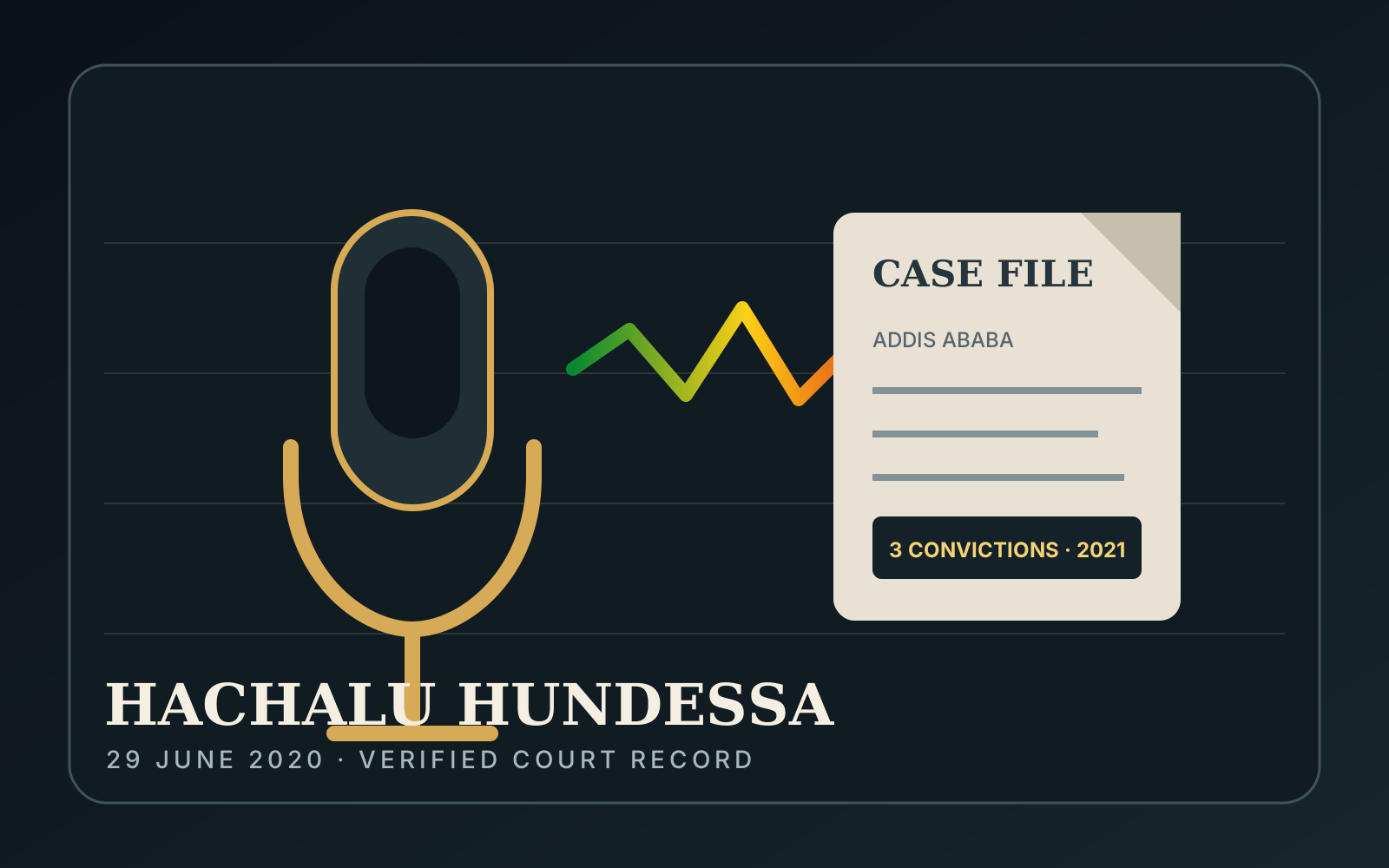
Case-status note: “Solved / adjudicated” refers to three verified convictions. It does not mean that every person involved was identified, that every prosecution theory was independently proven, or that Hachalu's family accepts the official account as complete.
A singer identified with Oromo protest
Hachalu Hundessa—whose name is also transliterated as Haacaaluu Hundeessaa—was an Ethiopian singer and songwriter from Ambo. His music addressed Oromo identity, historical dispossession and political exclusion. Human Rights Watch described his songs as capturing the struggles and frustrations that animated Ethiopia's 2014–2018 anti-government protest movement.
That public role made his killing nationally consequential, but it does not by itself establish why he was targeted. Responsible documentation must separate Hachalu's political importance from a proven criminal motive. The sources establish the shooting and later court outcomes; competing political narratives extend beyond what the public judgment record available to this archive can resolve.
The night of June 29, 2020
Hachalu was shot in Addis Ababa on the evening of June 29, 2020. Reports place the attack in the Gelan Condominiums area. He was taken to Tirunesh Beijing General Hospital, where he died. Early reporting described the assailants as unidentified, reflecting the state of the evidence before arrests and charges.
The killing triggered immediate grief and anger. Demonstrations and wider violence followed in Addis Ababa and across Oromia. Those later deaths and abuses are not counted as separate victims of Hachalu's murder on this page. They form an important aftermath with distinct perpetrators, evidence and questions of responsibility.
Unrest, deaths and an information blackout
Authorities cut internet access as protests spread. Human Rights Watch warned that the shutdown made independent verification harder and called on security forces to avoid excessive force. Initial public death tolls changed rapidly as reports emerged from different places.
The Ethiopian Human Rights Commission later investigated the violence from June 29 through July 2 in 40 localities. It documented 123 deaths, at least 500 physical injuries and thousands of displaced people in the areas it reviewed. The commission attributed deaths and injuries to individuals and groups participating in the unrest, government security forces, and other causes. Its findings show why the aftermath cannot responsibly be reduced to a single undifferentiated number or a single alleged actor.
Arrests and the government's allegation
On July 10, 2020, Ethiopia's attorney general announced the arrest of two men described as the suspected attacker and an accomplice, while saying a third suspect remained at large. The government alleged that the attack had been ordered by an anti-government organization.
At that point the arrested men had not yet been charged. The distinction matters: an official allegation is not a verdict. This archive records it as the prosecution's public theory, not as an independently established fact and not as a basis for assigning criminal guilt to a wider political movement.
The federal court case
The case proceeded before the Federal High Court's Lideta branch. In July 2021, the court found three defendants—Tilahun Yami, Kebede Gemechu and Abdi Alemayehu—guilty of different offenses connected to Hachalu's killing. Contemporary court reporting distinguishes the counts rather than treating all three defendants as having the same role.
Tilahun Yami was convicted under Ethiopia's anti-terrorism law in connection with the fatal shooting. Reporting on Kebede Gemechu and Abdi Alemayehu refers to separate Penal Code offenses. That difference is preserved because “convicted in the case” does not mean identical criminal conduct or identical proof.
Sentences on August 3, 2021
The court imposed sentence on August 3, 2021. Ethiopian Monitor and Addis Standard reported that Tilahun Yami received life imprisonment. Kebede Gemechu received 18 years of rigorous imprisonment, while Abdi Alemayehu received six months.
These sentences are the verified basis for the solved or adjudicated classification. The page does not equate a life sentence with execution, does not assume that no appeal was filed, and does not claim that later review was exhausted. A reliable public final appellate decision was not located during the source review completed September 13, 2026.
What the convictions do—and do not—settle
The verdicts establish a trial-level legal outcome for three defendants. They do not automatically prove every public statement made during the investigation. Nor do they establish that every possible organizer, motive or participant was identified.
In reporting published around the sixth anniversary of the killing, Hachalu's widow, Fantu Demisse, continued to ask for the complete truth behind the assassination. That position does not erase the convictions. It demonstrates the difference between a court's findings against named defendants and a family's broader questions about whether the full architecture of a crime has been uncovered.
Current status
This archive records the case as solved or adjudicated because three convictions and custodial sentences are documented. The status is deliberately qualified: the accessible record does not support a claim that every avenue of responsibility is closed.
No unverified suspect is labeled a murderer here. No political organization is assigned criminal responsibility beyond the government's stated allegation. If a final appellate ruling or new prosecution becomes publicly available, the case file should be revised with the decision date and source.
Why the case remains significant
Hachalu's death removed a distinctive artistic voice and opened one of the most volatile episodes in Ethiopia's recent history. Its significance lies both in the individual loss and in the scale of the reaction, including documented killings, injuries, displacement, arrests and restrictions on information.
A victim-aware account keeps Hachalu at the center without using the unrest as spectacle. It also resists false certainty: the 2021 sentences are facts; wider claims about direction and motive remain bounded by the evidence and by the limits of the public record.
Frequently asked questions
Who was Hachalu Hundessa?
Hachalu Hundessa, also written Haacaaluu Hundeessaa, was an Ethiopian Oromo singer whose music became closely associated with the Oromo protest movement.
When was he killed?
He was shot in Addis Ababa on June 29, 2020, and died after being taken to Tirunesh Beijing General Hospital.
Who was convicted?
In 2021, a federal court convicted Tilahun Yami, Kebede Gemechu and Abdi Alemayehu on different offenses connected to the case.
What sentences were imposed?
Reports state that Tilahun Yami received life imprisonment, Kebede Gemechu 18 years and Abdi Alemayehu six months.
Is every question resolved?
No. The convictions are a verified trial outcome, but later reporting records that Hachalu's widow continues to question whether the complete truth and wider responsibility were established.