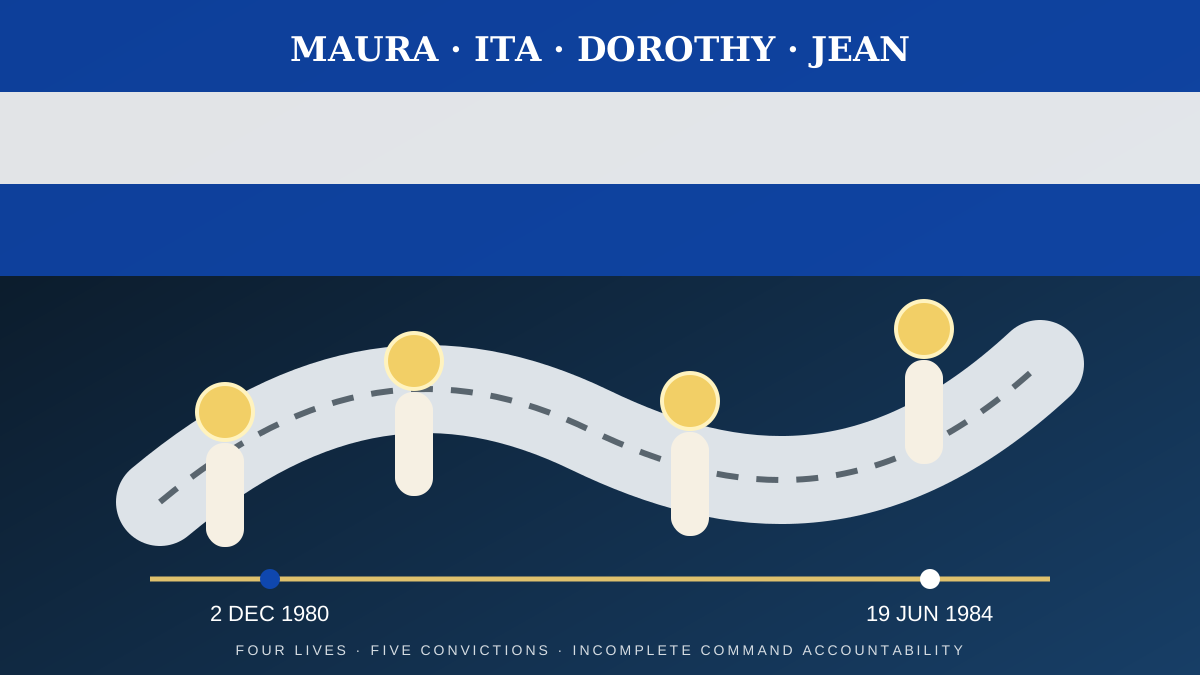
Case-status note: “Solved / partial” reflects the Salvadoran convictions of five National Guardsmen for the murders. It does not imply that alleged orders, command responsibility or obstruction by higher officials received equivalent final criminal judgments.
What happened to the four churchwomen?
Maura Clarke and Ita Ford returned to El Salvador from a Maryknoll meeting in Nicaragua on December 2, 1980. Dorothy Kazel and Jean Donovan met them at the airport. After the four women left together, National Guardsmen stopped their vehicle, abducted them and took them to an isolated area in La Paz Department.
The women were assaulted and killed. Local residents found their bodies and, under instructions from local authorities, initially buried them in a common grave. The grave was opened after church representatives and the United States embassy learned what had happened. This page does not repeat unnecessary graphic detail.
Four lives and four forms of service
Clarke and Ford were Maryknoll Sisters. Kazel was an Ursuline Sister. Donovan was a lay missionary. All four worked with displaced, impoverished and conflict-affected communities during a period of escalating violence against clergy and religious workers in El Salvador.
Their identities matter beyond nationality or institutional affiliation. The record names each victim because phrases such as “the churchwomen” can obscure four separate lives: Maura Clarke, Ita Ford, Dorothy Kazel and Jean Donovan.
An investigation shaped by delay and pressure
The killings caused international outrage and pressure for an investigation. The Inter-American Commission on Human Rights later reviewed the case and described irregularities, delay and failures to investigate responsibility beyond the immediate perpetrators. The United Nations Truth Commission also concluded that the abductions had been planned in advance and that officials concealed facts that could have clarified the chain of responsibility.
Those findings support institutional accountability, but they do not permit the archive to identify every suspected superior as criminally convicted. Truth-commission conclusions, international responsibility, a domestic murder conviction and a civil verdict are different forms of record.
Five guardsmen convicted in 1984
In May 1984, a Salvadoran jury convicted five former National Guardsmen: Daniel Canales Ramírez, Carlos Joaquín Contreras Palacios, Francisco Orlando Contreras Recinos, José Roberto Moreno Canjura and Luis Antonio Colindres Alemán. On June 19, each received a 30-year prison sentence, then the maximum punishment available for the offense.
The Washington Post reported that the case was the first time Salvadoran military personnel had been convicted in a civilian court for a political killing. That landmark did not make the investigation complete. The judgment addressed the five men before the court, not every allegation about planning, orders or concealment.
Later admissions, releases and unanswered command questions
In 1998, four of the convicted men publicly admitted their roles and said they had acted after being told that orders came from higher officers. Three were released that year for good behavior. Their statements intensified scrutiny of senior officers, but an accusation made by convicted perpetrators is not itself a final judgment against another person.
Relatives brought a civil action in the United States against former generals José Guillermo García and Carlos Eugenio Vides Casanova. In 2000, a Florida jury found the defendants not liable. The outcome must be recorded accurately: it was a defense verdict in a civil lawsuit, not proof that every command-level question had been exhaustively resolved.
The Inter-American record
The Inter-American Commission concluded that El Salvador violated rights protected by the American Convention through the killings, the inadequate investigation and the failure to provide effective judicial protection. Its report treated the five convictions as only part of the state's obligations and called for investigation of the intellectual authors and others responsible.
International responsibility is not interchangeable with an individual criminal conviction. This file therefore uses a partial-accountability label: direct perpetrators were convicted, while the wider chain described in authoritative findings did not result in matching final criminal judgments.
What is established, and what remains incomplete?
- Established victims: Maura Clarke, Ita Ford, Dorothy Kazel and Jean Donovan were abducted and murdered on December 2, 1980.
- Adjudicated perpetrators: five former National Guardsmen were convicted in 1984 and sentenced to 30 years.
- Authoritative findings: international and truth-commission records documented planning, concealment and investigative failures.
- Later civil verdict: a U.S. jury found two former generals not liable in 2000.
- Still incomplete: no equivalent final criminal judgment established the full alleged chain of command.
Frequently asked questions
Who were the four churchwomen murdered in El Salvador?
They were Maryknoll Sisters Maura Clarke and Ita Ford, Ursuline Sister Dorothy Kazel, and lay missionary Jean Donovan.
When were the churchwomen killed?
They were abducted and murdered on December 2, 1980, after leaving El Salvador's international airport.
Who was convicted?
Five former Salvadoran National Guardsmen were convicted of the murders in 1984 and each received a 30-year prison sentence.
Why is the case classified as solved only in part?
The direct perpetrators were convicted, but findings that the crime had been planned and ordered from above did not produce equivalent final criminal judgments against higher commanders.
What did the Inter-American Commission find?
The Commission found serious failures and delays in the investigation and concluded that El Salvador bore international responsibility for violations connected to the murders and their judicial handling.
Were senior commanders convicted in the United States?
No. A U.S. civil jury in 2000 found two former generals not liable in the lawsuit brought by relatives. That verdict must not be described as a criminal conviction.