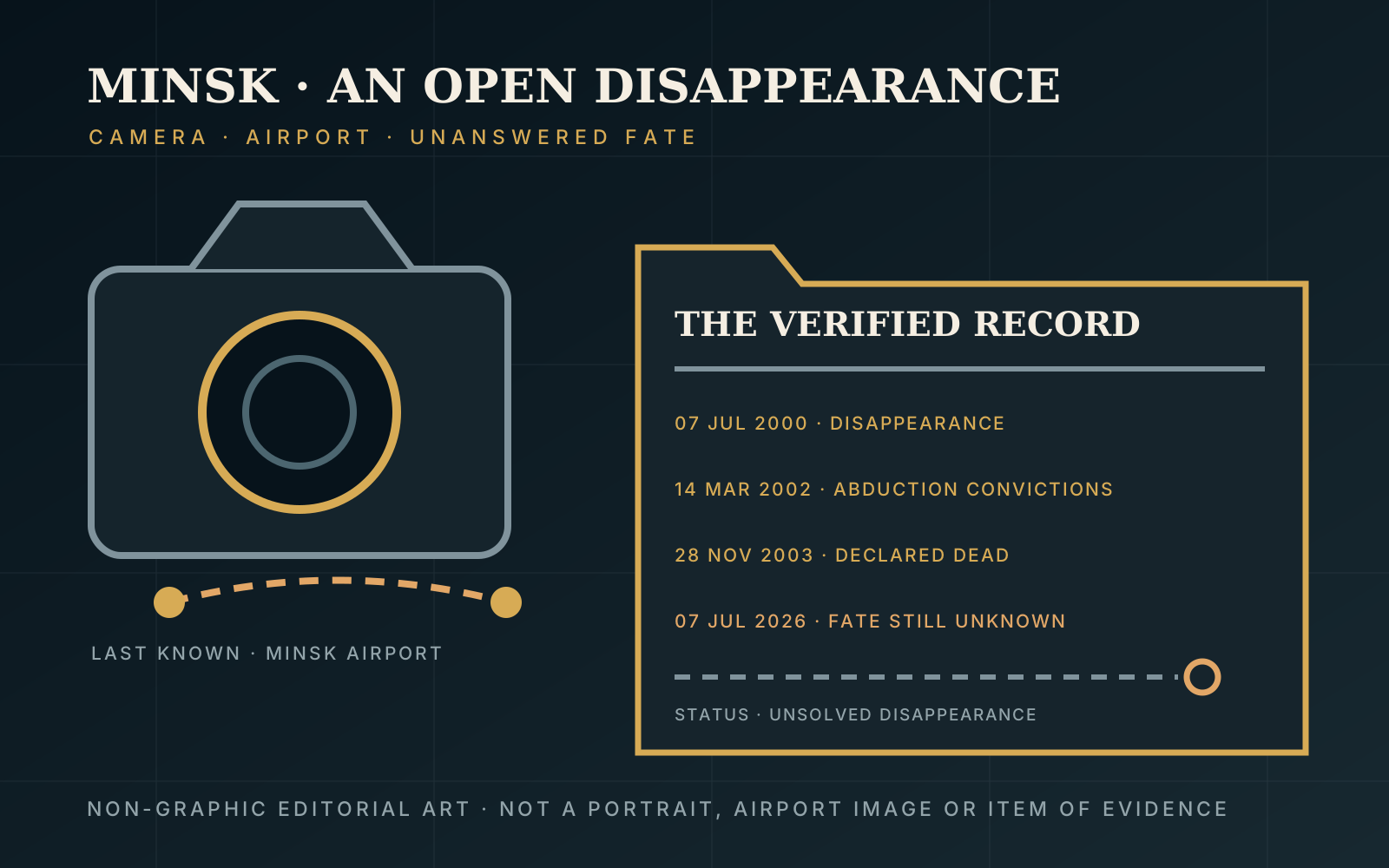
Case-status note: “Unsolved” does not ignore the 2002 convictions of Valery Ignatovich and Maxim Malik for abduction. It records what those convictions did not resolve: Zavadski's body was never found, his ultimate fate was not established in a complete public account, and allegations of wider responsibility were not determined by a transparent murder trial.
What happened to Dzmitry Zavadski?
Dzmitry Zavadski—also transliterated as Dmitry Zavadsky—was a 29-year-old Belarusian television cameraman working for the Russian public television network ORT. On the morning of July 7, 2000, he drove to Minsk National Airport to meet fellow journalist Pavel Sheremet, who was arriving from Moscow. Local reporting cited by the Committee to Protect Journalists placed Zavadski inside the airport shortly before the expected meeting.
He did not meet Sheremet. His car was later found locked and parked outside the airport building. Searches by police and prosecutors did not locate him. No verified public account has established where he was taken, whether he left the airport under coercion, where his remains might be, or precisely when and how he died.
Who was Zavadski and what was he working on?
Zavadski had worked as a cameraman for Belarusian president Alexander Lukashenko before moving into independent television work. In 1997, he and Sheremet were detained while filming near the Belarus–Lithuania border and later received suspended sentences for alleged illegal border crossing. By 2000, both men were working on reporting connected to the war in Chechnya.
Shortly before the disappearance, Zavadski and Sheremet had filmed The Chechen Diary, a documentary series for ORT. CPJ reported that sources in Belarus suspected a connection between the disappearance and footage said to show Belarusian security personnel alongside Chechen forces. That remains a reported theory, not a fact proven by an open criminal judgment.
The last known movements
The airport rendezvous creates a clear final timeline but not a complete reconstruction. Zavadski was reportedly seen at the airport, his car remained at the terminal, and he did not appear for the meeting. CPJ also recorded that he had received insistent calls from an unknown man after returning from Chechnya and that neighbors reported two men following him near his apartment on the day he vanished.
Those circumstances are significant because they suggest preparation or surveillance, but they do not independently identify an offender. This page therefore separates documented observations from later allegations and avoids presenting anonymous claims as settled evidence.
The investigation and competing accounts
From the beginning, public explanations diverged. Officials and journalists advanced different possible motives and actors. Some official statements pointed toward people connected to Chechnya, ORT colleagues or opposition circles. Zavadski's family, Sheremet and others argued that security-service involvement required serious investigation.
Amnesty International's August 2002 report placed Zavadski among four prominent disappearances in Belarus during 1999 and 2000. It documented what it described as an apparent failure to investigate effectively and summarized allegations linking high-level state officials to the disappearances. Those allegations are important to the history of the case, but they are presented as allegations because no cited final criminal judgment established them.
What did the 2002 court decide?
On March 14, 2002, a Minsk court convicted Valery Ignatovich and Maxim Malik—both described by CPJ as former members of the elite Almaz police unit—of abducting Zavadski. Each received a life sentence. Prosecutors argued that the kidnapping was retaliation for comments Zavadski had made about Belarusians fighting in Chechnya.
The proceeding was closed. Journalists were admitted only for the reading of the sentence. That matters when evaluating the public record: the convictions are real judicial outcomes, but outside observers did not have access to the evidence and testimony in the ordinary way of an open trial.
Why did the family challenge the result?
Zavadski's lawyer and family argued that the proceeding did not adequately examine allegations of official involvement and did not establish what happened after the abduction. CPJ recorded that relatives petitioned the Belarusian Supreme Court on March 25, 2002, contending that prosecutors had not sufficiently proved the two men's responsibility and requesting further investigation into both the abduction and Zavadski's fate.
The dispute is not a reason to erase the convictions. It is a reason to define them precisely. The court adjudicated an abduction charge against two defendants; it did not produce Zavadski's body, identify a cause of death or provide a complete, publicly testable account of every participant.
The 2003 declaration of death
On November 28, 2003, a district court in Minsk declared Zavadski legally dead. CPJ reported that his widow initiated the process so that property could be registered in her name. She also made clear that the administrative necessity did not end her effort to learn what had happened.
A legal declaration of death is not equivalent to a murder conviction. Courts can change a missing person's civil status after a long absence without determining the physical cause, location or criminal responsibility for the death. The distinction is essential here because summaries sometimes compress the declaration, the abduction convictions and the unresolved fate into a misleading “solved” label.
What is the current status in 2026?
On July 7, 2026—twenty-six years after the disappearance—Belsat published an anniversary review stating that Belarus still had no answers about Zavadski's fate. The review is consistent with the enduring gaps in the CPJ and Amnesty records: no recovered remains, no complete public reconstruction and no transparent adjudication of the wider allegations.
Crime by Region therefore classifies the case as Unsolved. The label can change only if reliable new evidence establishes Zavadski's fate or a competent court reaches a broader final outcome. A conviction for kidnapping is recorded as partial accountability, not stretched into a claim that the disappearance itself has been fully solved.
Why this case still matters
Zavadski's case sits at the intersection of disappearance, press freedom and public accountability. The missing person was a journalist whose work touched institutions with coercive power. When the investigation itself becomes contested, source discipline matters: every claim needs a named record, and allegations must remain clearly separated from court findings.
The case also demonstrates why databases should not treat legal status as a single switch. “Convicted” can accurately describe two defendants and still be an incomplete description of the case. The unanswered fate of the victim is not a technical footnote; it is the central question his family has carried for more than a quarter-century.
A victim-aware visual and editorial record
The illustration uses an empty camera frame, an airport waypoint and a broken timeline ending in 2026. It does not reproduce a real person's likeness, stage an abduction or present an invented document as evidence. The visual is designed to orient readers while preserving the difference between editorial art and the evidentiary record.
The page also avoids naming people as perpetrators based solely on allegations. It states the two convictions, the family's objections and the institutional concerns documented by established organizations without turning unresolved accusations into verdicts.
Frequently asked questions
Who was Dzmitry Zavadski?
Dzmitry Zavadski, also rendered Dmitry Zavadsky, was a 29-year-old Belarusian television cameraman working for the Russian network ORT.
When and where did he disappear?
He disappeared on July 7, 2000, after driving to Minsk National Airport to meet colleague Pavel Sheremet.
Was anyone convicted?
Valery Ignatovich and Maxim Malik were convicted in 2002 of abducting Zavadski and were sentenced to life imprisonment.
Why is the case still unsolved?
Zavadski's body was never recovered, his ultimate fate was not established in a complete public account, and his family challenged whether the trial identified the full responsibility.
Was he legally declared dead?
Yes. A Minsk district court declared him dead in November 2003, but that civil ruling did not determine how he died.
What is the latest verified status?
Reporting published on July 7, 2026, said Belarus still had no complete answers about Zavadski's fate.