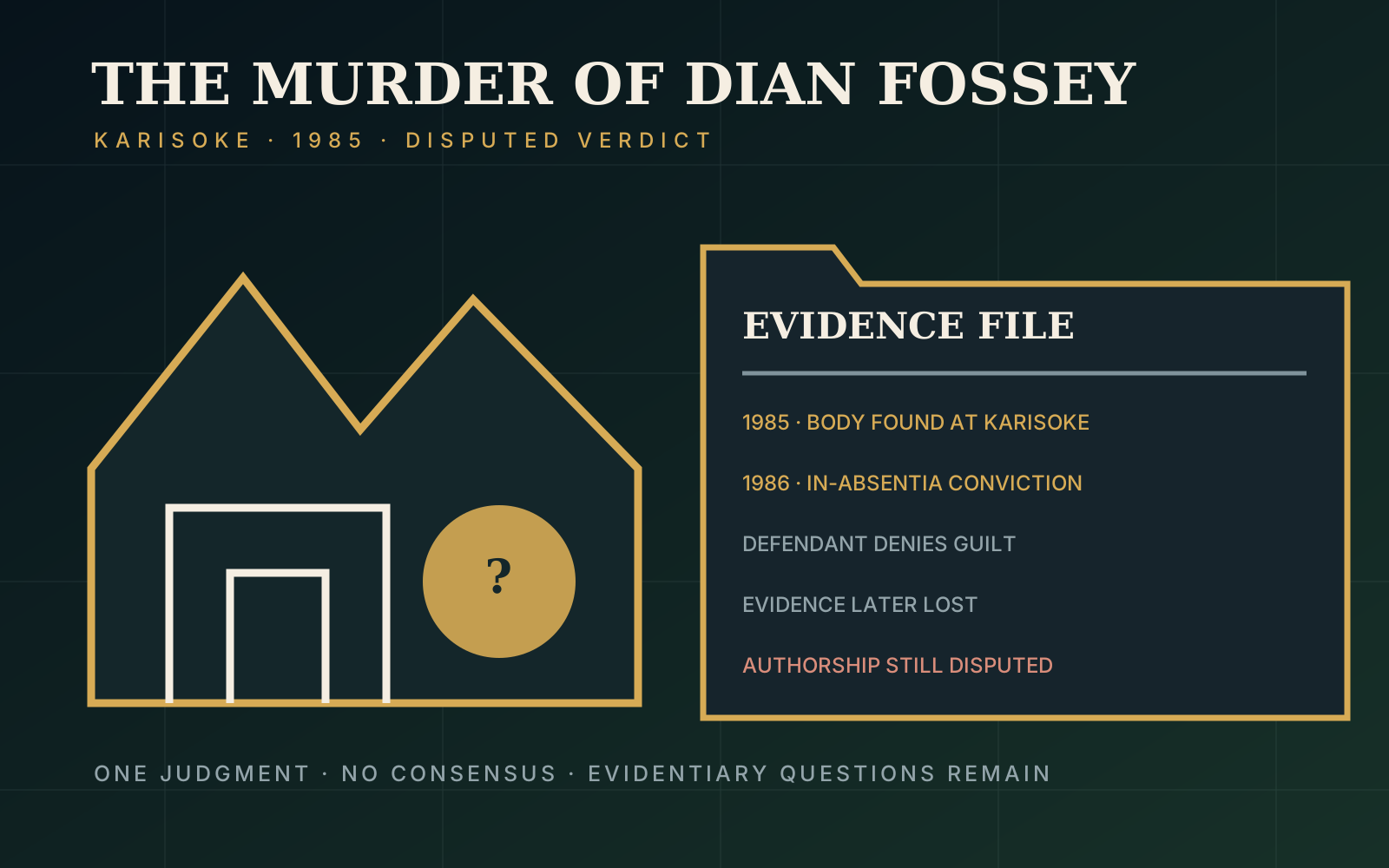
Case-status note: A court judgment exists, but it was entered in absentia after an exceptionally short proceeding with no defense case. McGuire has always denied guilt. This archive records the judgment without presenting its disputed conclusion as uncontested fact.
The discovery at Karisoke
Early on December 27, 1985, Fossey's body was discovered in the bedroom of her cabin at Karisoke, the research center she had founded in Rwanda's Virunga Mountains. She was 53. The room had been disturbed, but valuables remained, weakening a simple robbery explanation. Contemporary accounts said the assailant entered through an opening cut in the cabin wall.
Fossey had spent nearly two decades studying mountain gorillas and opposing poaching. Her work transformed scientific understanding of the animals and helped build international support for their protection. It also produced conflicts—with poachers, employees, officials and competing interests around conservation and tourism. Those tensions generated possible motives, but none may be treated as proof.
Evidence and early investigative problems
A doctor present after the discovery preserved strands of hair found in Fossey's hand and sent samples through the U.S. embassy and Rwandan authorities for analysis. According to a 2026 review by Le Monde, one sample reached a Paris laboratory; the surviving trail of the evidence is now uncertain. Handling at the scene was also imperfect, including the murder weapon being placed in a plastic bag without gloves.
The cabin had been ransacked, but money, traveler's checks, cameras and other valuables were reportedly left behind. The pattern suggested the killer may have known the isolated camp or sought something other than cash. It did not, by itself, identify a perpetrator.
Rwelekana and McGuire
Investigators detained people connected to the camp. Emmanuel Rwelekana, a tracker Fossey had dismissed, was accused of acting as an accomplice. He was found dead in custody months before trial. Authorities reported suicide, but his death prevented examination of the allegation in court.
Wayne Richard McGuire, an American graduate researcher who had worked at Karisoke, was charged with murder. Prosecutors alleged that he wanted Fossey's research material. McGuire returned to the United States before trial and publicly denied the accusation, describing Fossey as a friend and mentor and calling the case against him outrageous.
The 1986 in-absentia trial
On December 18, 1986, a court in Ruhengeri convicted McGuire in absentia and sentenced him to death. Contemporary reporting by the Los Angeles Times stated that the trial lasted approximately 40 minutes and that no defense case was presented. McGuire was not extradited and the sentence was never carried out.
A conviction is a significant legal event and must be recorded. Yet the manner in which it was obtained matters to an honest status assessment. An absent defendant had no effective opportunity to challenge witnesses, forensic evidence or the prosecution's theory. The judgment did not end international doubt about authorship.
Why the verdict did not settle the case
Later reporting has reconstructed competing theories involving professional conflict, dismissed employees, poaching networks and politically connected figures. These theories are not equivalent to findings. Le Monde's April 2026 investigation reviewed the Rwandan judgment, interviewed witnesses and traced the disputed hair evidence; it concluded that, forty years later, no reliable consensus identifies the killer.
It also reported that investigators did not fully pursue all lines of inquiry and that original evidence was later lost or became untraceable amid Rwanda's upheaval. The unresolved evidentiary chain makes a modern re-examination difficult. The possibility of DNA testing depends on whether any preserved sample can still be located and authenticated.
Fossey's life beyond the mystery
Fossey founded Karisoke in 1967 and developed long-term observations of mountain-gorilla behavior. Her conservation methods were forceful and controversial, but her scientific and protective work is distinct from speculation about her death. The Dian Fossey Gorilla Fund notes that theories about her murder have never been fully resolved.
She was buried at Karisoke near the gorillas whose lives she had documented. Treating the case responsibly means remembering her as a scientist and conservationist, not reducing her life to the circumstances of her killing.
Current status
The narrow legal status is that Wayne McGuire was convicted in absentia in Rwanda in 1986 and has denied guilt. The broader investigative status is unresolved: the process lacked an adversarial defense, the evidentiary record is incomplete, Rwelekana died before trial, other theories were not conclusively tested, and the conviction has not produced a widely accepted account of who killed Fossey.
For that reason the archive labels the case disputed conviction / unresolved authorship, rather than simply solved.
Verified timeline
- 1967: Fossey establishes the Karisoke Research Center in Rwanda.
- Night of December 26–27, 1985: Fossey is killed in her cabin; her body is found the following morning.
- 1986: Emmanuel Rwelekana dies in custody before trial.
- August 29, 1986: McGuire publicly denies the accusation in Los Angeles.
- December 18, 1986: a Rwandan court convicts McGuire in absentia after a brief proceeding and imposes a death sentence.
- April 1, 2026: Le Monde publishes a forty-year review documenting lost evidence, competing theories and continuing uncertainty.
Frequently asked questions
When was Dian Fossey killed?
During the night of December 26–27, 1985, at the Karisoke Research Center in Rwanda.
Who was convicted?
Wayne McGuire was convicted in absentia by a Rwandan court on December 18, 1986. He denied guilt.
Why is the case still considered disputed?
The trial was brief, no defense case was presented, evidence was poorly preserved or later lost, and competing lines of inquiry remain unresolved.
What happened to Emmanuel Rwelekana?
The former tracker accused as an accomplice died in custody before trial, so the allegation against him was never adjudicated.
Could DNA evidence resolve the case?
Potentially, but only if the reported hair sample can be located, authenticated and shown to have a reliable chain of custody.