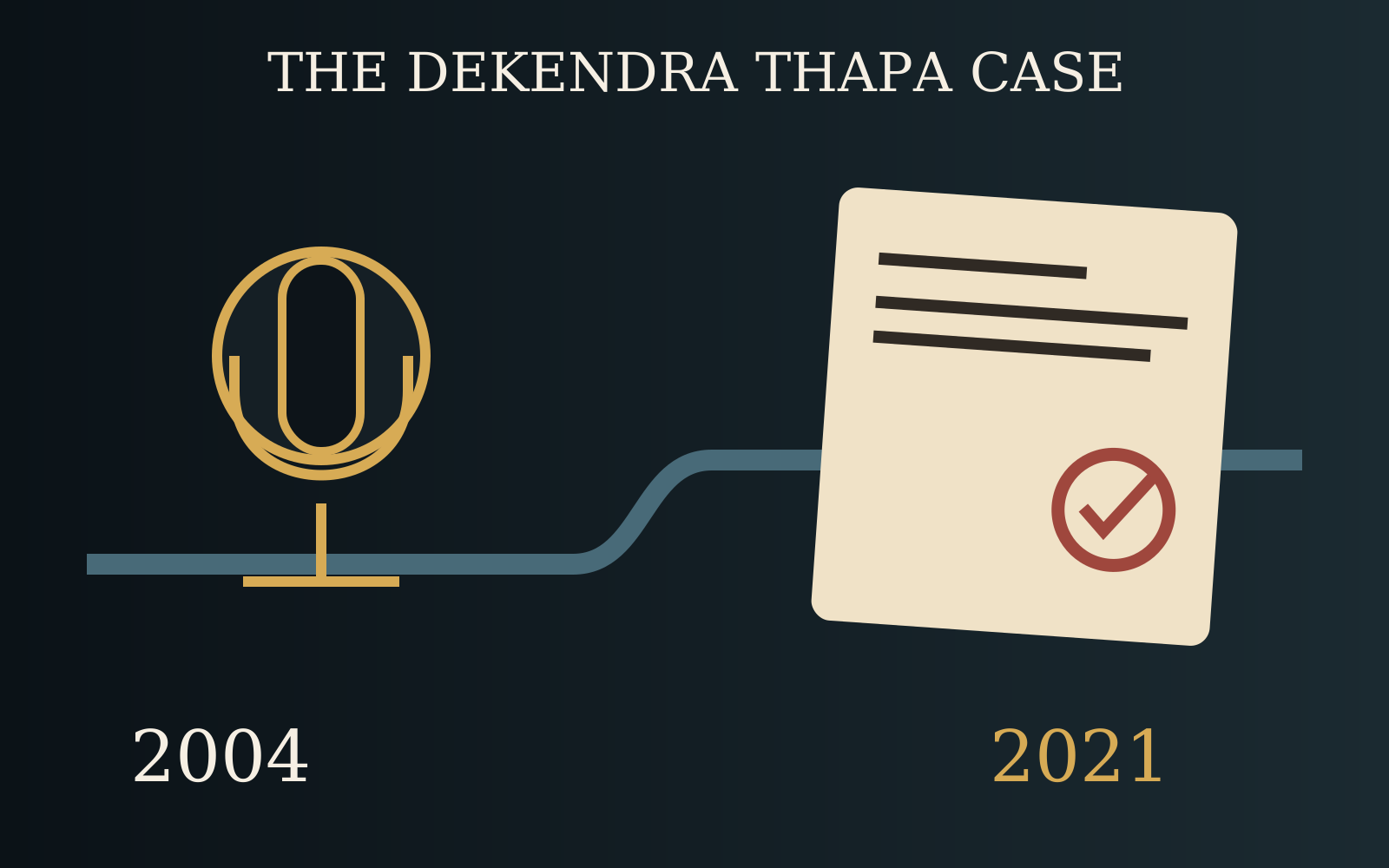
Case-status note: Convictions were imposed in 2014 and 2021. Some later defendants were sentenced in absentia, so this page separates adjudicated guilt from custody and sentence enforcement.
What happened to Dekendra Thapa?
Dekendra Raj Thapa, a journalist working with Radio Nepal in Dailekh, was abducted by Maoist cadres on June 26, 2004. He had joined a group seeking to negotiate the restoration of a water supply blocked during Nepal's armed conflict. Other members of the group were released, but Thapa remained in captivity.
Local Maoist representatives later acknowledged that he had been killed on August 11, 2004. His burial place was located years later and his remains were recovered in 2008. The killing became a major test of whether an ordinary criminal court could address a conflict-era murder after the 2006 peace agreement.
The case eventually produced two sets of convictions. Five defendants received terms of roughly one-and-a-half to two years in 2014 under the law applied by the district court. In December 2021, the Dailekh District Court sentenced three additional defendants in absentia to 20 years and another defendant to three years.
The journalist and community figure
Thapa reported for Radio Nepal and was active in Dailekh's public life. The Committee to Protect Journalists records that local sources linked his murder to his journalism. He also served in a local drinking-water users' body, which explains why he became involved in the attempted negotiation over the district capital's water supply.
These roles should not be collapsed into a single motive without a final finding. Maoist representatives accused him of spying, while press-freedom groups treated the killing as work-related. The fact that he was reporting and engaged in community service is established; the complete motive and individual intentions were contested.
His wife, Laxmi Thapa, pursued the criminal complaint after the conflict. Her effort and the work of local journalists kept the case active through periods of institutional resistance.
Abduction and captivity
On June 26, 2004, Thapa and other journalists traveled to a Maoist-controlled area after the water line serving Dailekh Bazar was obstructed. The group hoped to secure restoration of the supply. Maoist cadres detained them.
Some captives were released, but Thapa was moved and held for weeks. Accounts later presented by investigators and rights groups described interrogation and abuse before his death. This page avoids graphic detail because it is unnecessary to establish the crime.
The essential sequence is supported across independent records: abduction during the conflict, prolonged unlawful custody, killing on August 11 and concealment of the body.
Recovery of the remains
Thapa's burial site was identified in 2008, four years after the killing. Recovery of his remains transformed the case from an acknowledged killing with a missing body into one with physical evidence and a documented site.
Laxmi Thapa filed a police complaint in August 2008. Progress remained slow, and the case was repeatedly affected by disputes over whether conflict-era crimes should proceed in ordinary courts or await transitional-justice mechanisms.
For the family, recovery brought confirmation but not immediate accountability. Investigators still had to identify participants, collect witness statements and overcome political pressure.
Political interference allegations
In January 2013, police arrested suspects and prosecutors prepared charges. Senior officials then sought to halt the investigation, arguing that the case belonged in a future truth-and-reconciliation process.
The International Commission of Jurists criticized those interventions and said they undermined the rule of law and prosecutorial independence. Nepal's courts ordered the ordinary criminal process to continue.
Transitional justice and criminal justice are not interchangeable labels. A truth mechanism may investigate patterns and recommend measures, while a murder prosecution determines individual criminal liability under evidence and law. The Thapa litigation became a prominent example of that distinction.
The 2014 district-court judgment
On December 7, 2014, the Dailekh District Court convicted five defendants. Nirak Bahadur Gharti, Harilal Pun and Jaya Bahadur Shahi received two-year terms. Lakshiram Gharti Magar received one year and six months, and Bir Bahadur KC received one year.
The terms were widely criticized as lenient. The court applied the homicide law in force when the crime occurred, including limits that produced shorter sentences for some participants. Two defendants had already spent enough time in custody to complete their terms.
The 2014 judgment was real accountability, but not the end of the case. Other accused people had not been before the court, and the full set of alleged participants had not received final judgments.
The 2021 convictions
On December 12, 2021, the Dailekh District Court delivered a later judgment concerning additional defendants. Press-freedom organizations reported that three people tried in absentia received life terms defined as 20 years under the applicable law. Another defendant, Bhaktiram Lamichhane, received three years.
The International Federation of Journalists and the Committee to Protect Journalists both recorded the 2021 outcome. Because several defendants were absent, a sentence and its enforcement are separate facts. This dossier confirms the judgment but does not claim that every 20-year term was being served.
The later verdict substantially changed the archive status. The murder is no longer accurately described as wholly unprosecuted, even though enforcement and broader responsibility remain incomplete.
Current status
The case is classified solved / adjudicated with partial enforcement. Multiple defendants were convicted in 2014 and 2021. The underlying crime, victim and sequence are established, and courts assigned individual criminal responsibility.
“Partial” is retained because some 2021 defendants were sentenced in absentia, public reporting does not establish enforcement of every term, and the court cases may not encompass every person involved in the abduction, custody and killing.
No reliable later appellate reversal was located in the sources reviewed through September 15, 2026. The page therefore reports the district-court outcomes while avoiding a claim that every procedural avenue or enforcement question is closed.
Why the case matters
Thapa's case shows how a local murder can become a national test of post-conflict justice. Investigators faced attempts to divert the case from ordinary courts, and the victim's family waited years for even the first convictions.
It also demonstrates why status labels need precision. The case has convictions, so “unsolved” would hide real judgments. But “fully resolved” would conceal absent defendants, disputed sentence adequacy and incomplete enforcement.
The verified conclusion is narrower and stronger: Dekendra Thapa was abducted and killed in 2004; his remains were recovered; five defendants were convicted in 2014; four more received sentences in 2021; and significant accountability gaps remain.
Frequently asked questions
Who was Dekendra Thapa?
Dekendra Raj Thapa was a journalist for Radio Nepal and a community figure in Dailekh.
When was he abducted?
Maoist cadres abducted him on June 26, 2004, while he and others were trying to negotiate restoration of a blocked water supply.
When was he killed?
Sources and later court proceedings place his killing on August 11, 2004.
Were people convicted?
Yes. Five defendants received shorter prison terms in 2014, and three defendants tried in absentia received 20-year terms in December 2021. A fourth received three years.
Why were there two rounds of sentences?
The 2014 judgment concerned defendants arrested earlier. Later proceedings addressed additional accused people who had not been tried in that first case.
What is the status?
Solved with partial accountability. Multiple convictions exist, but some defendants were sentenced in absentia and enforcement was not fully documented.