What happened in December 1982?
Suriname had been under military rule since a February 1980 coup led by Desi Bouterse. In the following years, opposition came from lawyers, journalists, labor leaders, academics, soldiers and other public figures calling for a return to democratic government.
The Inter-American Commission on Human Rights’ 2022 admissibility report records the families’ account that the 15 men were arrested between 7 and 8 December 1982 and taken to Fort Zeelandia, then the principal armed-forces compound in Paramaribo. The Commission described the petition as alleging torture followed by summary execution. Death certificates recorded 9 December as the date of death. The Surinamese state acknowledged in those proceedings that the men were killed at the fort, while contesting the admissibility of the families’ claims.
The International Commission of Jurists, which monitored the later trial, summarized the events as executions on 8 December after the men had been taken from their homes and arbitrarily detained the previous night. Variations in the source record over whether the deaths should be dated 8 or 9 December are why this archive describes the events as taking place over 7–9 December rather than forcing a false single-day precision.
A union leader, Fred Derby, survived detention and later became an important witness. Reuters reported that the 2019 court found Bouterse had overseen an operation in which soldiers abducted 16 leading critics and killed 15 of them.
Who were the 15 victims?
The IACHR report identifies the men and records their occupations and public roles. They were:
- John Baboeram, a lawyer who defended people charged over opposition to military rule;
- Abraham “Bram” Behr, a journalist and publisher;
- Cyrill Daal, an influential labor leader;
- Kenneth Gonçalves, a lawyer and president of the Surinamese Bar Association;
- Edmund “Eddy” Hoost, a lawyer;
- André Kamperveen, a journalist and broadcaster;
- Gerard Leckie, a psychologist, university professor and academic-association president;
- Sugrim Oemrawsingh, a university professor of mathematics and physics;
- Leslie Rahman, a journalist and union leader;
- Soerendra Rambocus, an army lieutenant;
- Harold Riedewald, a criminal-defense lawyer;
- Djiewansing Sheombar, a soldier;
- Jozef Slagveer, a journalist and news-agency owner;
- Somradj “Robby” Sohansingh, an industrial business owner; and
- Frank Wijngaarde, a printing-business manager and journalist.
This archive names all 15 because a mass killing should not be reduced to a case title centered only on the most powerful defendant. It omits graphic descriptions of their injuries. The relevant evidentiary point is that the families and international monitors documented indications of severe abuse before death, while later courts adjudicated the murders themselves.
Why did accountability take decades?
For 18 years, no criminal prosecution reached court. The families petitioned Suriname’s High Court of Justice in March 2000. In October 2000, the court ordered the prosecutor general to institute proceedings and seek a preliminary judicial investigation. Charges were filed in 2004 against more than 20 suspects, and trial proceedings against 25 people began on 30 November 2007 before the Krijgsraad, a military court composed of civilian judges for the Bouterse case.
The process then encountered repeated interruptions. Bouterse was elected president in 2010. In April 2012, his political party helped enact an amnesty measure covering the period of the killings, and the trial was suspended while its constitutional compatibility remained unresolved. The ICJ later reported that the amnesty provision was repealed and that courts rejected other attempts to stop the case.
The IACHR’s 2022 report did not decide the criminal guilt of the defendants. It addressed a different question: whether the families’ international petition alleging failures of fair trial, judicial protection and the duty to investigate torture could proceed. The Commission found the petition admissible, emphasizing the long delay and the claimed continuing effects. That procedural ruling and the domestic criminal judgments are related parts of the accountability record, but they are not interchangeable.
What did Suriname’s courts decide?
On 29 November 2019, the Krijgsraad convicted Bouterse and sentenced him to 20 years for planning and ordering the murders. Because he had not attended that phase, he obtained a review. On 30 August 2021, the court affirmed the conviction. Bouterse then appealed to the Hof van Justitie, Suriname’s highest court.
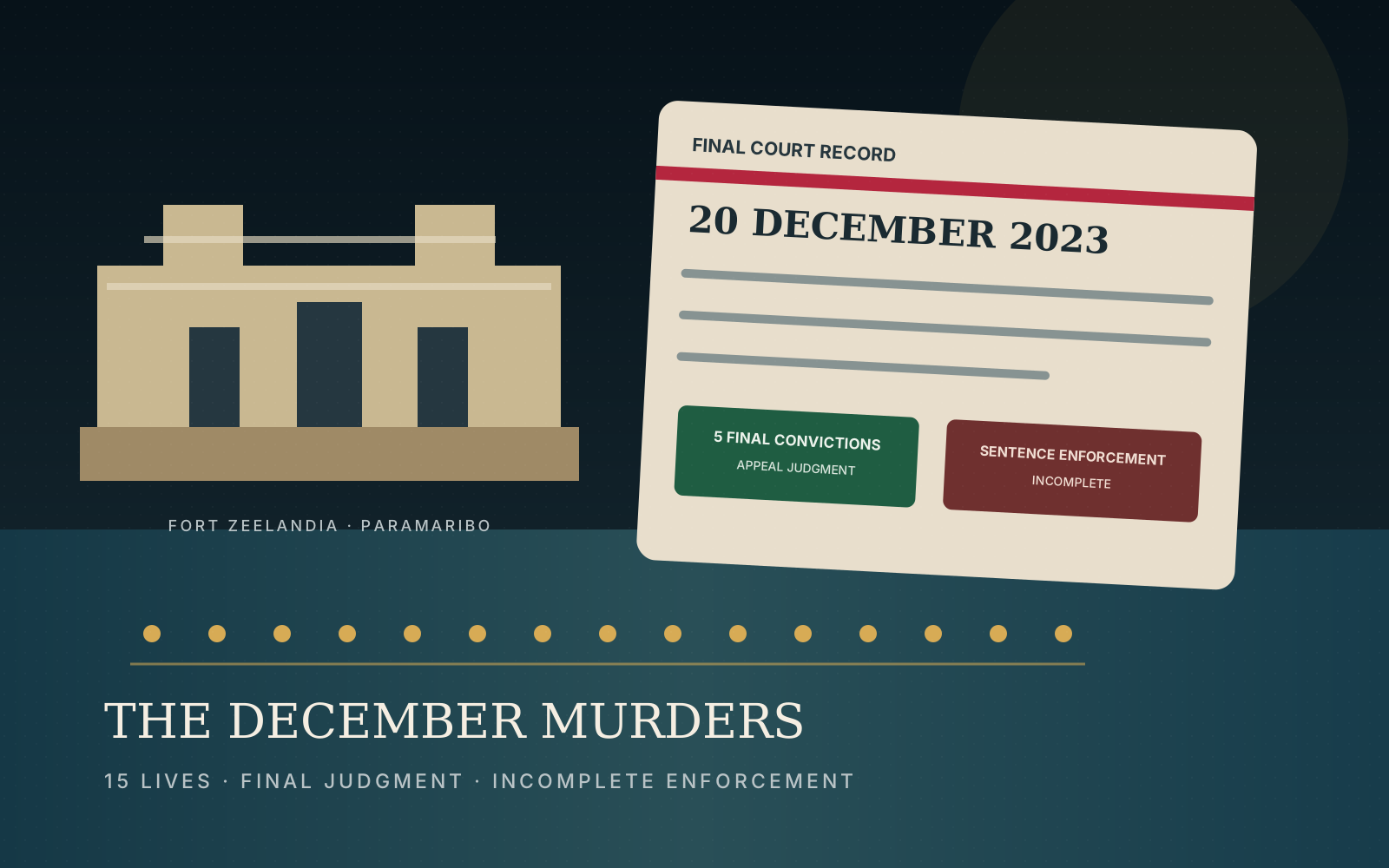
On 20 December 2023, the appellate court upheld Bouterse’s conviction and 20-year term. It also upheld the convictions of four former military officers and imposed 15-year sentences on each. Reuters reported that no further appeal was available. The judgment therefore converted a long-contested trial record into a final national decision for those five appellants.
The final judgment does not erase the distinct procedural histories of all 25 original defendants. Contemporary reporting said some were acquitted, some died during the case, and not all convicted defendants followed the same appeal path. This page limits its summary to the findings clearly supported by the final appellate reporting: Bouterse and four co-defendants had convictions upheld in December 2023.
Were the sentences carried out?
The public prosecutor ordered Bouterse and the four co-defendants to report to prison in January 2024. Bouterse did not appear. Reuters later reported that he and co-defendant Iwan Dijksteel had disappeared; this page does not generalize that status to every convicted person.
On 25 December 2024, Suriname’s government confirmed that Bouterse had died the previous day, aged 79. He had remained a fugitive and never served the 20-year sentence. His death ended the possibility of imprisoning him, but it did not vacate the final conviction.
This distinction matters. A case can be solved at trial because a final judgment establishes individual responsibility, yet still have an incomplete enforcement record. Calling the case simply “unsolved” would ignore the final convictions. Calling it fully closed would conceal that the principal defendant avoided imprisonment until his death.
Why is the case classified as solved at trial?
Crime by Region places a file in the solved section when a competent court has reached a final judgment establishing criminal responsibility. This case meets that threshold because:
- a long-running criminal proceeding examined responsibility for the 15 murders;
- Bouterse was convicted in 2019 and the conviction was affirmed on review in 2021;
- the highest court upheld his conviction and those of four co-defendants in 2023; and
- the final ruling imposed identified prison terms.
The archive’s qualifier—sentence enforcement incomplete—is equally important. It preserves the difference between adjudication and punishment served. It also leaves room for the continuing international proceeding concerning the families’ rights without treating an admissibility decision as a merits judgment.
Case timeline
- 25 February 1980
A military coup led by Desi Bouterse overthrows Suriname’s elected government. - 7–9 December 1982
Fifteen prominent men are detained and killed at Fort Zeelandia; Fred Derby survives detention. - 1985
The UN Human Rights Committee concludes that victims in complaints before it were arbitrarily deprived of life. - 31 October 2000
Suriname’s High Court orders the prosecutor general to institute criminal proceedings. - 1 December 2004
Prosecutors file charges against more than 20 suspects. - 30 November 2007
Trial proceedings begin against 25 defendants. - April–May 2012
An expanded amnesty measure leads to suspension of most proceedings. - 29 November 2019
The Krijgsraad convicts Bouterse and imposes a 20-year sentence. - 30 August 2021
The Krijgsraad affirms Bouterse’s conviction on review. - 9 February 2022
The IACHR declares the families’ petition concerning judicial protection and fair-trial rights admissible. - 20 December 2023
The Hof van Justitie upholds Bouterse’s conviction and those of four co-defendants. - January 2024
Bouterse is ordered to report to prison but fails to appear. - 24 December 2024
Bouterse dies while a fugitive, without serving the 20-year sentence.
Sources and verification
Inter-American Commission on Human Rights — Report No. 19/22, Petition 1212-14 (9 February 2022)
International Commission of Jurists — Suriname trial-monitoring archive and case history
Amnesty International — families’ search for justice and 2007 trial record (6 December 2012)
Reuters — final appeal judgment and sentences (20 December 2023)
Reuters — order to report to prison (10 January 2024)
Reuters — government confirmation of Bouterse’s death and fugitive status (25 December 2024)
Editorial method: The victim identities and early procedural history were checked against the IACHR record; trial stages against ICJ monitoring; and the final judgment, imprisonment order and later death against dated Reuters reporting. Allegations submitted by families are identified as allegations, and domestic findings are not extended beyond the defendants and issues adjudicated. Last reviewed 18 October 2026.
Frequently asked questions
What were Suriname’s December Murders?
Fifteen men who opposed Suriname’s military government were detained and killed at Fort Zeelandia in Paramaribo in December 1982.
Who were the victims?
They were lawyers, journalists, labor leaders, academics, soldiers and business figures: John Baboeram, Bram Behr, Cyrill Daal, Kenneth Gonçalves, Eddy Hoost, André Kamperveen, Gerard Leckie, Sugrim Oemrawsingh, Leslie Rahman, Soerendra Rambocus, Harold Riedewald, Djiewansing Sheombar, Jozef Slagveer, Robby Sohansingh and Frank Wijngaarde.
What was the final court outcome?
On 20 December 2023, Suriname’s highest court upheld Desi Bouterse’s 20-year sentence and the convictions of four co-defendants, each sentenced to 15 years.
Did Bouterse serve his sentence?
No. He failed to report to prison in January 2024 and died on 24 December 2024 while a fugitive.
Why did the trial take so long?
The criminal process opened in 2000, trial proceedings began in 2007, and the case encountered years of delays, an amnesty measure, review proceedings and appeal.
Is the case completely closed?
The domestic convictions are final, but sentence enforcement was incomplete and the IACHR petition concerning the families’ fair-trial and judicial-protection claims remained a separate international proceeding.