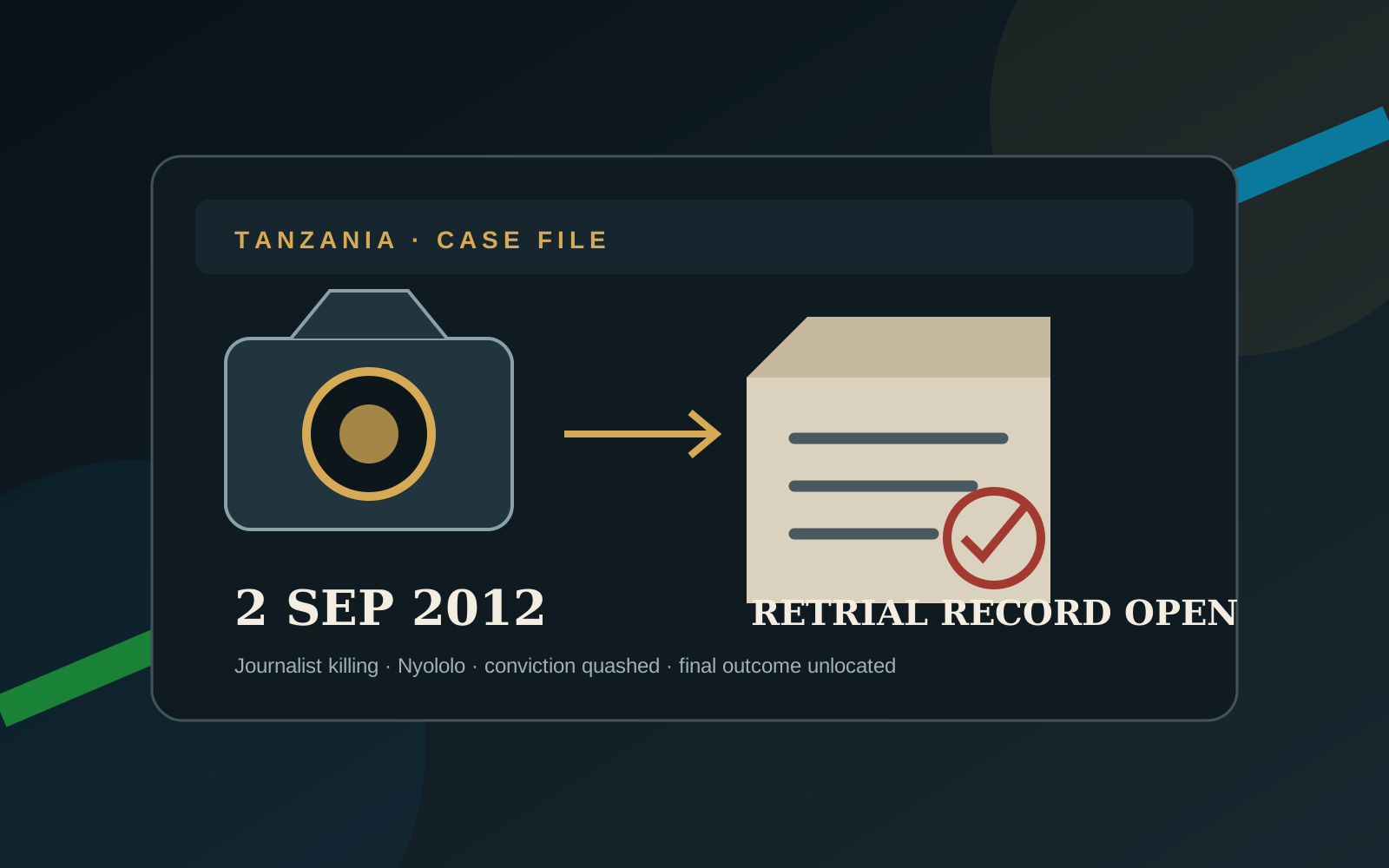
Case-status note: This file distinguishes the 2016 manslaughter conviction from the 2018 appellate decision that nullified the proceedings. The Court of Appeal ordered a fresh trial; it did not affirm the conviction or enter a final acquittal on the evidence. Because a conclusive retrial outcome was not located, the case remains “unsolved / partial” here.
A journalist covering a political gathering
Daudi Mwangosi was a 40-year-old journalist with the private television station Channel Ten. He also chaired the press club in Iringa, a role that placed him within the region's professional journalism community. On September 2, 2012, he traveled to Nyololo village in Mufindi District to cover a gathering involving supporters of Chama cha Demokrasia na Maendeleo, commonly known as Chadema.
The Committee to Protect Journalists documented that police confronted journalists and demonstrators at the gathering. Its account, based on news reports and interviews with journalists who witnessed the incident, said Mwangosi became involved after police assaulted and arrested another reporter. This background explains why he was present and why the confrontation escalated, but it does not justify reconstructing conversations or motives that the record does not establish.
UNESCO's director-general condemned the killing later that month and called for a thorough investigation. The international response reflected a press-freedom concern as well as the death of one person: a reporter had been killed while carrying out an assignment in a public setting involving state officers.
The fatal encounter at Nyololo
The published appellate judgment describes a rapidly developing confrontation between police and people at the gathering. Mwangosi died after a police tear-gas launcher was discharged at very close range. The injury was catastrophic, but this archive omits graphic detail that is unnecessary to understand the case.
Images and eyewitness reporting circulated widely after the killing. Those materials helped establish public scrutiny, yet the criminal proceeding still depended on admissible evidence, witness testimony and correct procedure. The accused officer, police constable Pacificus Cleophance Simon, was charged with murder.
It is important to separate institutional context from individual criminal liability. The police operation and treatment of journalists were matters of public concern. The court case, however, asked whether the evidence proved the charge against one named officer under Tanzanian criminal law.
The 2016 trial and manslaughter conviction
The High Court proceedings took place at Iringa. Although Simon had been charged with murder, the court convicted him of the lesser offence of manslaughter. Contemporary reporting placed the conviction on July 25, 2016 and the sentence two days later: 15 years' imprisonment.
A conviction at trial was a major procedural milestone, but it was not the end of the case. Simon appealed. His challenge included the way the trial judge had directed the assessors who sat with the court, a procedural safeguard required in the form of trial used for the case.
The later appellate judgment supplies the clearest authoritative account of why the conviction could not stand. It therefore controls this archive's description of the outcome, even though contemporary headlines understandably described Simon as Mwangosi's convicted killer after the High Court decision.
Why the Court of Appeal quashed the conviction
On June 4, 2018, the Court of Appeal of Tanzania allowed Simon's appeal. The judges found that the trial judge's summing-up had failed to give the assessors an adequate account of the evidence and the parties' competing positions. Because the assessors had not been properly guided, their participation was reduced to what the appellate court described as an empty ritual.
The remedy was procedural but consequential. The Court of Appeal declared the High Court proceedings a nullity, quashed the manslaughter conviction and set aside the 15-year sentence. It then ordered a fresh trial before a different judge and a new set of assessors, with the case to be handled expeditiously.
What the appeal did not decide: Quashing a conviction because the trial process was defective is not the same as finding that the accused did not commit the act. Equally, an earlier conviction that has been quashed cannot be presented as a current, final adjudication of guilt.
The retrial and the public-record gap
Tanzanian reporting documented the retrial returning to court in 2021. That establishes that the appellate order was acted upon at least to the point of renewed proceedings. It does not establish a verdict.
A review of publicly accessible court-law databases, established Tanzanian news reporting and international press-freedom records through September 13, 2026 did not locate a reliable final retrial judgment or sentence. Search limitations are not proof that no later proceeding exists. The responsible conclusion is narrower: the outcome could not be verified from the accessible record reviewed for publication.
For that reason, this page does not restore the quashed 2016 conviction, call Simon an acquitted man, or claim that the case ended in 2018. It records a prosecution with an invalidated first trial and an ordered retrial whose final result remains unlocated.
What remains unresolved
- What final judgment, if any, was entered after the reported retrial proceedings?
- Did the retrial reach verdict, dismissal or another procedural resolution?
- Were disciplinary or institutional findings issued separately from the criminal case?
- Where is the complete official retrial record available for public inspection?
These are gaps in the accessible record, not invitations to speculate. Any future update should be tied to a court document or reliable reporting that clearly identifies the proceeding and result.
Frequently asked questions
Who was Daudi Mwangosi?
He was a 40-year-old Channel Ten reporter and chairman of the Iringa Press Club.
When was he killed?
He was killed on September 2, 2012 while covering a Chadema gathering at Nyololo village in Mufindi District, Iringa Region.
Was anyone convicted?
Pacificus Cleophance Simon was convicted of manslaughter in 2016 and sentenced to 15 years, but that conviction and sentence were quashed in 2018 because the trial proceedings were legally defective.
Did the appeal amount to an acquittal?
No. The Court of Appeal declared the proceedings a nullity and ordered a fresh trial. It did not enter a final acquittal on the merits.
What is the current status?
Unsolved or partial. A retrial was reported in progress in 2021, but no reliable public final retrial outcome was located in the review completed September 13, 2026.