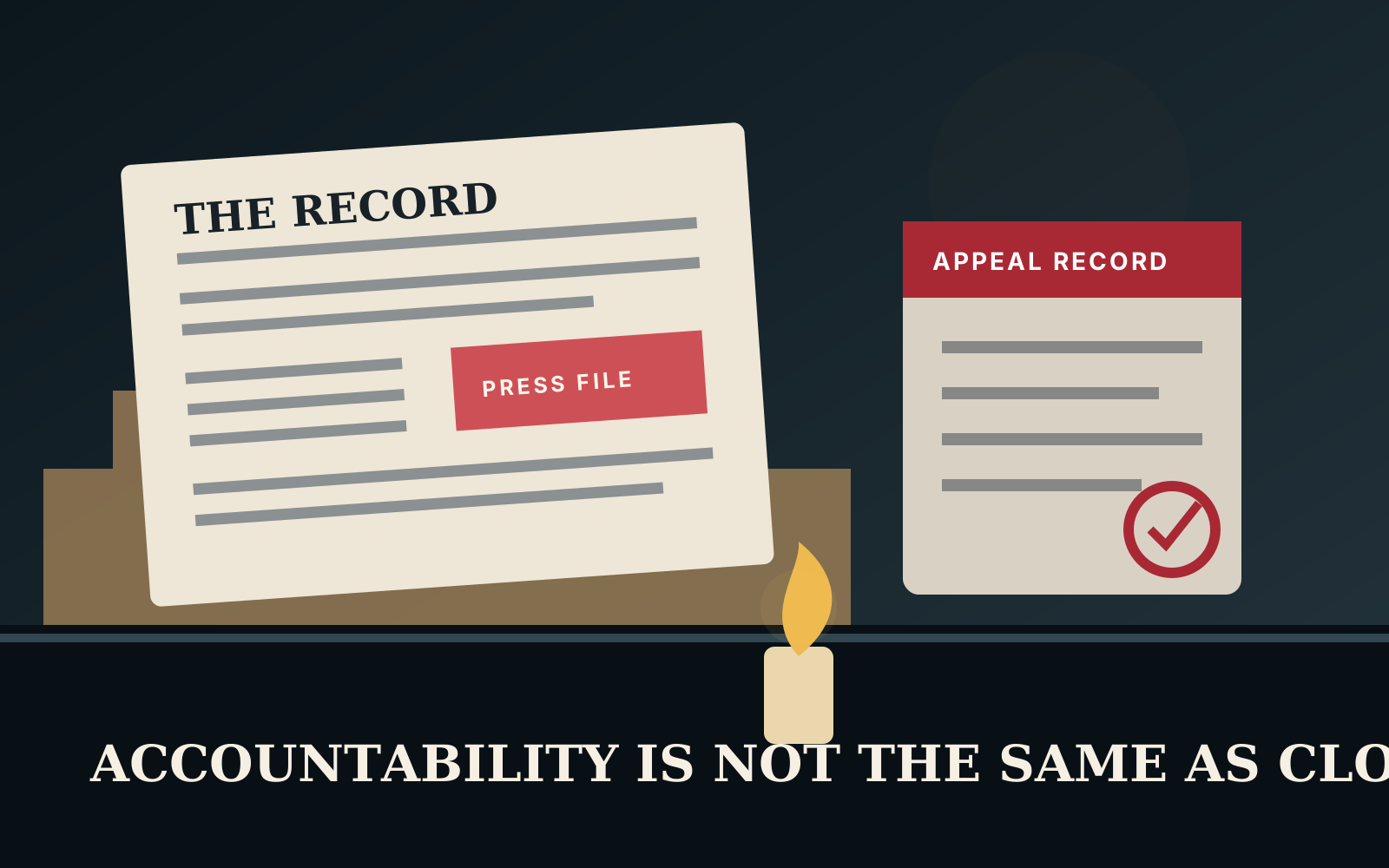
Status boundary as of 28 September 2026: five final convictions establish operational roles in detonating or supplying the bomb. They do not establish by final judgment who ordered or financed the assassination. Yorgen Fenech was acquitted by a jury on 2 September 2026; the Attorney General appealed on points of law on 22 September. A pending appeal is not a conviction, and this page does not assign guilt beyond adjudicated facts.
The journalist and the attack
Daphne Caruana Galizia was a Maltese investigative journalist and columnist whose reporting examined corruption, financial arrangements and the conduct of powerful institutions and individuals. Her work made her both widely read and the target of lawsuits, threats and sustained hostility. Those circumstances are part of the public record, but they do not by themselves identify who organized her murder.
On the afternoon of 16 October 2017, Caruana Galizia left her home in Bidnija. A bomb placed in her car detonated shortly afterward, killing her. The violence was immediately recognized as an attack on a journalist as well as a homicide. Investigators faced two distinct tasks: establish who carried out the physical operation and determine whether another person or group had commissioned it.
That distinction defines the case today. Courts have produced final outcomes for five participants connected to the bomb's detonation or supply. The broader commissioning question has not ended with a final conviction. Keeping those two levels separate avoids both understating the accountability already achieved and overstating what the legal record proves.
The operational investigation
Malta's investigation led to the arrest of brothers George and Alfred Degiorgio and Vincent Muscat in December 2017. Prosecutors alleged that they carried out the bombing operation. The case developed through telecommunications evidence, surveillance and testimony, followed by guilty pleas rather than full contested verdicts for these three men.
Vincent Muscat pleaded guilty in February 2021 to participation in the murder and received a 15-year prison sentence. His agreement to cooperate with authorities gave investigators evidence concerning the operational chain. That cooperation does not make every statement independently proven; it is recorded here because it formed part of the public proceedings and his conviction.
George and Alfred Degiorgio pleaded guilty in October 2022 after their trial had begun. Each received a 40-year sentence. Their pleas established their own criminal responsibility for the bombing operation. They did not, standing alone, amount to a final judicial determination of who had commissioned or financed the murder.
The bomb-supply prosecution
A separate prosecution focused on Robert Agius and Jamie Vella, accused of supplying the explosive device. In June 2025, a Maltese court convicted both men and imposed life sentences. The result extended final accountability beyond the people who admitted carrying out the attack to the supply of the weapon used.
Agius and Vella appealed. On 26 January 2026, Malta's Court of Criminal Appeal confirmed their convictions and life sentences. This appellate outcome is why the archive describes five participation convictions as final: Muscat and the Degiorgio brothers had already entered guilty pleas and been sentenced, while the contested bomb-supply convictions survived appeal.
The same 2025 proceeding included charges against other defendants, but the precise outcome of each person and count must not be collapsed into a single statement. This archive names a person as convicted only where the sources and judgment history clearly support that conclusion. It also avoids treating testimony about alleged organizers as if it were itself a verdict.
The middleman and evidentiary limits
Melvin Theuma described himself as a middleman and received a presidential pardon in 2019 conditioned on truthful cooperation. He became an important prosecution witness in later proceedings. A pardon conditioned on testimony is not a conviction and does not automatically validate every allegation made by the witness.
Courts and juries assess witness credibility alongside recordings, documents, communications and the defense case. Public discussion often compresses this process into a simple chain of accusations. The legal record is more demanding: an allegation may explain why a person was charged, yet guilt still requires proof accepted under the applicable criminal standard.
For this reason, the page distinguishes a witness's account, a prosecutor's theory, a charge, a guilty plea, a conviction and a final appellate outcome. Those are not interchangeable stages. The distinction is especially important in a case that combines cooperating witnesses, multiple proceedings and intense public scrutiny.
The Fenech trial and acquittal
Businessman Yorgen Fenech was charged with complicity in the murder and criminal association. His jury trial opened in 2026 and lasted about two months. The prosecution alleged that he had commissioned the assassination; the defense challenged the reliability of the case and the credibility of key testimony.
On 2 September 2026, the jury acquitted Fenech by an eight-to-one vote. That verdict means he was not convicted of the charges tried. It would be inaccurate to describe him as legally responsible after the acquittal, even if allegations remain part of the historical record or are repeated in public debate.
Following the verdict, Malta's government said testimony from the trial had been transmitted to two ongoing magisterial inquiries and to the Police Commissioner for assessment of possible criminal liability by third parties. Those referrals are investigative steps, not findings of guilt. The same government statement recognized that legal time limits and additional processes were still running.
The Attorney General's September 2026 appeal
On 22 September 2026, Malta's Attorney General filed an appeal against Fenech's acquittal. Reuters reported that the challenge was limited to points of law. Under that process, the Court of Criminal Appeal may examine alleged legal errors and, if the governing test is met, may order a retrial.
The appeal does not convert the acquittal into a conviction. Until a court changes the procedural position, the acquittal remains the verdict returned by the jury. Nor does the filing predict how the appellate court will rule. The correct current description is therefore: acquitted at trial, with a prosecution appeal pending.
Authorities also questioned three jurors, a reserve juror and a juror's husband over alleged misconduct connected to the trial. Reuters reported that they were released on police bail and had not been charged when the appeal was filed. Their questioning is not proof that misconduct occurred and is not used here to undermine the verdict.
Public inquiry and institutional responsibility
A separate public inquiry examined whether the Maltese state bore responsibility for circumstances that enabled the assassination and whether institutions had adequately protected Caruana Galizia. Its 2021 report found serious institutional failures. That process addressed state responsibility and governance; it was not a criminal trial deciding who planted, supplied or commissioned the bomb.
Public-inquiry findings can inform reform and accountability without satisfying the elements of a criminal offense against a named individual. The archive therefore keeps institutional findings in their proper lane. It does not translate systemic criticism into criminal guilt.
The continued activity of magisterial inquiries likewise shows that the evidentiary record may still develop. An inquiry can gather testimony and evaluate possible offenses, but a person under examination remains unconvicted unless and until a court enters a lawful judgment.
What is established — and what is not
The record establishes that Daphne Caruana Galizia was killed by a car bomb on 16 October 2017. It establishes final criminal responsibility for Vincent Muscat, George Degiorgio and Alfred Degiorgio in carrying out the attack, and for Robert Agius and Jamie Vella in supplying the bomb. It also establishes that Fenech was acquitted in September 2026 and that the Attorney General later appealed on points of law.
The record does not establish through a final conviction who commissioned or financed the murder. It does not authorize treating every person named in testimony or journalism as a criminal participant. It does not turn an institutional finding, an investigative referral or an appeal into a guilty verdict.
This boundary matters for the victim too. A case file should document the attack on Caruana Galizia and the accountability record without allowing unresolved accusations to eclipse her work, her family or the legal rights of people who have not been convicted.
Why the case is classified as partially adjudicated and unsolved
The five convictions are substantial. They resolve who performed several operational roles and carry serious sentences. Calling the entire case “unsolved” without qualification would hide that accountability.
Calling the case fully “solved,” however, would imply that the commissioning and financing questions were concluded by final judgment. They were not. The archive therefore uses a compound label: unsolved / partially adjudicated — five participation convictions; commissioning unresolved.
This classification can change if later proceedings produce a final, reliable judgment. It is not a prediction about the pending appeal or inquiries. It is a snapshot of the verified procedural record on 28 September 2026.
Verified timeline
- 16 October 2017: Daphne Caruana Galizia is killed by a car bomb near her home in Bidnija.
- December 2017: George Degiorgio, Alfred Degiorgio and Vincent Muscat are arrested in the operational investigation.
- 2019: Melvin Theuma receives a conditional presidential pardon and agrees to provide evidence.
- February 2021: Vincent Muscat pleads guilty and receives a 15-year sentence.
- July 2021: Malta's public inquiry publishes findings on institutional responsibility and failures.
- October 2022: George and Alfred Degiorgio plead guilty and each receives a 40-year sentence.
- 10 June 2025: Robert Agius and Jamie Vella are convicted of supplying the bomb and sentenced to life imprisonment.
- 26 January 2026: The Court of Criminal Appeal confirms the Agius and Vella convictions and life sentences.
- 2 September 2026: A jury acquits Yorgen Fenech of complicity and criminal association.
- 3 September 2026: Malta's government notes continuing legal processes and referrals of testimony to inquiries and police.
- 22 September 2026: The Attorney General appeals Fenech's acquittal on points of law.
- 28 September 2026: The five participation convictions are final; the commissioning question and appeal remain unresolved.
Frequently asked questions
When and where was Daphne Caruana Galizia killed?
She was killed by a car bomb on 16 October 2017 near her home in Bidnija, Malta.
Who has been convicted in the case?
Vincent Muscat, George Degiorgio and Alfred Degiorgio were convicted for operational roles in the bombing. Robert Agius and Jamie Vella were convicted of supplying the bomb.
Are those five convictions final?
Yes. The bomb-supply convictions and life sentences of Robert Agius and Jamie Vella were confirmed on appeal in January 2026; the other three men had previously entered guilty pleas and were sentenced.
Was Yorgen Fenech convicted?
No. A jury acquitted him in September 2026. Malta's Attorney General appealed the verdict on points of law later that month.
Does the pending appeal make Fenech guilty?
No. The acquittal remains the operative verdict unless a court lawfully changes the procedural position. A pending appeal is not a conviction.
Why is the wider case classified as unsolved or partially adjudicated?
Five convictions establish operational participation, but no final conviction identifies who ordered or financed the assassination, and further appeal and inquiry processes remain pending.
Sources and source-quality review
- Reuters — Attorney General appeals Fenech acquittal22 September 2026 · current appeal posture, legal scope and juror-questioning boundary.
- Reuters — jury acquits Yorgen Fenech2 September 2026 · verdict, vote and distinction from five participation convictions.
- Reuters — Agius and Vella sentenced to life10 June 2025 · bomb-supply verdicts and earlier guilty pleas and sentences.
- Government of Malta — statement following the verdict3 September 2026 · referrals to magisterial inquiries and the Police Commissioner, with ongoing-process caveat.
- Daphne Caruana Galizia Foundation — appeal court confirms bomb-supply convictions26 January 2026 · final appellate outcome for Robert Agius and Jamie Vella.
- Committee to Protect Journalists — Daphne Caruana Galizia case profileInstitutional case record · journalism background, killing and accountability history.
- Daphne Caruana Galizia Foundation — public inquiry recordInquiry scope and report access · institutional responsibility kept separate from individual criminal guilt.
Editorial review: the operational convictions and sentences were cross-checked through Reuters and the appellate record reported by the Daphne Caruana Galizia Foundation. The September 2026 acquittal and appeal were checked separately against Reuters and Malta's official statement. Allegations about commissioning are described only as allegations or charges; the page does not infer guilt from testimony, inquiry referrals or public-inquiry findings.