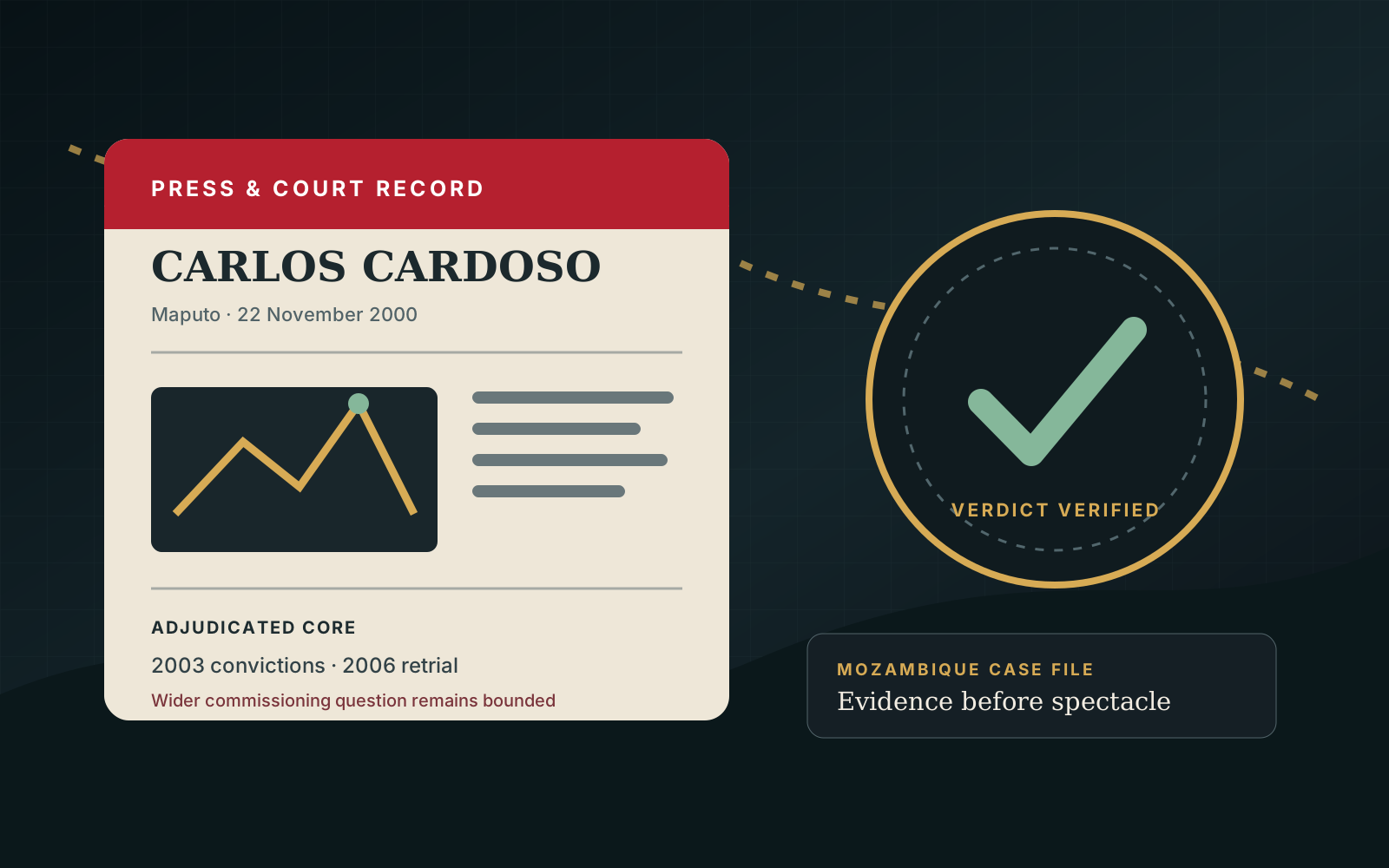
What happened in Maputo
Carlos Alberto Lopes Cardoso was an investigative journalist, editor and publisher known for reporting on corruption and public finance in Mozambique. On 22 November 2000, he was shot and killed while travelling from the office of his newspaper, Metical, in Maputo. His driver was wounded. Contemporary reporting and press-freedom organizations treated the attack as a targeted killing rather than a random street crime.
Cardoso had been examining a major banking-fraud controversy involving the former Commercial Bank of Mozambique. That work is essential context: it explains why reporting about the murder repeatedly examined possible links to financial interests. Context is not the same as a final finding of motive. The criminal proceedings established roles for convicted defendants, while reporting and later advocacy continued to question whether all people behind the killing had been identified.
The case drew attention because it joined two public-interest questions: accountability for a homicide and whether a journalist could safely investigate powerful economic networks. The archive therefore focuses on the evidence and court outcomes without turning Cardoso's death into spectacle.
Investigation and arrests
Mozambican authorities arrested six men in connection with the killing. The group included people accused of organizing, financing and carrying out the attack. One defendant, Aníbal António dos Santos Júnior, commonly called Aníbalzinho, escaped from pretrial detention in September 2002. His absence complicated the proceedings but did not stop the joint trial from opening in November 2002.
The Committee to Protect Journalists monitored the process and sent a representative to the verdict. Its reporting described testimony about planning and payment as well as allegations raised inside the courtroom about others who were not among the six defendants. Reporters Without Borders likewise stressed that convictions for the operational group did not necessarily disclose the identity of every person involved.
That distinction matters. A trial can produce valid convictions while leaving a broader theory incomplete. This page attributes allegations to the sources that reported them and does not label any unconvicted person as the proven commissioner.
The 2003 verdict
On 31 January 2003, the court convicted all six defendants. CPJ reported prison terms of at least 23 years, with dos Santos—tried in absentia—receiving 28 years and six months. The New Humanitarian's account of the judgment similarly recorded the convictions and described the intense public attention surrounding the proceedings.
The verdict was a substantial judicial outcome: it moved the file beyond suspicion, arrest or charge. It also required precise wording. “Six convictions” does not mean six separate shooters, nor does it mean that every defendant had an identical role. The judgment covered a group accused of different forms of participation in planning and executing the murder.
Dos Santos was captured in South Africa and returned to Mozambique around the time of the verdict. Because he had been tried while absent, his later presence triggered a separate procedural chapter rather than simply ending the story with the 2003 sentence.
Aníbal dos Santos and the new trial
Dos Santos later received a new trial in Mozambique. In January 2006, the court sentenced him to 30 years in prison, the maximum term reported under Mozambican law at the time. The retrial supplied an in-person adjudication after his earlier conviction in absentia.
His custody history included escapes and extraditions, which can obscure the legal core. For classification, the relevant fact is that a court again convicted and sentenced him after a new proceeding. Later reporting based on Mozambique's National Penitentiary Service said he was released in October 2025 after serving the full sentence. Release after completion does not reverse the conviction.
The archive does not infer from imprisonment or release that every evidentiary dispute disappeared. Nor does it treat later statements by a convicted person as automatically verified. The reliable boundary remains the convictions and sentences reported by multiple organizations.
Bank-fraud reporting and the motive question
At the time of his death, Cardoso was pursuing reporting connected to a large fraud involving the privatization and management of a major Mozambican bank. The Open University's Mozambique document archive preserves reporting about the financial controversy and Cardoso's questions. CPJ's investigation also examined the stories he was working on.
These sources support a careful statement: his journalism was scrutinizing powerful financial interests, and the prosecution record contained claims about payment for the killing. They do not support turning one alleged commissioning theory into an uncontested fact. Reporters Without Borders said three years after the murder that the identity of all those involved was still not known, even though six people had been convicted.
This is why the page uses “bounded.” The case has a completed criminal core, but its outer boundary—who commissioned the attack, what precise interests drove it and whether anyone escaped accountability—remained contested.
Why the case matters for press freedom
Cardoso's murder was not only the loss of a journalist and family member. It tested whether investigative reporting on public money could be answered through law rather than intimidation. The fact that the trial was closely followed by Mozambican media and international press-freedom groups gave the proceedings an importance beyond the six defendants.
The strongest editorial approach is to avoid romanticizing risk. Cardoso's public role explains the significance of the case, but it does not make graphic reconstruction necessary. The record is better served by naming the date, place, judicial stages, source boundaries and unresolved questions.
It also avoids a common error in true-crime summaries: collapsing “the killers were convicted” into “the whole case was solved.” Accountability for the operational group and certainty about the ultimate commissioner are related but different claims.
Verified timeline
- 22 November 2000: Carlos Cardoso is shot and killed while travelling from the Metical office in Maputo; his driver is wounded.
- 2001: Six men are charged in connection with the murder.
- September 2002: Aníbal dos Santos escapes from pretrial detention.
- November 2002: The joint murder trial opens in Maputo.
- 31 January 2003: Six defendants are convicted and receive lengthy prison terms; dos Santos is sentenced in absentia.
- 2003: Dos Santos is returned from South Africa to Mozambique.
- January 2006: After a new trial, dos Santos receives a 30-year sentence.
- October 2025: Mozambique's penitentiary service says dos Santos was released after serving the full sentence.
Why Crime by Region marks it adjudicated
The site's classification separates an arrest from a conviction and a conviction from complete historical closure. Six defendants were convicted in 2003. Dos Santos later received a new trial and a 30-year sentence. Those facts justify a solved or adjudicated label for the criminal responsibility determined in court.
The qualifier prevents overclaiming. CPJ and Reporters Without Borders documented unresolved questions about broader responsibility. The page therefore does not use the convictions to certify a disputed account of who ultimately ordered the killing.
Frequently asked questions
Who was Carlos Cardoso?
He was a Mozambican investigative journalist and editor known for reporting on corruption and public finance.
When and where was he killed?
He was shot and killed in Maputo on 22 November 2000 while travelling from his newspaper office.
What happened in 2003?
Six defendants were convicted and received prison terms ranging from 23 years to 28 years and six months.
Why was Aníbal dos Santos tried again?
He had been convicted while absent after escaping custody. Following his return, a new trial ended with a 30-year sentence in 2006.
Is every part of the case solved?
No. The convictions establish responsibility for named defendants, but sources continued to distinguish that result from unresolved questions about the full commissioning chain.
Was Cardoso's banking investigation the proved motive?
It is well-documented context, but this archive does not state that one motive or commissioning theory was conclusively proved.
Sources and source-quality review
- Committee to Protect Journalists — Mozambique reportMay 2002 · investigation background, arrests, Cardoso's reporting and unresolved responsibility.
- Committee to Protect Journalists — special Cardoso coverageTrial monitoring, 31 January 2003 verdict, sentences, escape, capture and extradition reporting.
- Reporters Without Borders — Three years after Carlos Cardoso's murder2003 · six convictions and explicit limits concerning unidentified participants.
- The New Humanitarian — trial convictions4 February 2003 · independent account of the verdict, trial evidence and disputed allegations.
- Open University — Mozambique documents archiveDocument collection preserving reporting on the banking controversy and Cardoso's investigation.
- Club of Mozambique — SERNAP release statement9 October 2025 · report based on the National Penitentiary Service stating that dos Santos completed his sentence.
Editorial review: the core chronology was cross-checked across trial-monitoring organizations, an independent humanitarian news service, an academic document archive and a later penitentiary update. Allegations about commissioners remain attributed and are not converted into findings.