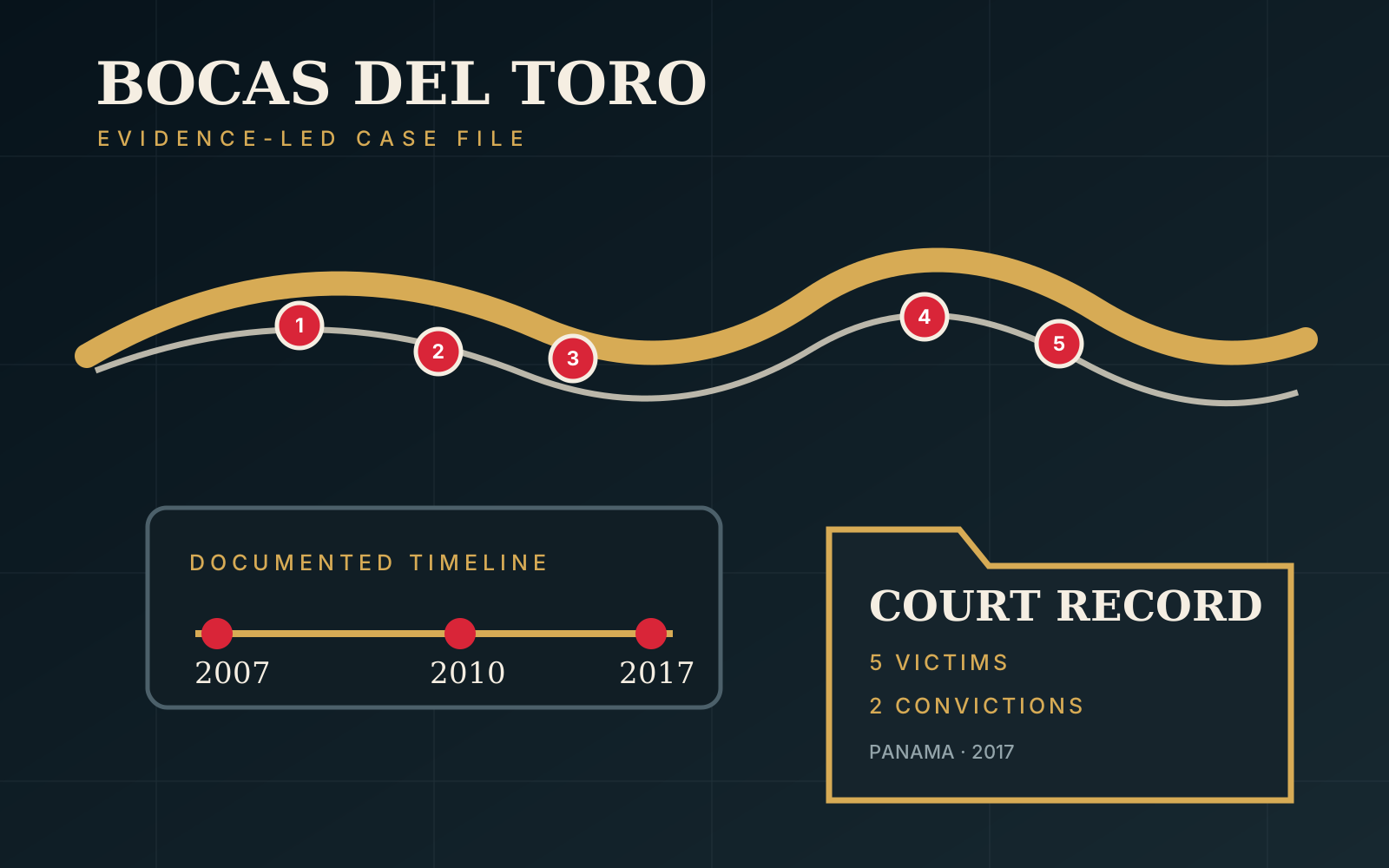
Case-status note: “Solved / adjudicated” refers to the 2017 homicide and robbery convictions. Panamanian outlets reported appeals and review requests afterward. Because no reliable final appellate decision was located through September 14, 2026, this file does not describe those proceedings as complete or claim that the sentences became final on a particular date.
What happened in Bocas del Toro?
Panamanian authorities prosecuted William Dathan Holbert and Laura Michelle Reese over the deaths of five people who lived in the Bocas del Toro island region. The Associated Press reported that authorities placed the killings between 2007 and 2010 and said they were committed so property could be taken. A 2017 notice from Panama's Judicial Branch confirms that both defendants were convicted of homicide and robbery.
The victims named by the court were Bo Barry Lawrence Icelar, Michael Brown, Manchittha Nankatroke Brown, Watson Seaward Brown and Cheryl Linda Hughes. Four were adults and Watson was the Brown family's son. Keeping their names together matters: later retellings often center Holbert's nickname and turn the case into a personality story, while the judicial record concerns five people whose lives and property were taken.
The archive title “Bocas del Toro Murders” describes the adjudicated five-victim case. It does not absorb every later rumor, suspected disappearance or unproven allegation connected to the defendants. Claims outside the 2017 judgment require their own evidence and are not presented here as established crimes.
A 2007–2010 timeline
Reporting reviewed by Sky News places the deaths of Michael Brown, Manchittha Nankatroke Brown and Watson Seaward Brown in 2007. The family had property in Bocas del Toro. That same reporting places the deaths of Cheryl Linda Hughes and Bo Barry Lawrence Icelar in 2010.
The Associated Press summarized the full charged series as five killings between 2007 and 2010. Panama's Judicial Branch later grouped the five names in the homicide-and-robbery judgment. The sources differ in how briefly they describe the dates, so this archive retains the broader 2007–2010 range rather than assigning an unsupported exact day to each death.
Public accounts describe the victims as foreign residents in a Caribbean tourism region. That setting explains why the case received international attention, but it should not turn the province into scenery for spectacle. The legally important facts are the linked deaths, the transfer or taking of property, the investigation and the convictions.
The five people named by the court
Bo Barry Lawrence Icelar had lived in Panama after owning an art gallery in Santa Fe, New Mexico. Cheryl Linda Hughes was from the St. Louis area and operated a small hotel. Michael and Manchittha Brown lived with their son Watson in Bocas del Toro. Those limited biographical details come from contemporary reporting and help distinguish the people from the assets discussed at trial.
The Judicial Branch notice lists all five as victims of the homicide and robbery prosecution. It does not reduce the case to a single disappearance or a dispute over real estate. The convictions covered a connected course of lethal and property crime involving separate households.
Some media accounts use variant spellings for Manchittha Nankatroke Brown and Cheryl Linda Hughes. This page follows the spellings published by Panama's Judicial Branch and includes common variants only in search metadata so they do not create duplicate identities.
Discovery and investigation
Sky News reported that the investigation accelerated after two bodies were found in August 2010 on the grounds of a hostel associated with Holbert. A further search located three more bodies. The discoveries established that what had appeared to be separate absences and property changes were connected.
At the time, prosecutors said Holbert admitted the five killings and described what he had done and why. A confession is not, by itself, the same as a final court judgment. Here, however, the later prosecution produced convictions, and the court's 2017 notice independently records the offenses, victims and sentences.
Associated Press reporting said Holbert and Reese were arrested in 2010 while trying to enter Nicaragua from Costa Rica. This page avoids resolving minor differences in narrative accounts about the precise side of the border where custody began. The material point is that the pair were detained after leaving Panama and returned to face proceedings there.
The property-related prosecution
Authorities told the Associated Press that the victims were killed so their property could be stolen. That account is consistent with the court's decision to convict both defendants not only of homicide but also of robbery. It provides a documented motive without relying on later dramatizations about the defendants.
The evidence-led description is therefore “multiple homicide and robbery.” It is more precise than presenting the case only as a stranger-killing spree, and it keeps the financial component tied to the offenses actually adjudicated.
Property records, aliases and relationships between the defendants and victims helped investigators understand how the cases connected. This archive does not reproduce claims about additional assets or alleged victims that were not part of the five-victim judgment.
The 2017 convictions
The legal hearing took place on July 10, 2017, before the Superior Court of the Third Judicial District in Chiriquí. The court then used the period allowed by law to issue its judgment. On August 14, Panama's Judicial Branch announced the convictions of William Dathan Holbert and Laura Michelle Reese for homicide and robbery involving the five named victims.
The court sentenced Holbert to 47 years and one month in prison. Reese received 26 years and four months. The court also held Reese jointly liable with Holbert for compensation for damage arising from the crimes, with the amount to be determined separately.
Those exact terms are more reliable than rounded headlines saying 47 and 26 years. The page uses the court's figures while retaining the rounded versions in the short archive summary for readability.
Appeals and the limit of the public record
Panamá América reported in September 2017 that Holbert's lawyer appealed and that the prosecutor asked the Supreme Court's Criminal Chamber to uphold the 47-year-and-one-month sentence. The defense argued that the penalty should have been calculated under an earlier penal code because part of the conduct occurred in 2007.
Día a Día reported in April 2018 that the Criminal Chamber had received appeals for both Holbert and Reese. In September 2018, Panamá América reported a further review request and described a ruling as still awaited.
No reliable published final appellate decision was located during the review through September 14, 2026. That absence does not prove that no later court action occurred. It means the responsible formulation is limited: the 2017 convictions and sentences are documented, appeals were filed, and the publicly located appellate endpoint remains unclear.
Why the case is classified as solved
Crime by Region uses “Solved / adjudicated” when a reliable judicial record establishes convictions or an equivalent legal resolution. This case meets that standard because Panama's Judicial Branch published the offenses, victim names, defendants and sentences.
The classification does not mean every question surrounding the defendants has been answered. It does not convert uncharged suspicions into additional victims, and it does not erase the uncertainty about the ultimate disposition of reported appeals.
If a reliable final appellate judgment becomes available, the case file should be updated with the court, date and precise effect on each conviction and sentence. Until then, the trial-level adjudication and the unresolved public appellate record remain clearly separated.
Why this case matters
The Bocas del Toro prosecution shows how crimes against separate households can be linked through property, location and a common pair of defendants. It also demonstrates why a true-crime archive should distinguish an admission, a conviction, a sentence and an appeal rather than compressing them into the word “caught.”
It is equally a lesson in victim-aware framing. Nicknames, tropical settings and claims beyond the judgment can overwhelm the five documented lives. The court record provides a firmer center: five named victims, two homicide-and-robbery convictions and two distinct prison terms.
The verified bottom line is clear. Five people were killed between 2007 and 2010; the investigation connected those deaths to the taking of property; Holbert and Reese were convicted in 2017; and subsequent appeals were reported without a reliably located final published outcome.
Frequently asked questions
Who were the five victims in the court record?
Panama's Judicial Branch named Bo Barry Lawrence Icelar, Michael Brown, Manchittha Nankatroke Brown, Watson Seaward Brown and Cheryl Linda Hughes.
When did the killings happen?
Authorities said the killings occurred between 2007 and 2010 in Bocas del Toro Province. The Brown family was killed in 2007; Hughes and Icelar were killed in 2010.
How were Holbert and Reese arrested?
Associated Press reporting said they were arrested in 2010 while trying to enter Nicaragua from Costa Rica after the investigation expanded.
What were they convicted of?
The Superior Court of the Third Judicial District convicted William Dathan Holbert and Laura Michelle Reese of homicide and robbery involving the five victims.
What sentences did the court impose?
Holbert received 47 years and one month in prison. Reese received 26 years and four months.
Is the appeal finished?
Appeals and later review proceedings were reported in 2017 and 2018. A reliable published final appellate decision was not located in the review through September 14, 2026, so this file does not claim that appellate review is complete.