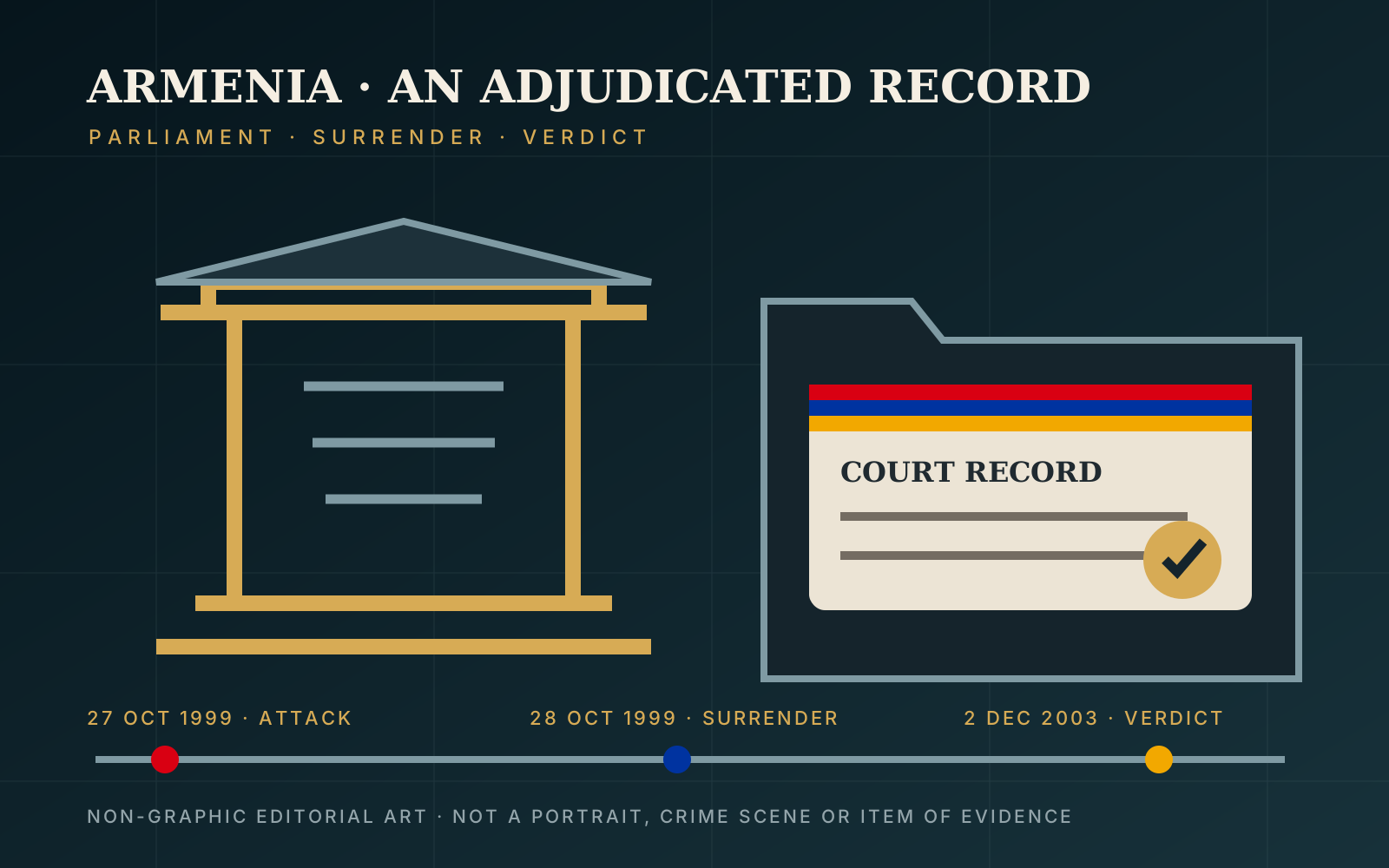
What is established?
Five gunmen led by Nairi Hunanyan—whose surname also appears as Hunanian in contemporary English reports—entered the chamber of Armenia's National Assembly on October 27, 1999. The legislature was holding a question-and-answer session with government officials. The group opened fire, killing Prime Minister Vazgen Sargsyan, National Assembly Speaker Karen Demirchyan and six other officials.
The shooting became a hostage crisis inside the parliament building. After negotiations continued through the night, the gunmen released the captives and surrendered on the morning of October 28. A contemporaneous statement from the U.S. Department of State, relaying information from Embassy Yerevan, recorded five hostage-takers surrendering and confirmed eight deaths.
Criminal proceedings followed. The trial opened in February 2001 and concluded on December 2, 2003. Reporting from the Institute for War & Peace Reporting identified six defendants who received life terms and a seventh who received 14 years. This makes the direct criminal case adjudicated. It does not establish every later allegation about whether people outside the convicted group helped plan the attack.
The eight people killed
The attack targeted a sitting government session. The victims were public officials carrying out their duties inside the legislature:
- Vazgen Sargsyan
Prime Minister - Karen Demirchyan
National Assembly Speaker - Yuri Bakhshyan
Deputy Speaker - Ruben Miroyan
Deputy Speaker - Leonard Petrosyan
Minister for Operational Issues - Henrik Abrahamyan
Member of Parliament - Armenak Armenakyan
Member of Parliament - Mikayel Kotanyan
Member of Parliament
English-language sources vary in transliteration and in the titles used for some offices. The list preserves the commonly reported English names and avoids turning those spelling differences into separate identities.
From a parliamentary session to a hostage crisis
The National Assembly was in session in Yerevan when the armed group entered. The killings occurred in the chamber, after which the attackers retained control of the building and held officials and lawmakers as hostages. The immediate public record was necessarily incomplete: first-day reports focused on the deaths of the prime minister and speaker, the number of casualties and efforts to end the standoff.
That distinction matters when reading archived coverage. An early report may list only the senior figures whose deaths had been confirmed at the time, while later sources identify all eight victims and the defendants. This file gives priority to facts that remained consistent across the contemporaneous official statement, later anniversary reporting and the trial record.
The hostage crisis ended without a further assault on the building. According to the State Department account, the five hostage-takers surrendered at roughly 11 a.m. local time on October 28. The surrender moved the case from emergency response to criminal investigation and made a conventional trial possible.
The trial and December 2003 verdict
The prosecution did not produce an immediate verdict. The case reached trial in February 2001, more than a year after the attack, and hearings continued for almost three years. That long process included the armed participants as well as defendants accused of assisting the operation.
IWPR's report from December 11, 2003, named the six defendants given life sentences: brothers Nairi and Karen Hunanyan; their uncle Vram Galstyan; Eduard Grigoryan; Derenik Bejanyan; and driver Ashot Knyazyan. Hamlet Stepanyan received a 14-year term. The court found the defendants guilty on charges that included murder, terrorism and an attempt to seize power.
The central numerical distinction is important. Five armed men entered parliament; seven defendants were sentenced in the case. Six received life imprisonment, while the seventh received 14 years. Describing all seven as gunmen would be inaccurate, just as saying only five people were sentenced would omit the two assisting defendants.
Later reporting continued to describe Hunanyan as serving a life sentence for the attack. When he sought parole in 2019, Armenia's Justice Ministry confirmed the filing; the report also restated his 2003 conviction and the eight deaths. That later administrative development did not overturn the verdict.
What the verdict did not settle
The courtroom established responsibility for the people charged and convicted. It did not end public debate over whether there had been other organizers or political beneficiaries. Families of victims and political actors continued to raise questions after the verdict. Those questions are part of the case's documented aftermath, but questions are not findings.
This archive therefore uses a two-part rule. The attack is solved / adjudicated as to the convicted group. Claims about uncharged or unidentified organizers remain outside that solved label unless supported by a later, verified court judgment. No person is presented here as a mastermind merely because a relative, opponent or commentator suspected them.
This boundary also prevents a familiar true-crime error: treating an unresolved theory as permission to weaken a valid verdict. The convictions remain part of the record. So does the limited scope of what those convictions prove.
Verified timeline
- October 27, 1999
Five armed men enter the National Assembly during a government question-and-answer session. Eight officials are killed and hostages are held inside. - Morning of October 28, 1999
After overnight negotiations, the hostage-takers release captives and surrender. - February 2001
The trial begins in Yerevan. - December 2, 2003
The court imposes six life sentences and one 14-year sentence. - October 2019
Justice officials confirm that Nairi Hunanyan has filed a parole request after serving 20 years; the conviction remains in force.
Why Crime by Region classifies it as solved
A “solved” label can overstate certainty if it is used carelessly. Here the direct attackers did not remain unidentified or at large: they surrendered, faced trial and received sentences. The site's fuller label—Solved / adjudicated—signals that the classification rests on a completed court process.
The label is not applied to every conceivable layer of the event. It does not claim that investigators proved who conceived every aspect of the plan, nor does it validate the many political theories that followed. Readers should interpret the status as a description of adjudicated criminal responsibility, not as a declaration that every historical question has been answered.
Sources and verification notes
Key facts were cross-checked against a contemporaneous government statement, independent trial reporting and later Armenian and regional reporting. Links lead to the records used, not to copied text.
- U.S. Department of State — Hostage Crisis at Armenian Parliament EndsOctober 28, 1999 · contemporaneous account of surrender, deaths and immediate aftermath.
- Institute for War & Peace Reporting — Armenian Verdict Leaves Relatives UnhappyDecember 11, 2003 · detailed account of the seven sentences and limits of the verdict.
- Radio Free Europe/Radio Liberty — Armenia Remembers 1999 Parliament Shoot-Out VictimsOctober 28, 2010 · anniversary review of the attack, victims and life sentences.
- ARKA — Parliament attack ringleader files parole requestOctober 22, 2019 · Justice Ministry confirmation and current sentence context at that date.
Frequently asked questions
What happened on October 27, 1999?
Five armed men entered Armenia's National Assembly during a government question-and-answer session, killed eight officials and held hostages overnight.
Who was killed?
The victims were Prime Minister Vazgen Sargsyan, Speaker Karen Demirchyan, deputy speakers Yuri Bakhshyan and Ruben Miroyan, minister Leonard Petrosyan, and MPs Henrik Abrahamyan, Armenak Armenakyan and Mikayel Kotanyan.
When did the attackers surrender?
The hostage crisis ended on the morning of October 28, 1999, after overnight negotiations.
What sentences were imposed?
On December 2, 2003, six defendants received life sentences and a seventh received a 14-year prison term.
Why is the case marked solved?
The direct attackers were identified and surrendered, and a court completed the trial and imposed sentences. The status is limited to that adjudicated responsibility.
Were claims about other organizers proven?
Not by the judgment summarized here. Questions persisted, but this file does not present allegations against people outside the convicted group as established fact.