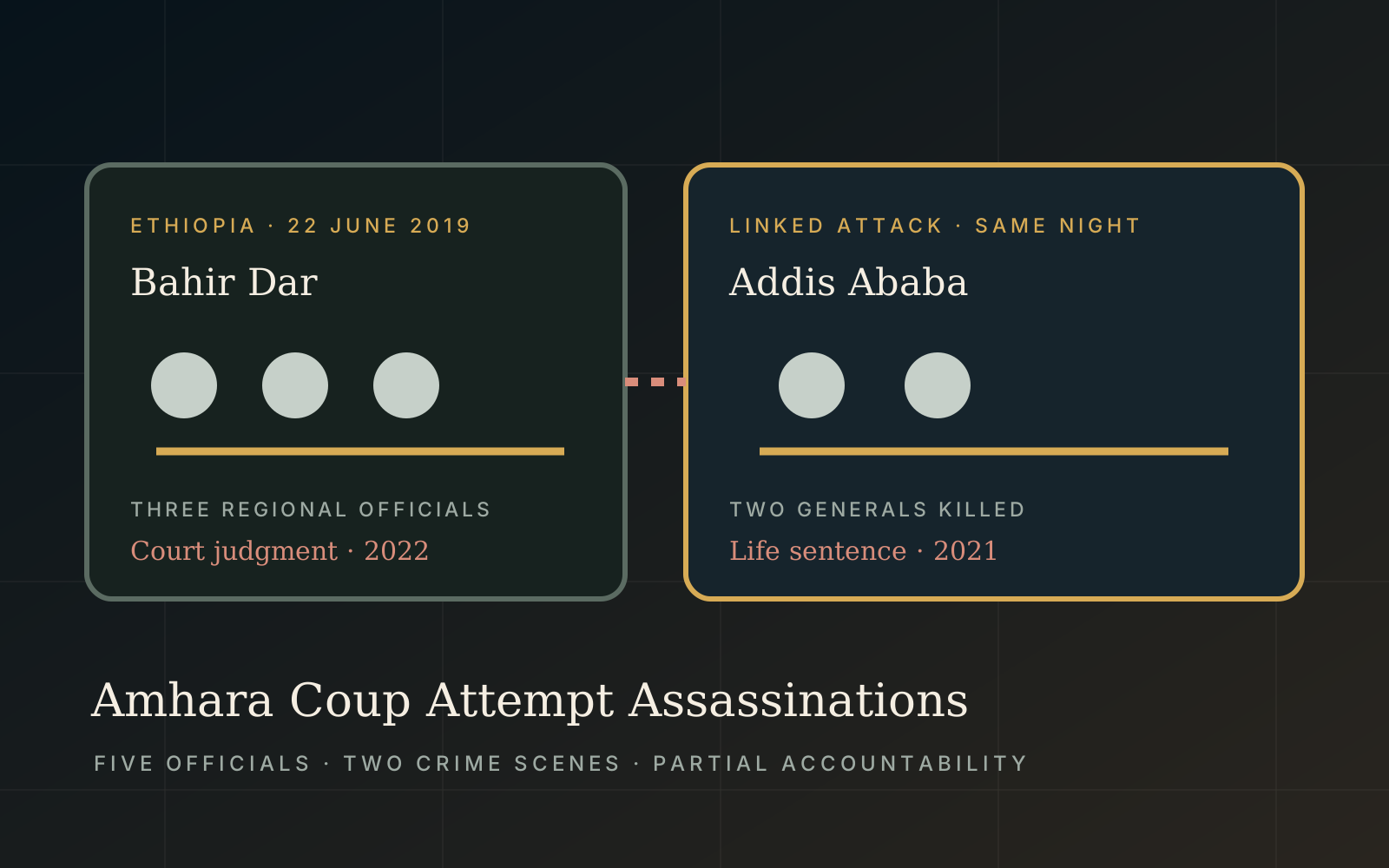
Case-status note: Court reporting supports convictions for the direct killings. The government's allegation that Brigadier General Asaminew Tsige organized a coordinated coup plot was never tested in a final judgment against him because security forces killed him before trial. This file keeps conviction, allegation and political interpretation separate.
The attack in Bahir Dar
Ambachew Mekonnen, president of the Amhara regional government, was meeting other officials in Bahir Dar on the evening of June 22, 2019. Armed men entered the meeting and opened fire. Ambachew and adviser Ezez Wassie died; regional attorney general Migbaru Kebede was seriously wounded and died on June 24.
Reuters later reported the regional government's account that members of a newly formed militia within the regional security services struck the president's office, police headquarters and ruling-party offices. Fighting around the failed takeover killed additional people. Those broader clash deaths are not merged into this page's count of five named assassination victims because contemporary totals varied and covered a wider sequence of violence.
The killings in Addis Ababa
Hours after the Bahir Dar attack, army chief of staff General Se'are Mekonnen was shot at his home in Addis Ababa. Retired Major General Gizae Aberra, who was visiting him, was also killed. Government statements identified Se'are's bodyguard, Private Mesafint Tigabu, as the gunman and linked this shooting to the events in Amhara.
English-language sources romanize the same names differently: Se'are or Seare, Gizae or Gezai, and Mesafint or Mesfin. These variants are disclosed to prevent a spelling difference from being mistaken for a separate person or case.
Five officials, two crime scenes
The five principal victims were Ambachew Mekonnen, Ezez Wassie, Migbaru Kebede, Se'are Mekonnen and Gizae Aberra. They held regional political, legal and national military roles, but each death was an individual homicide with consequences for relatives, colleagues and institutions.
The killings occurred amid deep political tension, yet the victims are not treated as symbols or narrative devices. Graphic details are unnecessary to establish what happened. The documented locations, timing, official roles and judicial outcomes provide the relevant evidentiary record.
The alleged coup plot
The office of Prime Minister Abiy Ahmed accused Amhara security chief Brigadier General Asaminew Tsige of directing an attempted coup against the regional administration and said the two attacks were connected. Reuters and other major outlets reported that allegation as the government's account, not an independently adjudicated fact.
Security forces shot and killed Asaminew on June 24 after a manhunt. Because he never stood trial for the 2019 killings, he must be described as the alleged organizer rather than a convicted mastermind. His death also removed the possibility of testing important evidence through his defense and cross-examination.
Investigation and arrests
Authorities arrested suspected participants after the attacks. Early official information about the Addis Ababa gunman was inconsistent, but later prosecutors brought Mesafint Tigabu before the Federal High Court. Separate proceedings in the Amhara Region addressed the Bahir Dar murders.
The two venues matter. A conviction for the shootings inside Se'are's home did not by itself prove who planned the Bahir Dar operation, and the regional convictions did not automatically establish every alleged link between the crime scenes. The case is therefore presented as a connected event with distinct prosecutions.
The 2021 and 2022 judgments
On June 28, 2021, the Federal High Court sentenced Mesafint Tigabu to life imprisonment for killing Se'are Mekonnen and Gizae Aberra. The conviction resolved direct criminal responsibility for the Addis Ababa shootings in the public record reviewed.
On March 8, 2022, the Amhara Regional Supreme Court sentenced three defendants identified as Capt. Memar, Belaysew Sefinew and Liknaw Yihune to life imprisonment in absentia over the killings of regional officials. The in-absentia posture is important: a sentence is a judicial outcome, but it does not establish that the defendants were in custody or that the punishment was enforced.
Status through September 15, 2026
The reviewed sources document life sentences in both murder proceedings. No later reliable source located for this update established that the in-absentia defendants had been taken into custody, that all appellate avenues had ended, or that a court had definitively resolved the full alleged coordination behind the attacks.
The file is classified as solved / partial. Direct perpetrators were convicted in the two proceedings, while alleged organizer Asaminew Tsige was never tried and broader responsibility remains incomplete. The label does not imply that every political explanation circulated after the killings has been proved.
Questions still unanswered
- What evidence established or contradicted operational coordination between Bahir Dar and Addis Ababa?
- Who, beyond the convicted direct participants, knew of or helped plan the attacks?
- Were the three defendants sentenced in absentia later arrested or retried?
- What became of any appeals from the 2021 and 2022 judgments?
- How many deaths in the wider fighting were directly attributable to the coup attempt?
- Could a future judicial review more fully test the allegations against the deceased alleged organizer?
Sources and methodology
- Reuters, June 23, 2019Initial chronology, named victims and attributed government account of the linked attacks.
- Reuters, June 26, 2019Regional account of the Bahir Dar operation, wider fighting and alleged organizer.
- International Crisis Group, June 25, 2019Political context and careful separation of the two attack sites.
- Addis Standard, June 28, 2021Federal High Court conviction and life sentence for the Addis Ababa murders.
- Ethiopian Monitor, March 8, 2022Amhara court judgment and three life sentences imposed in absentia.
Facts were checked across contemporaneous international reporting, conflict analysis and later Ethiopian court coverage. Government allegations are attributed, name variants are disclosed and the different judicial postures are not flattened into a single verdict.
Frequently asked questions
What happened in Ethiopia on June 22, 2019?
Gunmen killed three Amhara regional officials in Bahir Dar, while a separate shooting in Addis Ababa killed army chief Se'are Mekonnen and retired general Gizae Aberra. The government described the linked attacks as an attempted regional coup.
Who were the five principal victims?
Ambachew Mekonnen, Ezez Wassie and Migbaru Kebede died after the Bahir Dar attack; Se'are Mekonnen and Gizae Aberra were killed in Addis Ababa.
Was anyone convicted?
Yes. Mesafint Tigabu received life imprisonment in 2021 for the Addis Ababa murders, and an Amhara court sentenced three defendants to life in absentia in 2022 over the Bahir Dar killings.
Was Asaminew Tsige convicted of organizing the attacks?
No. The government accused him of leading the plot, but security forces killed him before any trial. The organizer allegation therefore was never tested in a final judgment against him.
Why is the case classified as solved or partial?
Final or reported trial judgments address the direct killings, but the full alleged coordination, command structure and responsibility of all participants were not conclusively adjudicated in the sources reviewed.
Are different spellings of names found in the sources?
Yes. English-language reports vary in romanizing names such as Se'are or Seare, Gizae or Gezai, and Mesafint or Mesfin. This file identifies those variants as the same individuals.