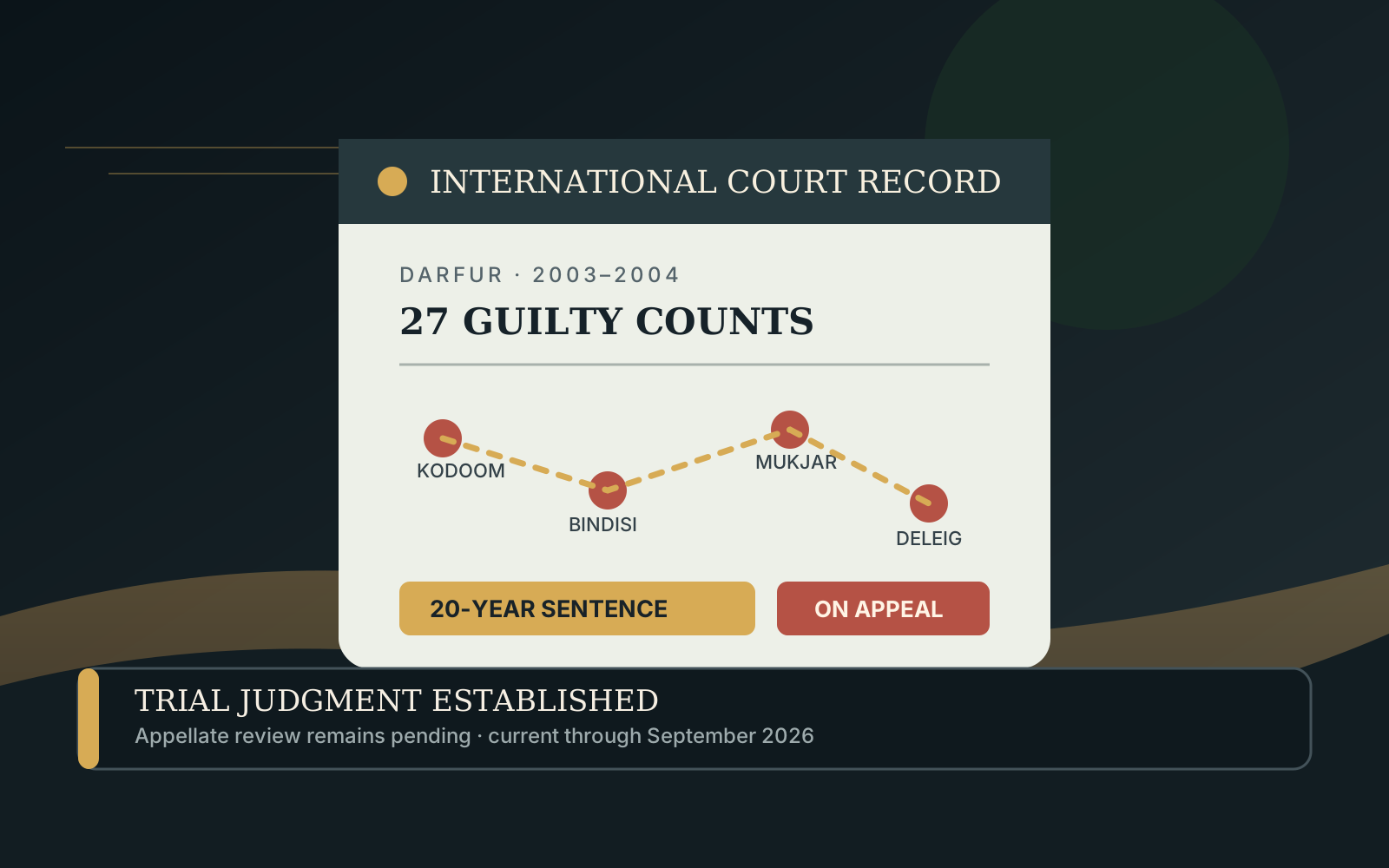
Status boundary: Trial Chamber I found Abd-Al-Rahman guilty beyond reasonable doubt and sentenced him to 20 years. The Defence has appealed the conviction. Both the Defence and Prosecution have appealed the sentence. This file therefore records a conviction while explicitly avoiding the label “final judgment.”
The Darfur campaign behind the case
War began in Darfur in 2003 after rebel movements challenged Sudan's government, accusing it of marginalizing the western region. The government responded through its armed forces and allied Janjaweed militias. The ICC judgment did not treat the violence as a vague background conflict. It examined a coordinated campaign against civilian communities perceived as supporting the rebellion.
The case focused on attacks in and around four places—Kodoom, Bindisi, Mukjar and Deleig—between August 2003 and April 2004. Trial judges found crimes against members of the Fur civilian population within a broader government plan to suppress the insurgency. The judgment addressed specific conduct and modes of liability; it was not a verdict against an ethnicity, region or every person associated with Sudanese forces.
Darfur became the first situation referred to the ICC by the United Nations Security Council, through Resolution 1593 in 2005. Sudan is not a state party to the Rome Statute, but the referral gave the Court jurisdiction over crimes within the defined Darfur situation. That institutional route matters because it explains why the prosecution occurred in The Hague rather than in a Sudanese court.
Identity, role and the defence dispute
Ali Muhammad Ali Abd-Al-Rahman is also known as Ali Kushayb. The prosecution described him as a senior Janjaweed leader who commanded militia fighters and acted with Sudanese government forces. His defence argued that he was not the person known as Ali Kushayb and sought acquittal. Trial Chamber I rejected that identity defence after assessing the evidence presented over the multi-year trial.
The court's conclusion went beyond command responsibility. Judges found that Abd-Al-Rahman gave instructions that resulted in crimes and also personally committed some offences. The final trial verdict covered murder, rape, torture, persecution, forcible transfer and other crimes against humanity and war crimes. Reporting on the judgment emphasized that the Chamber distinguished counts and incidents rather than entering a single undifferentiated finding about Darfur.
This page uses “also known as Ali Kushayb” because that alias appears throughout official court materials. It does not imply that an alias alone proves identity. The conviction rests on the evidence and findings recorded by the Trial Chamber, while the defence challenge is preserved because it remains relevant to the pending appeal.
Surrender, transfer and trial
The ICC first issued an arrest warrant in 2007. Abd-Al-Rahman remained outside Court custody for more than thirteen years. In June 2020 he surrendered in the Central African Republic and was transferred to ICC custody. The confirmation-of-charges process followed, and his trial opened on 5 April 2022.
Over the proceedings, the Chamber heard witness evidence, examined documentary material and considered submissions from the prosecution, defence and legal representatives of participating victims. The trial closed after final submissions in December 2024. None of those procedural milestones is equivalent to a conviction; the legal finding arrived when the Chamber delivered its reasoned judgment in October 2025.
The 27-count conviction
On 6 October 2025, Trial Chamber I unanimously found Abd-Al-Rahman guilty on 27 counts of crimes against humanity and war crimes committed between August 2003 and April 2004. The offences included murder, rape, torture, persecution, forcible displacement and attacks against the civilian population. He had faced 31 counts, so the verdict should not be summarized as a conviction on every charge originally presented.
The judges found that the Janjaweed crimes were part of a government strategy directed against communities believed to support the rebellion. Within the incidents proved at trial, the Chamber found Abd-Al-Rahman responsible both for conduct he personally perpetrated and for crimes ordered or carried out with others. The ruling was the ICC's first conviction arising from the Darfur situation.
The phrase “first Darfur conviction” is precise but limited. It does not mean the judgment resolved the full history of atrocities in Darfur, identified every perpetrator or completed the ICC's other cases. Other suspects, including former president Omar al-Bashir and former official Ahmad Harun, have separate cases and allegations. Their status cannot be imported into Abd-Al-Rahman's verdict.
The 20-year sentence
On 9 December 2025, Trial Chamber I imposed individual terms for the counts and then a joint sentence of 20 years' imprisonment. Time spent in ICC detention since June 2020 is to be deducted. Prosecutors had requested life imprisonment; the defence sought a substantially shorter term. The Chamber selected neither request in full.
Associated Press reported that the prosecution relied on the scale and gravity of the crimes, including at least 213 murdered people and 16 women and girls subjected to rape. Those figures describe the prosecution's sentencing submissions and the evidentiary record addressed by the court. They should not be transformed into a comprehensive death toll for the entire Darfur conflict.
The sentence records punishment for the 27 convictions in this specific case. It does not settle reparations. Victim participation and reparations follow their own ICC procedures, and developments in those proceedings should be reported separately rather than folded into the prison term.
Why the case is not yet final
On 6 November 2025, the Defence filed notice of appeal against the trial judgment. On 8 and 9 January 2026, the Defence and Prosecution respectively filed notices appealing the sentence. ICC case information current in 2026 states that the verdict and sentence are under appeal and that Abd-Al-Rahman remains in Court custody.
The competing sentence appeals point in different directions. The Defence challenges the punishment from its perspective; the Prosecution, which had requested life imprisonment, challenges from the opposite side. Until the Appeals Chamber rules, the accurate formulation is “convicted and sentenced at trial, appeals pending.”
An appeal does not erase the existing Trial Chamber judgment, but it prevents this archive from presenting the outcome as final. The appellate court may affirm, reverse or modify findings within the issues properly before it. This page will need revision when a final appeal judgment is delivered.
Case timeline
- August 2003–April 2004
Crimes later adjudicated by the ICC occur in and around Kodoom, Bindisi, Mukjar and Deleig. - 31 March 2005
The UN Security Council refers the Darfur situation to the ICC. - 27 April 2007
The ICC issues its first arrest warrant concerning Abd-Al-Rahman. - June 2020
He surrenders in the Central African Republic and is transferred to ICC custody. - 5 April 2022
The trial opens before Trial Chamber I. - 13 December 2024
Closing submissions conclude. - 6 October 2025
The Chamber enters 27 convictions for crimes against humanity and war crimes. - 9 December 2025
The Chamber imposes a joint 20-year prison sentence. - January 2026
Defence and Prosecution sentence appeals join the Defence appeal against conviction.
What remains open
The immediate legal questions are appellate. Will the Appeals Chamber uphold all 27 convictions? Will it maintain, reduce or increase the 20-year sentence? A separate question concerns reparations for participating victims. None should be predicted before the Court issues decisions.
The case also leaves a much wider accountability gap. It adjudicated one accused and a defined set of attacks. It did not decide responsibility for all crimes committed across Darfur, and it did not dispose of pending cases against other suspects. That limitation is not a defect in the page's title; it is the legal boundary of the judgment being documented.
Case FAQ
Was Abd-Al-Rahman acquitted of any charges?
He faced 31 counts and was convicted on 27. The page therefore does not claim that every original count resulted in conviction.
Is “Ali Kushayb” a separate person?
The defence argued that Abd-Al-Rahman was not the man known by that alias. Trial Chamber I rejected that defence and convicted him. The issue forms part of the case history and may be raised on appeal.
Is the 20-year sentence final?
No. Both Defence and Prosecution appealed the sentence, and the Defence also appealed the conviction.
Does this judgment cover Sudan's current civil war?
No. The convictions concern crimes committed in Darfur in 2003 and 2004. Alleged crimes in the conflict that began in 2023 are separate matters.