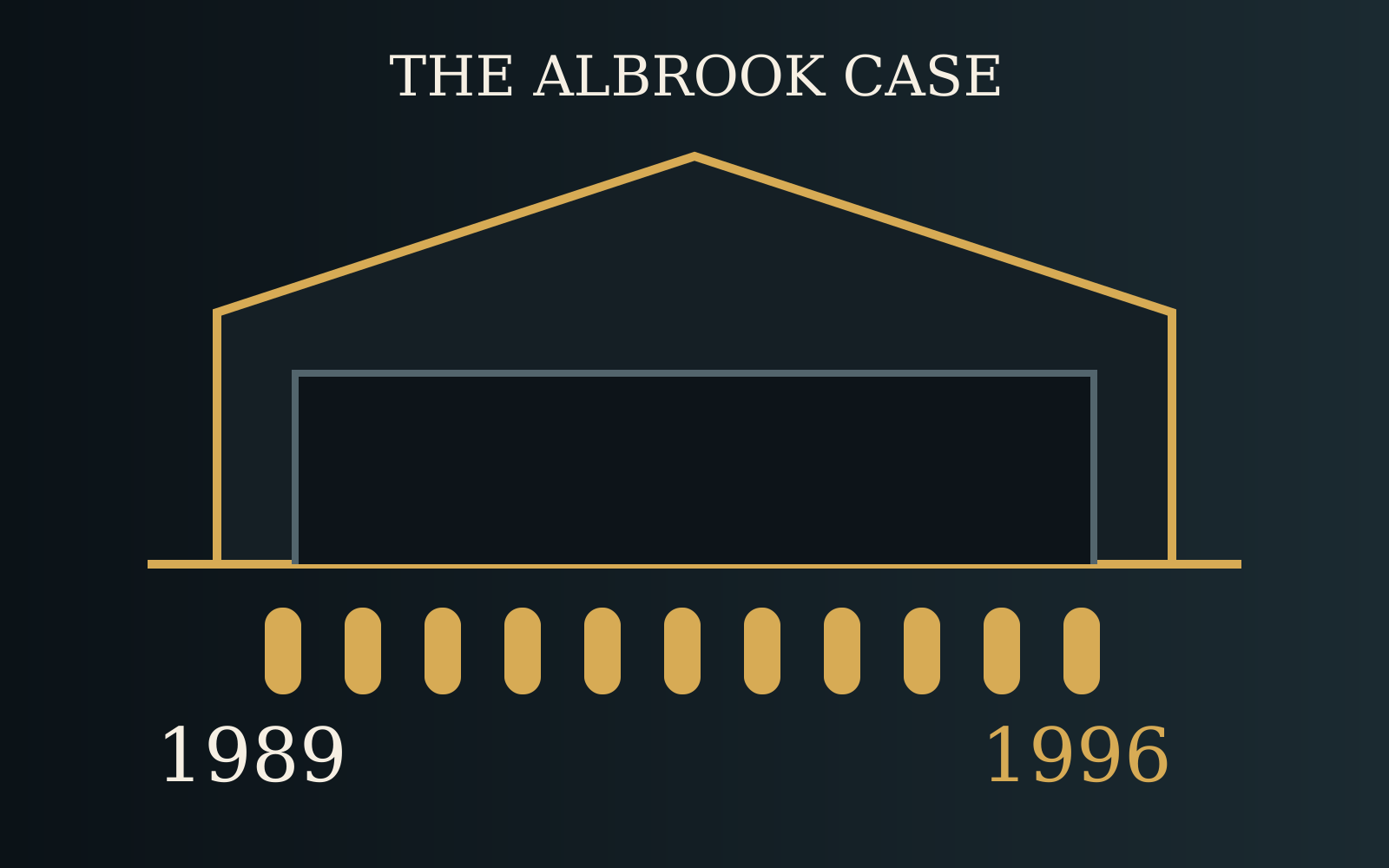
Scope note: Court histories separate the murder of Moisés Giroldi from the Albrook proceeding concerning nine other officers. Panamanian memorial accounts recognize 11 dead. This file preserves those categories instead of forcing them into one count.
What happened in the Albrook Massacre?
On October 3, 1989, Major Moisés Giroldi and allied members of the Panama Defense Forces attempted to remove military ruler Manuel Noriega. The officers briefly captured Noriega, but loyal forces regrouped, the uprising collapsed and participants surrendered or were captured.
Instead of being held for lawful proceedings, a group of defeated officers was killed. The episode became known as the Albrook Massacre because several victims were taken to an aircraft hangar at Albrook and executed. Giroldi was killed at the Tinajitas barracks in San Miguelito. Panamanian memorial accounts recognize 11 dead across the episode.
Later criminal proceedings separated parts of the event. Manuel Noriega and intelligence agent Heráclides Sucre were convicted in the murder of Giroldi and sentenced to 20 years. Noriega also received a separate 20-year sentence for his role in the deaths of nine other officers. The convictions establish responsibility for core killings without proving that every participant in the wider operation was prosecuted.
The failed October 3 uprising
The coup attempt unfolded during the final months of Noriega's rule, when Panama was under intense domestic and international pressure. Giroldi commanded a unit close to the military headquarters and participated with other officers seeking to force Noriega from power.
The plotters detained Noriega but failed to secure the broader command structure. Loyal units counterattacked and regained control. Accounts of external contacts, roadblocks and missed opportunities have remained politically disputed. Those strategic controversies are context, not justification for what happened to captured officers afterward.
The criminal issue begins at surrender and custody. Whatever offenses the rebels may have committed during the uprising, they were entitled to detention and trial. Summary killing after capture is not a lawful military response.
The victims and the count
Moisés Giroldi is the best-known victim because he led the uprising and his murder was prosecuted separately. Other dead included officers who had joined the attempt and were detained after it failed. Public memorials in Panama honor 11 people.
Published court histories often describe a case involving Giroldi and another involving nine officers killed at Albrook. Some accounts also include an eleventh participant who died after mistreatment in custody. The difference reflects legal case boundaries and circumstances, not a reason to erase anyone.
This dossier therefore states the memorial total of 11 while explaining that Noriega's two relevant homicide convictions were structured around Giroldi and nine other officers. It does not merge every death into a single judgment that the courts did not issue.
Evidence and official findings
The Inter-American Commission on Human Rights recorded that the October 3 uprising failed and that Giroldi and other officers were executed. Contemporary reporting documented bodies, military custody and accounts from relatives and surviving participants.
After Noriega's government fell in December 1989, Panamanian authorities opened homicide cases. The prosecutions relied on testimony and reconstructed chains of command in a period when the accused former ruler was outside Panama and tried in absentia.
In-absentia procedure matters for describing the record accurately. A conviction entered while the accused is abroad is still a conviction under the issuing legal system, but extradition, custody and enforcement are later questions. Noriega returned to Panama in December 2011 to serve sentences imposed there.
The Giroldi murder conviction
In March 1994, a Panamanian jury convicted Manuel Noriega of the murder of Moisés Giroldi. Heráclides Sucre, an intelligence agent, was also convicted. Both received 20-year prison terms, the maximum penalties sought by prosecutors in that case.
The verdict did not depend on the claim that Noriega personally fired the shots. Criminal responsibility can rest on participation, orders or assistance proved under the applicable law. This page does not independently assign a physical act beyond what the judicial outcome supports.
The Giroldi conviction is distinct from Noriega's earlier 20-year sentence for the murder of Hugo Spadafora, already documented in a separate Crime by Region file.
The separate Albrook conviction
In 1996, Noriega received another 20-year sentence for his role in the deaths of nine officers after the failed coup. La Prensa's review of his Panamanian convictions describes that term as the sentence for the Albrook Massacre.
Keeping the sentences separate prevents a common error: treating Noriega's accumulated 60 years as one judgment or one case. His three principal 20-year homicide terms concerned Spadafora, Giroldi and the nine officers grouped in the Albrook proceeding.
Other alleged participants appear in historical reporting, but this dossier names only convictions supported by the reviewed sources. It does not transform membership in Noriega's forces into individual guilt.
Return to Panama and sentence enforcement
Noriega spent years imprisoned abroad after his capture during the U.S. invasion. France extradited him to Panama in December 2011. He was then held under the Panamanian sentences imposed for crimes committed during his rule.
Amnesty International welcomed the opportunity for accountability while urging fresh investigations into other unresolved cases. Noriega's return made sentence enforcement possible but did not automatically resolve every disappearance or killing associated with the military regime.
He died in Panama in 2017. His death ended further punishment in practice; it did not erase the convictions or convert every unresolved allegation into a proved fact.
Current status and limits
The Albrook case is classified solved / partial accountability. Final homicide convictions established Noriega's responsibility for central killings, including a separate sentence concerning nine officers. Sucre was convicted in Giroldi's murder.
“Partial” remains necessary because the event involved multiple sites, custodians and potential decision-makers. The reviewed public record does not show final convictions for every individual who transported, guarded, interrogated or killed captives.
The verified core is strong: officers were killed after the uprising failed; Panamanian courts treated the deaths as criminal homicides; and Noriega received distinct 20-year terms in the Giroldi and Albrook proceedings.
What remains unclear?
The full operational chain remains incompletely documented in easily accessible public judgments. Which officers gave each immediate order? Who carried out each killing? Which witnesses were able to testify, and which records were lost in the regime's collapse?
Those gaps do not undermine the convictions that exist. They define their scope. A responsible archive can recognize adjudicated responsibility while refusing to imply that every participant or every death received a complete judicial accounting.
Frequently asked questions
What was the Albrook Massacre?
It was the execution of officers captured after the failed October 3, 1989 uprising against Manuel Noriega. The killings occurred at Albrook and other military sites.
How many people died?
Panamanian memorial accounts recognize 11 dead. Judicial records separately addressed Moisés Giroldi and nine other officers, so this page preserves the difference in case grouping.
Was Manuel Noriega convicted?
Yes. Panamanian courts imposed separate 20-year sentences connected to the murder of Moisés Giroldi and the killings of nine other officers.
When did the executions occur?
The principal executions occurred on October 3 and 4, 1989, after the coup attempt collapsed.
Why is the status solved but partial?
Convictions established criminal responsibility for central killings, but public records do not resolve every participant, order and act across the entire episode.
Did the uprising itself justify the killings?
No. Captured or surrendered participants were protected from summary execution; the court cases treated the deaths as homicides.