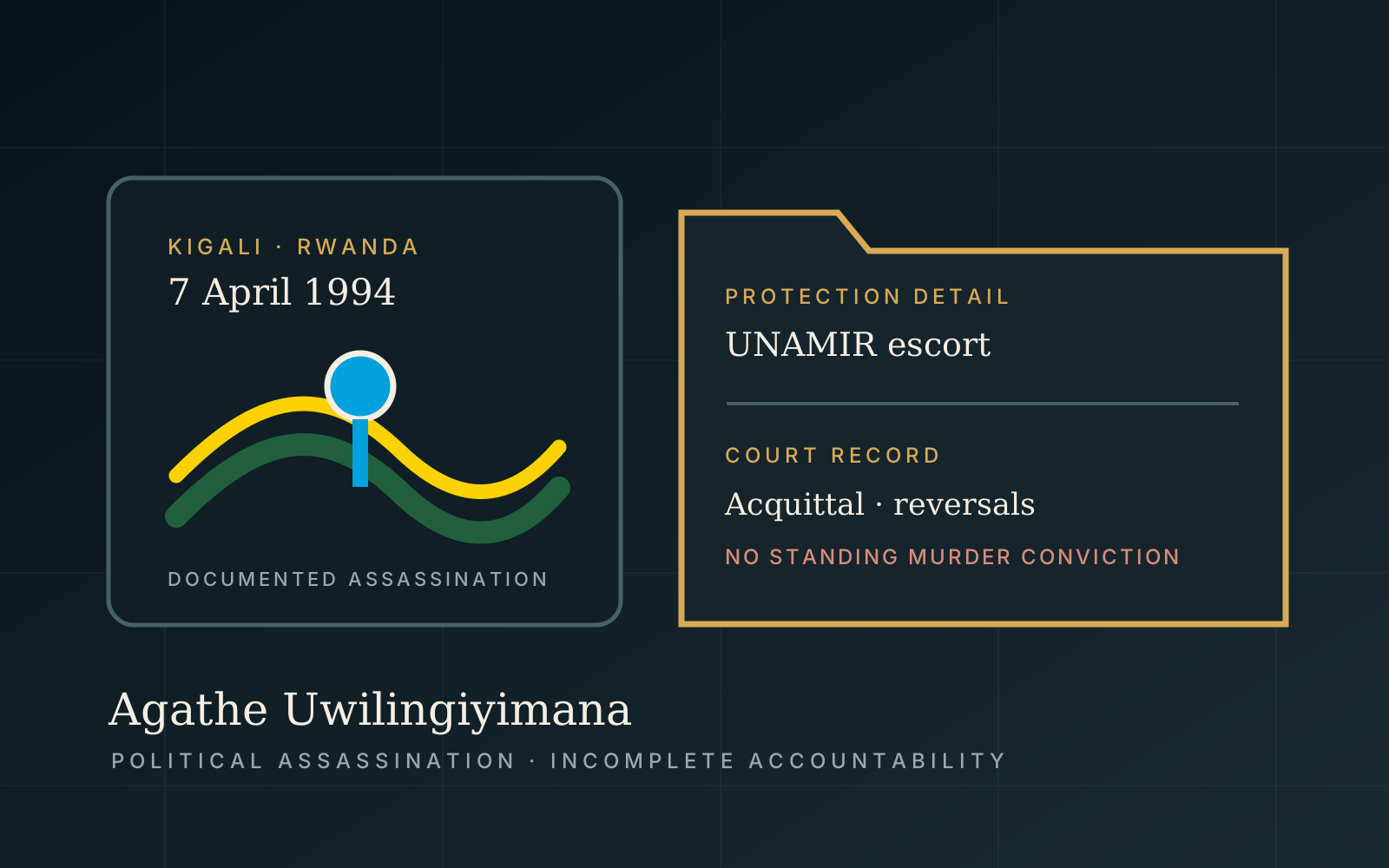
Case-status note: The assassination itself is documented. “Unsolved / partial accountability” means that later proceedings did not leave a standing conviction specifically identifying an individual as criminally responsible for the prime minister's murder. Convictions for the ten Belgian peacekeepers and other Rwandan civilians are related outcomes, not substitutes for that missing judgment.
What happened to Agathe Uwilingiyimana?
Agathe Uwilingiyimana was Rwanda's prime minister when the aircraft carrying President Juvénal Habyarimana and Burundi's president, Cyprien Ntaryamira, was shot down on the evening of April 6, 1994. The crash triggered an immediate struggle for power. By the next morning, armed units were targeting national officials associated with the political opposition or with the Arusha peace process.
Uwilingiyimana intended to speak on national radio and appeal for calm. The United Nations Assistance Mission for Rwanda, or UNAMIR, assigned peacekeepers to escort her. Soldiers surrounded the residence, disarmed the escort and removed the ten Belgian members of the unit. The prime minister and her husband, Ignace Barahira, were found and killed nearby on April 7. The Belgian peacekeepers were taken to Camp Kigali and killed after a prolonged attack.
The murders were not an isolated domestic incident. They formed part of a coordinated attack on Rwanda's moderate political leadership at the opening of the genocide against the Tutsi. This file narrows its scope to the prime minister's assassination and the court record tied to it; it does not attempt to compress the genocide or the deaths of the peacekeepers into one defendant's case.
A prime minister under threat
Uwilingiyimana had become prime minister in July 1993, the first woman to hold the office in Rwanda. She was a teacher and chemist before entering government, and she had served as education minister. Her political position placed her within a fragile coalition created amid civil war, negotiations and deep opposition from extremist factions.
By April 1994, the planned broad-based transitional government had not been installed. After the presidential aircraft was destroyed, Uwilingiyimana remained a central civilian authority and a potential public voice against escalation. Her proposed radio address mattered because control of the state and the public narrative was being contested in real time.
The danger extended beyond her home. Other political figures were tracked and killed during the same period. Reporting the assassination responsibly therefore requires two levels of context: Uwilingiyimana and Barahira were individual victims with a family, while their deaths also helped eliminate political leadership that might have opposed the extremist takeover.
The morning of April 7
UN records describe a protection detail that included ten Belgian and five Ghanaian peacekeepers. The mission operated under restrictive rules and amid rapidly collapsing command structures. Rwandan soldiers surrounded the group, and the peacekeepers surrendered their weapons. The Ghanaian soldiers were released; the Belgians were taken away.
Uwilingiyimana and Barahira left their residence and sought refuge in a nearby United Nations compound. Soldiers searched for them. The couple emerged while their children remained hidden. They were killed that morning. The children survived and were rescued from the area by UNAMIR officer Mbaye Diagne, whose later efforts to save civilians became separately documented by the United Nations.
The ten Belgians were transported to Camp Kigali. Four were killed early in the attack, while six resisted from a guard post before all ten died. The killings contributed to Belgium's decision to withdraw its contingent, a development that further weakened the international mission during the genocide's opening days.
How the event was reconstructed
The record comes from overlapping sources: UN investigations, UNAMIR material, witness testimony, tribunal exhibits and later criminal proceedings. These sources agree on the central sequence—an assigned escort, disarmament, the couple's killing and the transfer and killing of the Belgian peacekeepers—even where they differ on the precise movement or responsibility of particular officers.
The United Nations' independent inquiry into its actions during the genocide reviewed the orders, communications and constraints affecting UNAMIR. ICTR proceedings later tested evidence about command structures and the conduct of Presidential Guard, Para-Commando and Reconnaissance Battalion personnel. A Belgian jury separately considered Bernard Ntuyahaga's role.
This page does not reproduce graphic descriptions. They are unnecessary to establish the crime and risk turning documented suffering into spectacle. The evidentiary significance lies in who controlled forces, what orders or assistance were proved, and whether a particular charge survived appeal—not in publishing the injuries in detail.
The Ntuyahaga proceedings
Bernard Ntuyahaga, then a major in the Rwandan armed forces, surrendered to the ICTR in 1998. The tribunal indictment alleged responsibility connected to the disarming and arrest of the Belgian peacekeepers and accused him of facilitating Uwilingiyimana's assassination. He pleaded not guilty.
In March 1999, the ICTR allowed the prosecutor to withdraw that indictment. The withdrawal was a procedural decision, not an acquittal or a finding that the allegations were false. Ntuyahaga was eventually transferred to Belgium, where a jury tried charges under universal-jurisdiction legislation.
In July 2007, the Belgian court convicted him for the killings of the ten peacekeepers and an undetermined number of Rwandan civilians and imposed 20 years in prison. The same jury acquitted him of involvement in the prime minister's murder. That distinction is central: a final conviction for related killings cannot be reported as a conviction for Uwilingiyimana's assassination.
The ICTR Military I case
The ICTR's large “Military I” proceeding examined senior officers including Théoneste Bagosora. The Trial Chamber convicted Bagosora in 2008 of genocide, crimes against humanity and war crimes and imposed life imprisonment. Its findings included responsibility associated with the killing of the prime minister and other crimes in Kigali.
The Appeals Chamber delivered judgment on December 14, 2011. It affirmed substantial genocide and other convictions but reversed several findings and reduced Bagosora's sentence to 35 years. The official appellate record specifically notes reversal of his conviction tied to the killing of Uwilingiyimana. Any account that stops at the 2008 trial judgment therefore overstates the final result.
Other military defendants faced allegations concerning the prime minister and the peacekeepers in separate or joined proceedings. Those records include acquittals and appellate reversals. The legally safe conclusion is limited: senior-officer trials established extensive responsibility for crimes committed during the genocide, but they did not leave a final individual conviction specifically resolving this assassination.
Why the assassination remains unresolved
“Unresolved” does not mean that investigators know nothing about the units present or the broader political attack. UN and tribunal records attribute the physical hunt and killing to soldiers within identifiable state formations. The uncertainty concerns final individual criminal liability: which person ordered, aided or personally committed the murder, proved under a valid charge and sustained through appeal.
That distinction also protects against two errors. Institutional attribution is not automatically proof against every member of a unit, and a trial judgment later reversed is not a final conviction. The archive therefore records Ntuyahaga's acquittal on this allegation, the withdrawal of his ICTR indictment and the appellate change to Bagosora's case.
No later public judgment located in the source review through September 15, 2026 supplies the missing final conviction. The case remains historically documented but judicially incomplete.
Victims, consequence and memory
Uwilingiyimana was not only a state officeholder. She was a teacher, political reformer, wife and mother of five. Barahira was killed beside her. Their children survived because people inside and outside the UN compound hid and moved them through an exceptionally dangerous city.
The peacekeepers' deaths are inseparable from the morning's consequence, but they are not used here to inflate the victim count of the couple's assassination. The ten soldiers were victims of a related Camp Kigali crime with its own adjudicated record. Linking the events explains the failed protection operation while keeping the two legal questions distinct.
The assassination helped remove a leading moderate voice at the moment Rwanda's institutions were seized by extremists. Its enduring significance lies both in the loss of Uwilingiyimana and Barahira and in the unresolved gap between a detailed historical record and a final judgment assigning individual responsibility for their deaths.
Frequently asked questions
Who was Agathe Uwilingiyimana?
She was Rwanda's prime minister and the first woman to hold that office.
When was she killed?
She and her husband, Ignace Barahira, were killed in Kigali on April 7, 1994.
What happened to her UN escort?
Ten Belgian UNAMIR peacekeepers were disarmed, taken to Camp Kigali and killed. Five Ghanaian peacekeepers were released.
Was Bernard Ntuyahaga convicted of her murder?
No. A Belgian jury convicted him for the peacekeepers and other civilians but acquitted him of involvement in the prime minister's murder.
Why is the case unresolved?
Later proceedings documented the attack and produced related convictions, but no standing individual conviction specifically for Uwilingiyimana's murder was located.
Is this a duplicate of the Akayesu file?
No. The Akayesu case concerns different crimes in Taba commune. This file concerns the Kigali assassination and separate defendants and proceedings.